Workeey is built for your phone. Scan the code with your phone to get the Android app, or open workeey.com on your phone. The iPhone app and a desktop version are coming soon.
Get the Workeey app. Same account, same jobs.


Free roofing estimate template, with a full replacement quoted by the square
A roof replacement quote is usually the biggest number a homeowner sees all year, and they will hold it up against two or three others. A roofing estimate that counts the squares, names the shingle and lists the underlayment, flashing and vents shows them what they are actually comparing. Copy the free roofing estimate template below, check it against the full replacement sample, and send it before the next roofer knocks. After the job, use the roofing invoice template.
Download this estimate template: Word, Excel or PDF
Free to download, with no sign-up and no email. Open the Word file to type over the brackets, or the Excel file to swap in your own lines — the totals follow. Prefer paper? Print the blank PDF and fill it in by pen.
- Word (.docx) — the blank estimate, ready to fill in
- Excel (.xlsx) — the sample lines with amounts, tax and the total that work themselves out
- PDF (.pdf) — the filled-in sample, drawn the way Workeey draws a quote
- Blank PDF (.pdf) — print it and fill it in by pen
- Google Docs — your own copy of the Word file, in your Google Drive (Google asks you to sign in)
- Google Sheets — your own copy of the Excel file, in your Google Drive (Google asks you to sign in)
Fill in this estimate online
Change anything and download the PDF — free, no sign-up. What you type isn't sent to Workeey. The PDF is made in your browser.
Quote it, then invoice it, in Workeey
- Share quote makes a quote PDF good for 30 days that you share from your phone.
- When the roof is done, adjust the decking line to what you used and one tap turns the estimate into the invoice, which Workeey emails with a pay link.
- Free includes 23 quick estimates a month.
What goes on a roofing estimate
Roofing is priced by the square, 100 square feet of roof surface, and the estimate should use that unit so the homeowner can compare. Say how many squares the roof measures, how many layers are coming off, and how many squares of shingles you are ordering with waste included. Name the shingle by manufacturer, line and color.
Then the parts of the system a homeowner rarely thinks about: synthetic underlayment, ice and water shield at the eaves and valleys, drip edge, ridge vent, pipe boots and flashing. Those lines are where cheap quotes cut corners. Add the dumpster, the permit, and an allowance for rotten decking with a price per sheet, since nobody can see the deck until the old roof is off.
- Business name, phone, email and roofing license number if your state has one
- Client name, address, estimate number, date and expiry
- Roof size in squares, layers to tear off, and roof pitch
- Shingle manufacturer, product line, color, and squares ordered
- Underlayment, ice and water shield, drip edge, vents and flashing
- Decking replacement priced per sheet, billed only if needed
- Dumpster, cleanup, permit and warranty terms
- Deposit to start, weather terms and the acceptance line
Copy this roofing estimate template
The template below is plain text. Paste it wherever you write quotes, replace the brackets with your measurements and prices, and delete what does not apply. A repair needs a few lines; a full replacement needs the whole list.
Write the decking line as a price per sheet even if you expect none. It turns the most common roofing surprise into something the homeowner already agreed to. The skeleton:
- [Your business name] · License #[number if required] · [phone] · [email]
- Estimate #[3001] · Date: [date] · Valid until: [date, e.g. 30 days]
- Prepared for: [client name] · Address: [address]
- Roof: [squares] squares · [layers] layer(s) to remove · Pitch: [e.g. 6/12]
- Tear-off and disposal — [squares] × [rate] = [$]
- Shingles: [brand, line, color] — [squares] × [price] = [$]
- Installation labor — [squares] × [rate] = [$]
- Underlayment, ice and water shield, drip edge, vents, flashing — [qty] × [price] each
- Decking: [$] per sheet, only if rotten · Dumpster — [$] · Permit — [$]
- Warranty: [manufacturer] · [workmanship years]
- Subtotal [$] · Sales tax [rate]% [$] · Estimated total [$]
- Deposit to start: [%] · Accepted by: [name] · [date]
Sample roofing estimate (quote), filled in
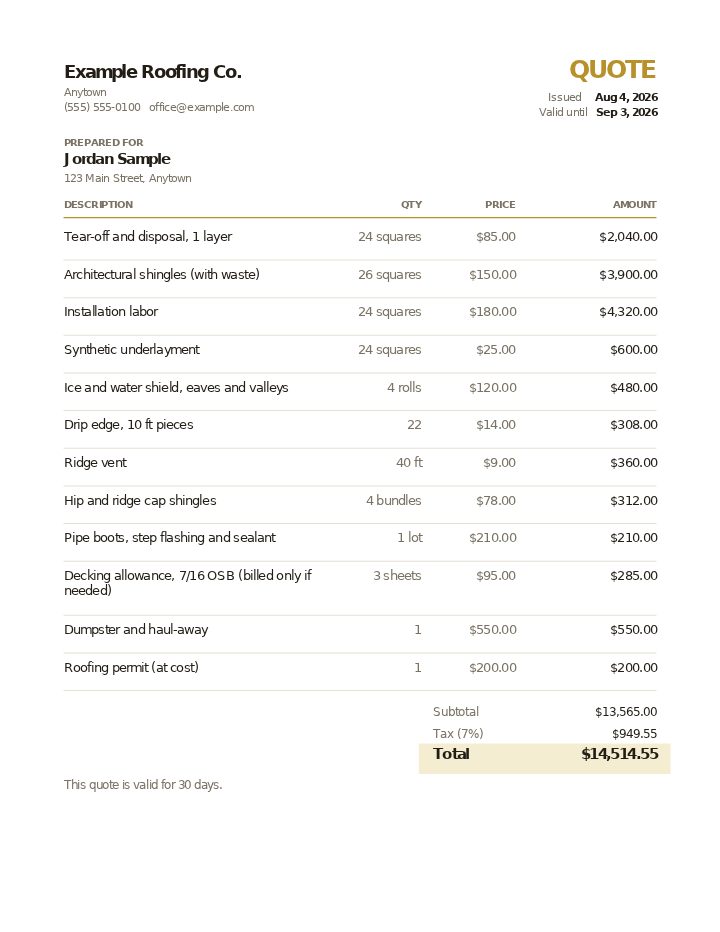
Here is the template for a full replacement on a simple gable roof: 24 squares at a walkable pitch, one layer of three-tab shingles off, architectural shingles on, with new underlayment, ice and water shield, drip edge and a ridge vent. Shingles are ordered at 26 squares to cover waste and starter. Three sheets of decking are allowed for. Business, client and prices are invented; the sample taxes the whole subtotal to keep it simple, but in some states roofers pay tax on materials when they buy them, so check yours.
| Qty | Price | Amount | |
|---|---|---|---|
| Tear-off and disposal, 1 layer | 24 squares | $85.00 / square | $2,040.00 |
| Architectural shingles (with waste) | 26 squares | $150.00 / square | $3,900.00 |
| Installation labor | 24 squares | $180.00 / square | $4,320.00 |
| Synthetic underlayment | 24 squares | $25.00 / square | $600.00 |
| Ice and water shield, eaves and valleys | 4 rolls | $120.00 / roll | $480.00 |
| Drip edge, 10 ft pieces | 22 | $14.00 | $308.00 |
| Ridge vent | 40 ft | $9.00 / ft | $360.00 |
| Hip and ridge cap shingles | 4 bundles | $78.00 / bundle | $312.00 |
| Pipe boots, step flashing and sealant | 1 lot | $210.00 | $210.00 |
| Decking allowance, 7/16 OSB (billed only if needed) | 3 sheets | $95.00 / sheet | $285.00 |
| Dumpster and haul-away | 1 | $550.00 | $550.00 |
| Roofing permit (at cost) | 1 | $200.00 | $200.00 |
| Subtotal | $13,565.00 | ||
| Sales tax 7% | $949.55 | ||
| Total | $14,514.55 |
The roof measures 24 squares; shingles are ordered at 26 to cover cutting waste and starter. Installation labor is $180 a square for a crew of four over about two days. Materials carry about a 20% markup over supplier price. Decking is an allowance: each rotten sheet replaced is billed at $95 and unused sheets come off the final invoice. The permit is at cost. This quote is valid for 30 days.
How to price a roofing estimate
Get the measurement right first, because every big line multiplies by it. Measure from the roof or from a satellite report, adjust for pitch, and count hips, valleys and penetrations, since a cut-up roof takes more labor and more waste than a plain gable of the same size. Steeper pitches and second stories need extra safety setup and slower work, so raise the labor per square for them.
Price materials from your supplier's current list, because shingle prices move during the season. Order waste: about ten percent on a simple roof, more with valleys and dormers. Spell out the warranty, both the manufacturer's and your workmanship. The estimate vs quote guide shows how to word the parts of a roof price you cannot see yet.
- Measure in squares and adjust for pitch before pricing anything
- Order 10% waste on simple roofs, more on cut-up roofs
- Raise labor per square for steep pitches, two stories and extra layers
- Price decking per sheet as an allowance instead of guessing
- List underlayment, ice and water shield and ventilation so cheaper quotes are easy to compare
Estimate, quote, then invoice — in Workeey
In Workeey the estimate is part of the job, along with the client, the address and the notes from your roof measurement. Enter your rates once, including hourly, first hour, call-out, travel, evening and weekend rates, parts markup and deposit percent, and the AI itemizes the estimate from them. Materials are priced from the web at your markup, and your own lines, like tear-off per square, are remembered so you are not typing them again on the next roof. Free includes 23 quick estimates a month.
Share quote makes a quote PDF good for 30 days that you share from your phone; the Email button opens your own mail app. The deposit percent prints on the quote, and Workeey does not collect deposits, so you take it the usual way. The homeowner doesn't sign in the app; they say yes to you. When the roof is done, adjust the decking line to what you used and one tap turns the estimate into the invoice, which Workeey emails with a pay link. See payments, pricing and the free estimate template.
More for roofers: pages and free templates
- Roofing software — inspection photos, quotes by the square, the invoice
- Best apps for roofers — the apps for this trade compared
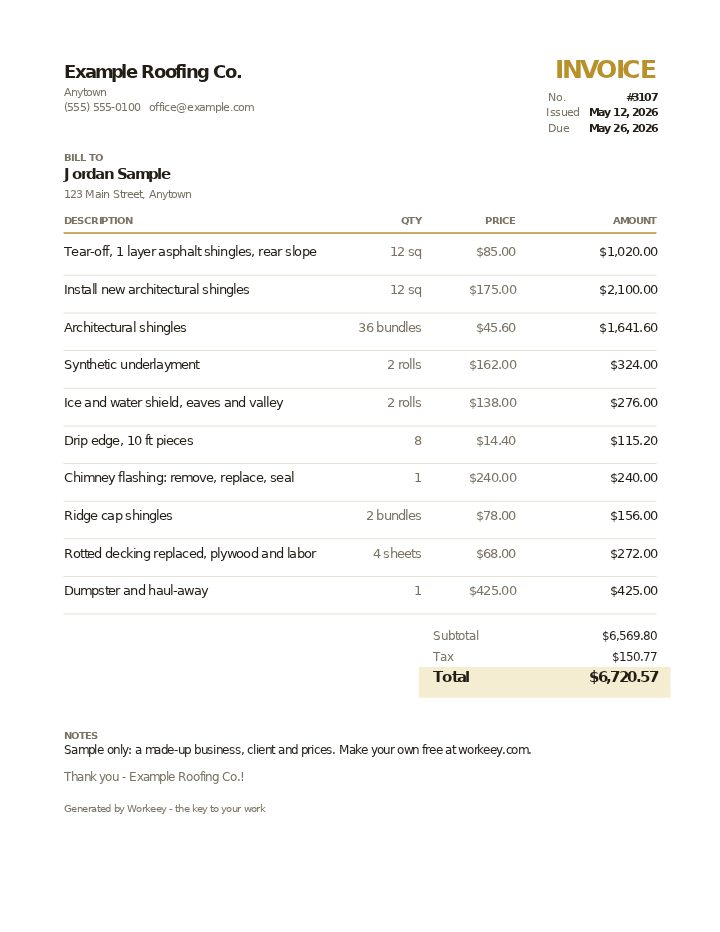
- Roofing invoice template — free, with a filled-in sample
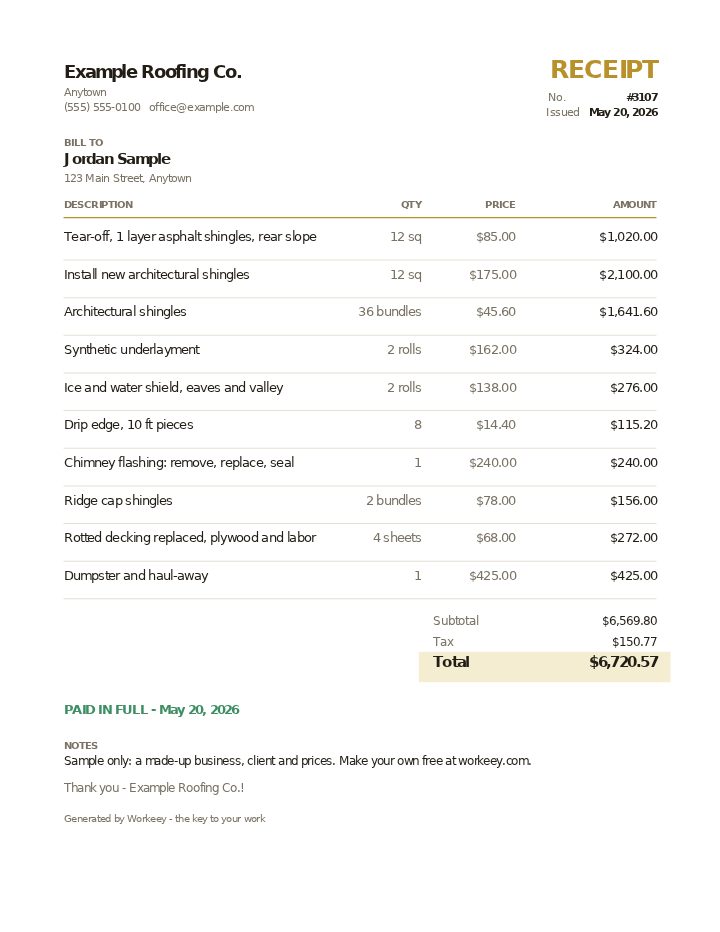
- Roofing receipt template — a free paid-in-full sample
- Roofer wages by state — what employed roofers earn in every state, from BLS data
- Free invoice template — every field a trade invoice needs
- Free estimate template — copy it, price it, send it
- Free receipt template — a paid-in-full receipt to copy
- Work order template — the job written down before you bill it
- Late payment reminder templates — texts, emails and a letter to copy and send
- All free templates and tools
How do you estimate a roof replacement?
Measure the roof in squares and adjust for pitch, then price tear-off, shingles with waste, installation labor, underlayment, ice and water shield, flashing, vents, dumpster and permit. Add a per-sheet decking allowance for damage you will only see once the old roof is off.
What is a square in roofing?
A square is 100 square feet of roof surface. A typical single-family roof is somewhere around 15 to 35 squares, depending on size and pitch.
How long should a roofing quote be valid?
Thirty days is common. Shingle and underlayment prices can change during the season, so a dated expiry keeps you from installing at last month's price.
Should a roofing estimate include rotten decking?
Yes, as an allowance with a price per sheet. Nobody can see the deck until tear-off, so agreeing the price ahead of time avoids an argument on the roof.