Workeey is built for your phone. Scan the code with your phone to get the Android app, or open workeey.com on your phone. The iPhone app and a desktop version are coming soon.
Get the Workeey app. Same account, same jobs.


Free roofing invoice template, with a filled-in reroof sample
Roofing invoices are big, and big numbers get questioned. Billing by the square, listing the shingles and underlayment, and showing the flashing, decking and dumpster on their own lines lets the homeowner see where the money went. Copy the free roofing invoice template below, check it against the sample partial reroof, and send it before the ladder comes down. Or let Workeey's invoicing build it from the finished job.
Download this invoice template: Word, Excel or PDF
Free to download, with no sign-up and no email. Open the Word file to type over the brackets, or the Excel file to swap in your own lines — the totals follow. Prefer paper? Print the blank PDF and fill it in by pen.
- Word (.docx) — the blank invoice, ready to fill in
- Excel (.xlsx) — the sample lines with amounts, tax and the total that work themselves out
- PDF (.pdf) — the filled-in sample, drawn the way Workeey draws an invoice
- Blank PDF (.pdf) — print it and fill it in by pen
- Google Docs — your own copy of the Word file, in your Google Drive (Google asks you to sign in)
- Google Sheets — your own copy of the Excel file, in your Google Drive (Google asks you to sign in)
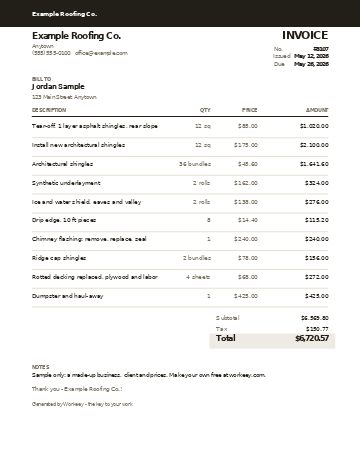
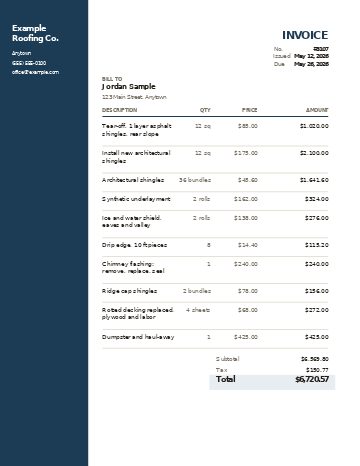
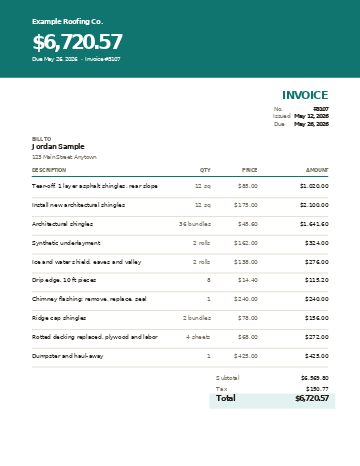
Fill in this invoice online
Change anything, pick a style, and download the PDF — free, no sign-up. What you type isn't sent to Workeey. The PDF is made in your browser.
Send it and get paid with Workeey
- The invoice is emailed to the homeowner from the app with a pay link, so once you connect Stripe they can pay by card, Apple Pay, Google Pay or US bank right away.
- You see each invoice as draft, sent, paid or overdue.
- Turn on reminder texts for an invoice that is running late and Workeey sends them on a schedule, up to eight, until it's paid.
- Invoicing costs nothing on the free plan.
Already have an invoice? The free invoice checker reads one you paste and says what it is missing.
What goes on a roofing invoice
A roofing invoice is a record the homeowner may need again: for their insurance company, or for a warranty claim years from now. So it should say exactly what was done and where. Name the slope or section you worked on, how many squares you tore off and put back, what you found under the shingles when you opened it up, and what product went on top.
Roofers price in squares, and one square is 100 square feet of roof. Keep that unit on the invoice for tear-off and installation, and list materials in the units they came in: bundles of shingles, rolls of underlayment, pieces of drip edge. Anything that was a surprise, like rotten decking found under the old shingles, gets its own line with a quantity, so the extra cost is explained instead of buried in the total.
- Your business name, phone, email, and roofing license number where required
- Homeowner's name, billing address, and the property address
- Invoice number, date, due date, and the claim number if insurance is involved
- Which part of the roof: rear slope, garage, the whole roof
- Tear-off and installation by the square, with the number of layers removed
- Shingles, underlayment, ice and water shield, drip edge and ridge cap
- Flashing work, and any decking replaced, by the sheet
- Dumpster or haul-away, then subtotal, tax, total and your warranty terms (is labor taxed in your state?)
Copy this roofing invoice template
Copy the lines below into a document and fill the brackets. If the job came from an insurance claim, put the claim number near the top. Keep the warranty line too. A workmanship warranty written on the invoice is a promise the homeowner can hold you to, so say how long it lasts and what it covers in plain words.
Keep the decking line even on jobs where it ends up empty. A per-sheet price told to the homeowner up front makes that line a known number, not a fight.
- [Business name] · [license #] · [phone] · [email]
- Invoice #[3107] · Date: [sent] · Due: [date] · Claim #: [if insurance]
- Bill to: [homeowner] · [billing address] · Property: [address]
- Scope: [section, e.g. rear slope, 12 squares] · [shingle brand, line, color]
- Tear-off, [layers] — [squares] × [rate] = [$]
- Install — [squares] × [rate] = [$]
- Shingles — [bundles] × [your price] = [$]
- Underlayment / ice and water shield — [rolls] × [price] = [$]
- Drip edge, flashing, ridge cap — [qty] × [price] = [$]
- Decking replaced — [sheets] × [price per sheet] = [$]
- Dumpster / haul-away — [$]
- Subtotal [$] · Sales tax [rate]% on [what is taxable] [$] · Total due [$]
- Workmanship warranty: [years] · Terms: [due date] · Pay by [link or check]
Sample roofing invoice, filled in
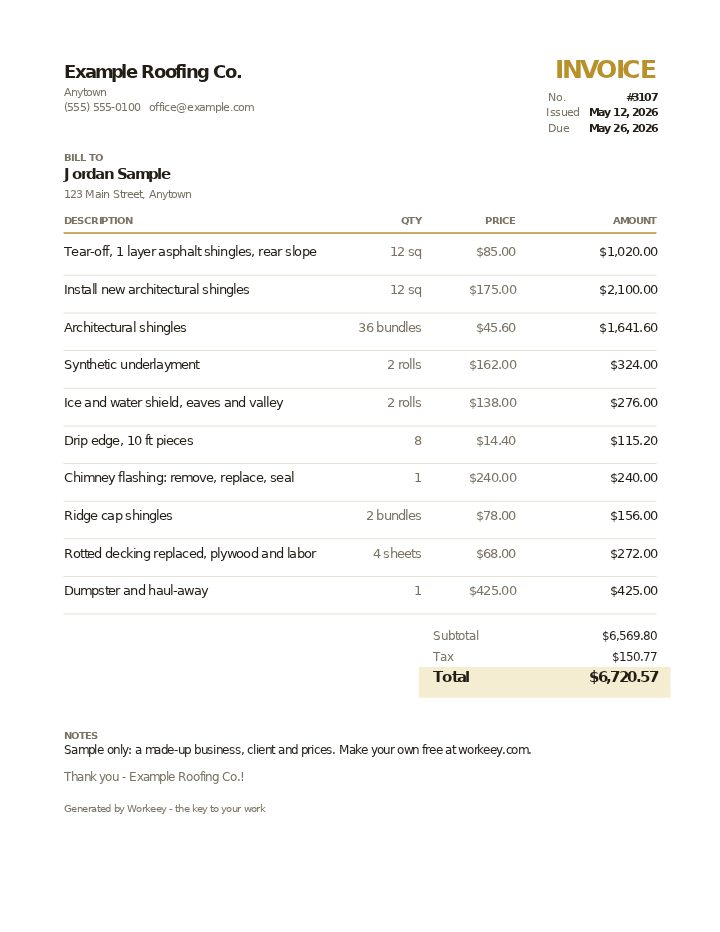
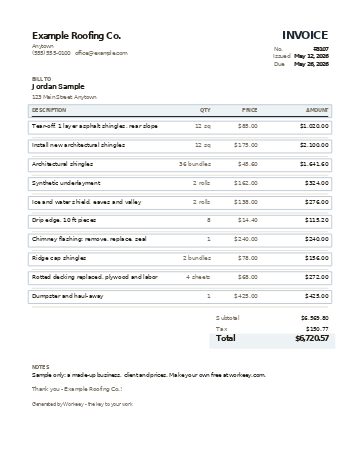
Here is the template filled in for a partial reroof: the rear slope of a house, 12 squares, one layer of old shingles torn off and architectural shingles installed. Four sheets of rotten decking turned up during tear-off. The business, client and prices are invented. Tax is charged here on the roofing materials only. In some states a roofer pays the tax on materials when buying them and charges none on the invoice, so check your state's rule.
| Qty | Price | Amount | |
|---|---|---|---|
| Tear-off, 1 layer asphalt shingles, rear slope | 12 sq | $85.00 / sq | $1,020.00 |
| Install new architectural shingles | 12 sq | $175.00 / sq | $2,100.00 |
| Architectural shingles | 36 bundles | $45.60 / bundle | $1,641.60 |
| Synthetic underlayment | 2 rolls | $162.00 / roll | $324.00 |
| Ice and water shield, eaves and valley | 2 rolls | $138.00 / roll | $276.00 |
| Drip edge, 10 ft pieces | 8 | $14.40 | $115.20 |
| Chimney flashing: remove, replace, seal | 1 | $240.00 | $240.00 |
| Ridge cap shingles | 2 bundles | $78.00 / bundle | $156.00 |
| Rotted decking replaced, plywood and labor | 4 sheets | $68.00 / sheet | $272.00 |
| Dumpster and haul-away | 1 | $425.00 | $425.00 |
| Subtotal | $6,569.80 | ||
| Sales tax 6% on roofing materials ($2,512.80) | $150.77 | ||
| Total due | $6,720.57 |
Shingles and drip edge are billed at cost plus 20%: $38.00 a bundle became $45.60, and $12.00 a piece of drip edge became $14.40. Three bundles cover a square, so 12 squares took 36 bundles. The decking line covers the plywood and the labor to swap each sheet, at the per-sheet price the homeowner agreed to before work started. Payment terms on this sample: due in 14 days, paid by card or bank from the pay link in the invoice email, or by check to Example Roofing Co.
How to invoice roofing work
Take photos before, during and after. A roof is the one job the homeowner can't easily go and look at, so pictures of the old shingles, the rotten boards you replaced and the new flashing around the chimney are what make the invoice believable. Text them to the homeowner or keep them with the job.
On a full replacement, materials can be most of the bill, and they arrive before you start. Many roofers ask for a deposit when the order goes in, bill it as its own invoice, and show it as already paid on the final one. If an insurer is paying part of the job, invoice the homeowner, not the insurance company, and put the claim number on it. When a payment goes past due, our late-payment reminder templates give you a polite first message and a firmer second one.
- Bill tear-off and install by the square, in the same units as your estimate
- Agree a per-sheet price for rotten decking before you open the roof
- Keep before-and-after photos with the job
- Put the claim number on any insurance job
- Write the warranty terms on the final invoice
Or do it free in Workeey
In Workeey you price a roofing job once. When the roof is done, one tap turns the job or its estimate into an invoice, with the homeowner, the property address and every line already filled in, tax added and the invoice numbered for you.
The invoice is emailed to the homeowner from the app with a pay link, so once you connect Stripe they can pay by card, Apple Pay, Google Pay or US bank right away; a small processing fee applies to online payments. You see each invoice as draft, sent, paid or overdue. Turn on reminder texts for an invoice that is running late and Workeey sends them on a schedule, up to eight, until it's paid. Invoicing costs nothing on the free plan, and the payments page explains how getting paid works.
More for roofers: pages and free templates
- Roofing software — inspection photos, quotes by the square, the invoice
- Best apps for roofers — the apps for this trade compared
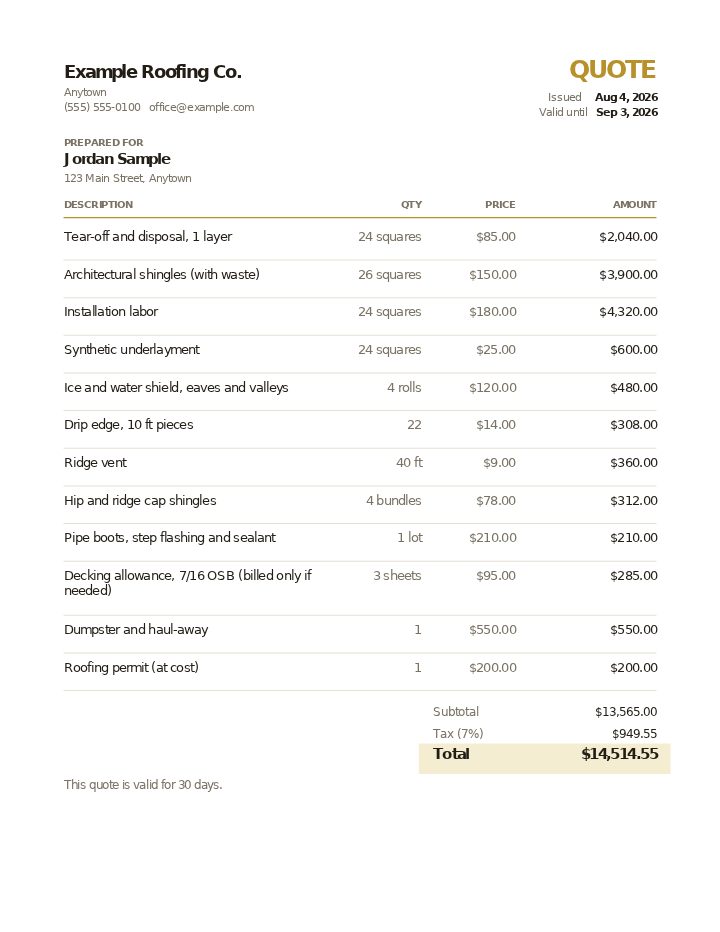
- Roofing estimate template — a free quote sample
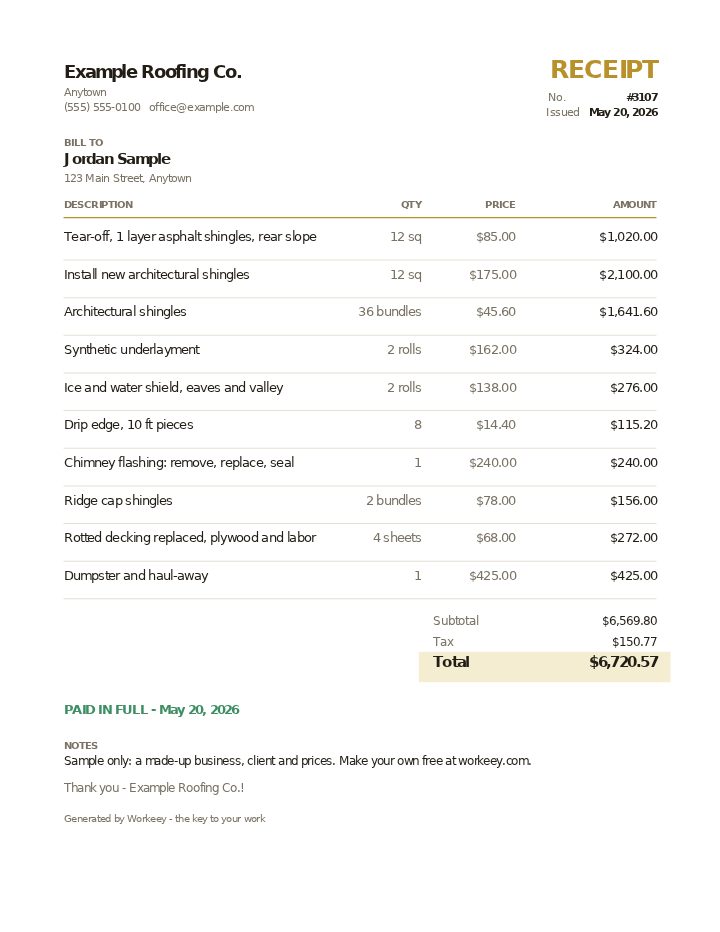
- Roofing receipt template — a free paid-in-full sample
- Roofer wages by state — what employed roofers earn in every state, from BLS data
- Free invoice template — every field a trade invoice needs
- Free estimate template — copy it, price it, send it
- Free receipt template — a paid-in-full receipt to copy
- Work order template — the job written down before you bill it
- Late payment reminder templates — texts, emails and a letter to copy and send
- All free templates and tools
How do roofers bill for a job?
Most bill by the square, which is 100 square feet of roof: one line for tear-off, one for installation, then the materials, any extra decking, flashing and the dumpster.
What should a roofing invoice include for insurance?
The claim number, the property address, the date of the work, exactly what was replaced and how much, and the shingle product used. Adjusters compare the invoice with their own estimate, so match their line items where you can.
Should a roofer charge a deposit?
Many do on full replacements, because the materials are ordered and paid for before work starts. Agree it in writing, invoice it separately, and show it as paid on the final invoice so the balance is clear. Check your state, since some limit how large a deposit a home improvement contractor can take.
How do I charge for rotten decking found during a reroof?
Agree a price per sheet before the job, in your estimate or contract. Then count the sheets you replace and bill them on their own line, with a photo or two of the damage.