Workeey is built for your phone. Scan the code with your phone to get the Android app, or open workeey.com on your phone. The iPhone app and a desktop version are coming soon.
Get the Workeey app. Same account, same jobs.


Free tree removal estimate template for tree service jobs
A tree removal price depends on things the homeowner rarely thinks about: how hard the tree leans toward the roof, whether a service line runs through it, and whether the wood stays or goes. Write those into the estimate and the price explains itself. Copy the free tree service estimate template below, compare it to the removal and stump grinding sample, and send it the day you look at the tree. Or let Workeey itemize it from your own rates.
Download this estimate template: Word, Excel or PDF
Free to download, with no sign-up and no email. Open the Word file to type over the brackets, or the Excel file to swap in your own lines — the totals follow. Prefer paper? Print the blank PDF and fill it in by pen.
- Word (.docx) — the blank estimate, ready to fill in
- Excel (.xlsx) — the sample lines with amounts, tax and the total that work themselves out
- PDF (.pdf) — the filled-in sample, drawn the way Workeey draws a quote
- Blank PDF (.pdf) — print it and fill it in by pen
- Google Docs — your own copy of the Word file, in your Google Drive (Google asks you to sign in)
- Google Sheets — your own copy of the Excel file, in your Google Drive (Google asks you to sign in)
Fill in this estimate online
Change anything and download the PDF — free, no sign-up. What you type isn't sent to Workeey. The PDF is made in your browser.
Quote it, then invoice it, in Workeey
- With Share quote it becomes a quote PDF, good for 30 days, with the deposit percent printed on it.
- Once the yard is raked and the stump holes are filled, one tap turns the estimate into the invoice, emailed with a pay link.
- The free plan covers 23 quick estimates a month.
What goes on a tree service estimate
Tree work carries more risk than most home services, and the estimate is where you show the client you have thought about it. Open with your business name, phone and email, your insurance, and any arborist certification or license your state or town asks for. Then the client and the address, the estimate number, the date and when it expires.
Name each tree by species, rough height and where it stands, "60 ft red oak, back left corner, over the garage", so there is no question which one comes down. For each, say how it comes down, what happens to the stump, and what you do with the wood and brush: haul it, chip it, or leave the logs cut to length. State who handles any permit, how work near utility lines is handled, and that lawn ruts or damage to buried lines nobody marked are not included.
- Business details, proof of insurance, and any license or certification
- Each tree: species, height, location and what it stands over
- Removal method: felled whole, or climbed and lowered in sections
- Stump grinding by diameter, and how deep you grind
- Wood and brush: hauled, chipped, or logs left for the client
- Permits, utility-line notes, cleanup and exclusions
Copy this tree removal estimate template
Paste the template into a document or your phone and fill in the brackets. One line per tree keeps it clear when the client wants to drop one later, and it lets you price a technical climb and a simple fell on the same quote.
Measure stumps across at ground level and write the inches on the estimate. Grinding priced by the inch is easy for a client to check with a tape measure, which settles arguments before they start. The skeleton:
- [Your business name] · [phone] · [email] · Insured: [carrier, coverage]
- Estimate #[…] · Date: […] · Valid until: [date, e.g. 30 days]
- Prepared for: [client name] · [address] · Permit: [needed or not, who pulls it]
- Tree 1: [species, height, location] — [method] — [$]
- Tree 2: [species, height, location] — [method] — [$]
- Stump grinding — [total inches] × [rate per inch] = [$] · Depth: [inches below grade]
- Haul-away — [loads] × [rate] = [$] · or Logs left: [length]
- Cleanup: [rake, blow, fill stump holes]
- Not included: [unmarked buried lines, lawn ruts, root removal]
- Subtotal [$] · Sales tax [rate]% [$] · Total [$]
- Deposit to start: [%] · Scheduled: [date, weather permitting]
- Accepted by: [name] · [date]
Sample tree removal estimate (quote), filled in
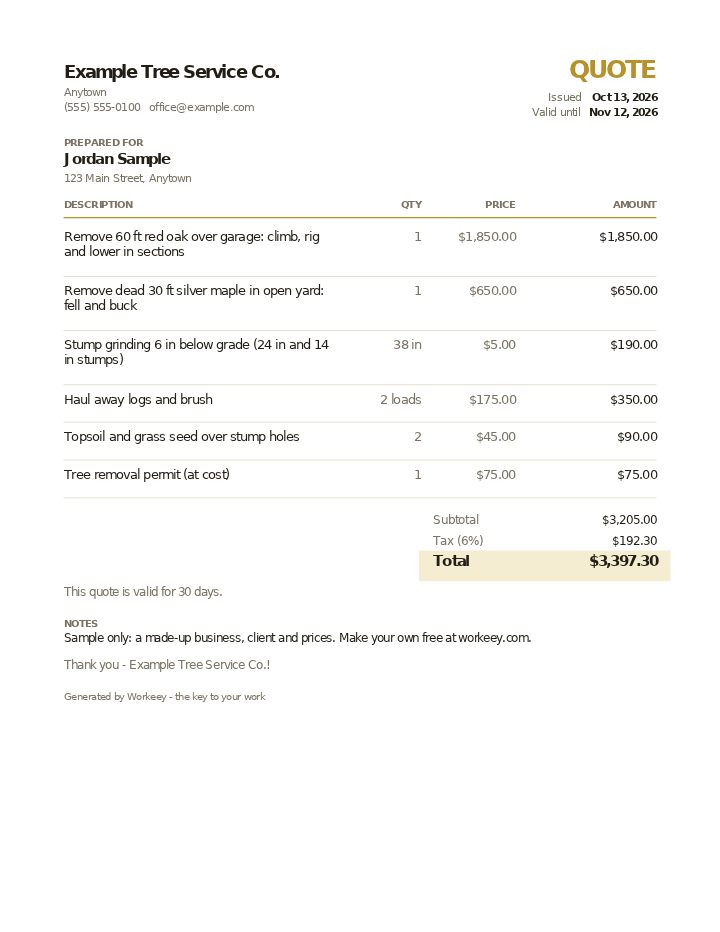
Here is the template filled in for two removals at one house: a large oak leaning over the garage that has to be climbed and lowered in pieces, and a dead maple in the open that can be dropped in one go. The business, the client and the prices are made up. This sample taxes the whole subtotal; whether tree work is taxable varies by state, so check yours.
| Qty | Price | Amount | |
|---|---|---|---|
| Remove 60 ft red oak over garage: climb, rig and lower in sections | 1 | $1,850.00 | $1,850.00 |
| Remove dead 30 ft silver maple in open yard: fell and buck | 1 | $650.00 | $650.00 |
| Stump grinding 6 in below grade (24 in and 14 in stumps) | 38 in | $5.00 / in | $190.00 |
| Haul away logs and brush | 2 loads | $175.00 / load | $350.00 |
| Topsoil and grass seed over stump holes | 2 | $45.00 | $90.00 |
| Tree removal permit (at cost) | 1 | $75.00 | $75.00 |
| Subtotal | $3,205.00 | ||
| Sales tax 6% | $192.30 | ||
| Total | $3,397.30 |
The oak is priced from the hours it takes to climb, rig and lower it safely around the garage roof, plus equipment and insurance; the maple costs far less because it can fall in one piece where nothing is in the way. Stumps are measured across at ground level and ground at $5 an inch. The permit is passed through at exactly what the town charges. The quote is valid for 30 days.
How to price a tree removal estimate
Price the risk, not the height. A 60-foot tree in an open field might take an hour with a saw; the same tree over a roof, a fence and a service drop is a full day of climbing and rigging. Look at the lean, the deadwood, what's underneath, and whether a bucket truck or a crane can reach it. Then price the hours and the equipment it really needs, with margin for the insurance that kind of work requires.
Price the extras so the client can choose. Stump grinding, haul-away and cleanup are where homeowners try to save, and separate lines let them decide without haggling over the removal itself. If a tree is near power lines, note that the utility may need to drop or shield the line first and that the date depends on them. If the client asks whether your number can change, our estimate vs quote guide has the plain answer.
- Price by difficulty: lean, targets underneath, access and climbing needed
- Grind stumps by the inch across, with the depth written down
- Make haul-away and wood removal separate lines the client can decline
- Pass permits through at cost and say who pulls them
- Build insurance and equipment costs into every removal price
Estimate, quote, then invoice — in Workeey
In Workeey the estimate lives in the job, next to the address and your notes on the lean and the service drop. Describe the trees and the AI itemizes an estimate from your own rates: hourly, first hour or call-out, travel, evenings and weekends, parts markup and deposit percent. Materials like topsoil and seed are priced from the web at your markup, and lines you write yourself, such as "stump grinding, per inch", are remembered for the next job. The free plan covers 23 quick estimates a month.
With Share quote it becomes a quote PDF, good for 30 days, with the deposit percent printed on it; share it from your phone or use the Email button to open your own mail app. The homeowner tells you yes, with nothing signed in the app, and Workeey doesn't collect deposits. Once the yard is raked and the stump holes are filled, one tap turns the estimate into the invoice, emailed with a pay link (payments). For the invoice itself, the free invoice template has the format; pricing covers the plans.
More for tree services: pages and free templates
- Tree service software — on-site quotes and the bill when the wood is gone
- Tree service invoice template — free, with a filled-in sample
- Free invoice template — every field a trade invoice needs
- Free estimate template — copy it, price it, send it
- Free receipt template — a paid-in-full receipt to copy
- Work order template — the job written down before you bill it
- Late payment reminder templates — texts, emails and a letter to copy and send
- All free templates and tools
How do you estimate a tree removal?
Start with the tree's size, then weigh what makes it hard: lean, targets underneath like a roof or fence, access for equipment, and whether it has to be climbed and lowered in pieces. Price the hours and equipment that takes, then add stump grinding, haul-away and any permit as separate lines.
Is stump grinding included in tree removal?
Usually not, unless the estimate says so. Most tree services price grinding separately, often by the inch of diameter, and say how deep they grind. Putting it on its own line lets the client choose to keep the stump or have it ground.
Do I need a permit to remove a tree?
It depends on the town. Some cities require a permit for trees above a certain trunk size, for protected species, or for trees near the street. Check locally, say on the estimate who pulls the permit, and bill it at cost.
How long is a tree removal quote good for?
Thirty days is common. A storm can change a tree's condition overnight, and a cracked or hung-up tree is a different job, so the quote should say the price holds only for the tree as you saw it.