Workeey is built for your phone. Scan the code with your phone to get the Android app, or open workeey.com on your phone. The iPhone app and a desktop version are coming soon.
Get the Workeey app. Same account, same jobs.


Free tree service invoice template, with pruning and stump grinding filled in
By the time you send the invoice, the evidence of the work is in the chipper. That's why a tree service invoice has to say clearly which trees, what was cut, how the stumps were measured and where the wood went. Copy the free tree service invoice template below, check it against the filled-in sample for pruning and stump grinding, and send it before you pull out of the driveway. See everything Workeey does for tree services.
Download this invoice template: Word, Excel or PDF
Free to download, with no sign-up and no email. Open the Word file to type over the brackets, or the Excel file to swap in your own lines — the totals follow. Prefer paper? Print the blank PDF and fill it in by pen.
- Word (.docx) — the blank invoice, ready to fill in
- Excel (.xlsx) — the sample lines with amounts, tax and the total that work themselves out
- PDF (.pdf) — the filled-in sample, drawn the way Workeey draws an invoice
- Blank PDF (.pdf) — print it and fill it in by pen
- Google Docs — your own copy of the Word file, in your Google Drive (Google asks you to sign in)
- Google Sheets — your own copy of the Excel file, in your Google Drive (Google asks you to sign in)
Fill in this invoice online
Change anything, pick a style, and download the PDF — free, no sign-up. What you type isn't sent to Workeey. The PDF is made in your browser.
Send it and get paid with Workeey
- The invoice is emailed to the homeowner from the app with a pay link, so after you connect Stripe they can pay by card, Apple Pay, Google Pay or US bank.
- Every invoice shows as draft, sent, paid or overdue.
- If one runs late, switch on reminder texts for it and they go out on a schedule, up to eight, until it's paid.
- Invoicing is free on the free plan.
Already have an invoice? The free invoice checker reads one you paste and says what it is missing.
What goes on a tree service invoice
Identify every tree in a way the homeowner would recognize: the species, where it stands and roughly how big it is. "Large red oak, back left corner" is enough. Then say what was done to it in the words arborists use, such as crown cleaning, thinning, raising, reduction or removal, with a short plain-English explanation the first time, so the client knows that crown raising meant lifting the low limbs over the driveway.
Stump grinding is easiest to bill by the inch of diameter, and the invoice should show the measurement. Say what happened to the wood and brush, because clients care: chipped and hauled, chips left for mulch, logs cut to firewood and stacked. If the job needed a permit for a protected tree, a bucket truck or a crane, or a utility to drop a line, those are lines too. Arborists who carry certification often print the number, which helps when an HOA or insurer asks.
- Business name, phone, email, and arborist certification or license if you have one
- The homeowner's name, billing address and the property worked on
- Invoice number, work date, invoice date and due date
- Each tree: species, location, rough size
- The work on each tree: pruning type, removal, cabling
- Stump grinding by the inch of diameter, and how deep
- Where the wood and brush went: hauled, chipped, left
- Permits, special equipment, cleanup, tax and total (is labor taxed in your state?)
Copy this tree service invoice template
Paste this skeleton into a document or your phone's notes and fill in the brackets. One line per tree keeps it honest, even when the price is a single number for the job, because the client can see that the third tree was worth what you charged for it.
Use the wood line even when the answer is "left on site". It records what was agreed, and it heads off the call asking when you're coming back for the logs.
- [Business name] · [certification / license #] · [phone] · [email]
- Invoice #[3340] · Work date: [date] · Invoice date: [date] · Due: [date]
- Bill to: [homeowner] · [billing address] · Trees at: [address]
- Tree 1: [species, location, size] — [work done] — [$]
- Tree 2: [species, location, size] — [work done] — [$]
- Stump grinding — [total inches] × [rate per inch], [depth] below grade = [$]
- Brush and wood — [chipped and hauled / left as firewood] — [$]
- Equipment: [bucket truck / crane / none] — [$]
- Permit: [number, if required] — [$ at cost]
- Fill and seed: [topsoil, grass seed] — [qty] × [price] = [$]
- Subtotal [$] · Sales tax [rate]% on [what is taxable] [$] · Total due [$]
- Due: [date] · Pay by [the email pay link or check]
Sample tree service invoice, filled in
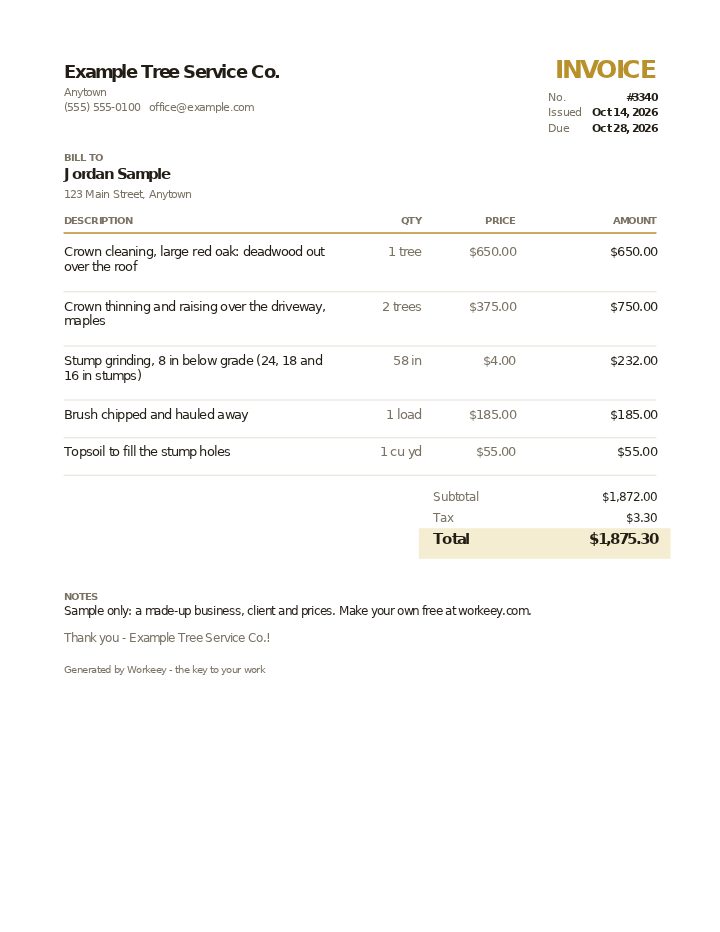
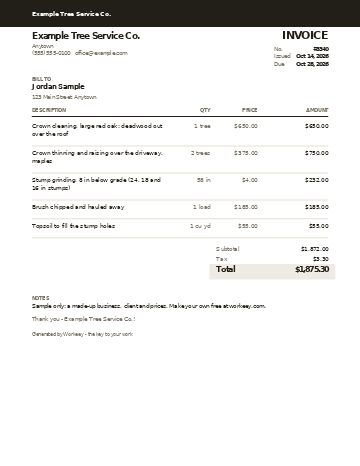
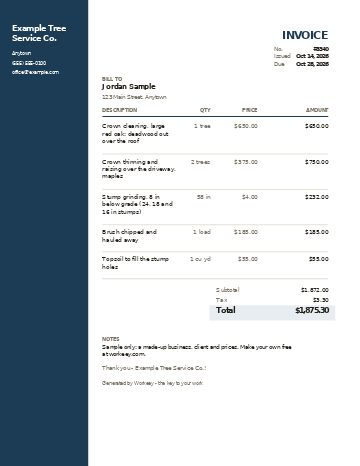
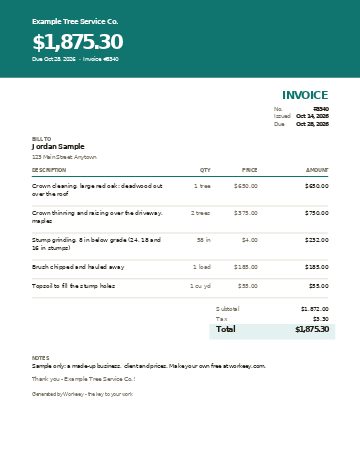
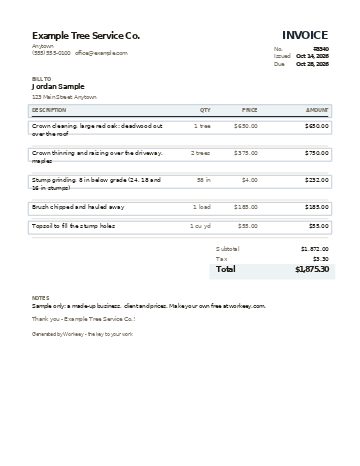
Here is the template filled in for a day of pruning and grinding at one house: deadwood cleaned out of a big red oak that hangs over the roof, two maples thinned and lifted over the driveway, and three old stumps ground eight inches below grade and filled with topsoil. All names and prices here are invented. Whether tree work is taxable depends on your state; this sample taxes only the topsoil.
| Qty | Price | Amount | |
|---|---|---|---|
| Crown cleaning, large red oak: deadwood out over the roof | 1 tree | $650.00 / tree | $650.00 |
| Crown thinning and raising over the driveway, maples | 2 trees | $375.00 / tree | $750.00 |
| Stump grinding, 8 in below grade (24, 18 and 16 in stumps) | 58 in | $4.00 / in | $232.00 |
| Brush chipped and hauled away | 1 load | $185.00 / load | $185.00 |
| Topsoil to fill the stump holes | 1 cu yd | $55.00 / cu yd | $55.00 |
| Subtotal | $1,872.00 | ||
| Sales tax 6% on topsoil ($55.00) | $3.30 | ||
| Total due | $1,875.30 |
Stumps are priced by the inch of diameter, measured across the widest point at ground level: 24, 18 and 16 inches make 58. The logs from the oak were cut to firewood length and left stacked by the shed, as the client asked, so only the brush was hauled. Tax applies only to the topsoil in this sample, because the state taxes the material and not the tree work. Payment terms on this sample: due in 14 days, paid by card or bank from the pay link in the invoice email, or by check to Example Tree Service Co.
How to invoice tree work
Invoice on the day, while the client can still see the lighter canopy and the clean ground. Photos help more in tree work than in most trades: one of the oak before, with the dead limbs over the roof, and one after, makes the line on the invoice obvious. If a job grew once you were up the tree, such as a split limb you found that had to come out, tell the client before you cut and add it as its own line with what you agreed. When the job started from our tree service estimate template, keep its tree-by-tree lines.
Storm work is different. After a storm, insurance companies often pay for removing a tree that fell on the house, so invoice the homeowner in full, describe the damage plainly and give them what their adjuster will ask for: the date, the photos and the line items. Don't wait on the insurer to pay you before you invoice. If the money is slow, our late-payment reminder templates help.
- Describe each tree so the client can point to it
- Measure stumps across the widest point and bill by the inch
- Write down what happened to the wood and brush
- Add found work only after the client agrees to it
- Keep before and after photos with every job
Or do it free in Workeey
Workeey keeps each tree job with its address, your notes and the client's number. When the last stump is ground, one tap turns the job or its estimate into an invoice: client, address and every line already in place, tax added and the invoice numbered.
The invoice is emailed to the homeowner from the app with a pay link, so after you connect Stripe they can pay by card, Apple Pay, Google Pay or US bank; a small processing fee applies to online payments. Every invoice shows as draft, sent, paid or overdue. If one runs late, switch on reminder texts for it and they go out on a schedule, up to eight, until it's paid. Invoicing is free on the free plan, and the payments page has the details.
More for tree services: pages and free templates
- Tree service software — on-site quotes and the bill when the wood is gone
- Tree removal estimate template — a free quote sample
- Free invoice template — every field a trade invoice needs
- Free estimate template — copy it, price it, send it
- Free receipt template — a paid-in-full receipt to copy
- Work order template — the job written down before you bill it
- Late payment reminder templates — texts, emails and a letter to copy and send
- All free templates and tools
How do tree services bill for a job?
Most quote and invoice per tree, based on size, difficulty and what's under it, with stump grinding priced by the inch of diameter and extras like haul-away, cranes or permits on their own lines. Some bill large jobs by the hour or day for the equipment and workers.
How do you charge for stump grinding?
The common way is by the inch of diameter at ground level, with a minimum charge for small jobs. Write the measurement on the invoice and say how deep you ground and whether the hole was filled.
Is tree removal taxable?
In many states tree work is not taxed, but some tax it as landscaping or real property service, and materials like topsoil may be taxable. Check your state and name what the tax is on.
Does insurance pay for tree removal, and who do I invoice?
Homeowner's insurance often covers removing a tree that fell on the house or another covered structure, usually up to a limit. Invoice the homeowner, and give them the photos and line items their insurer will want.