Workeey is built for your phone. Scan the code with your phone to get the Android app, or open workeey.com on your phone. The iPhone app and a desktop version are coming soon.
Get the Workeey app. Same account, same jobs.


Free concrete invoice template, with a patio and stoop filled in
On a concrete job the money is spent in one morning, when the truck pours, and the customer sees a gray slab and a big number. An invoice that shows the tear-out, the base, the steel, the yards of concrete and the finishing as separate lines tells them what's underneath. Copy the free concrete invoice template below, check it against the filled-in sample for a patio and back stoop, and send it once the forms come off.
Download this invoice template: Word, Excel or PDF
Free to download, with no sign-up and no email. Open the Word file to type over the brackets, or the Excel file to swap in your own lines — the totals follow. Prefer paper? Print the blank PDF and fill it in by pen.
- Word (.docx) — the blank invoice, ready to fill in
- Excel (.xlsx) — the sample lines with amounts, tax and the total that work themselves out
- PDF (.pdf) — the filled-in sample, drawn the way Workeey draws an invoice
- Blank PDF (.pdf) — print it and fill it in by pen
- Google Docs — your own copy of the Word file, in your Google Drive (Google asks you to sign in)
- Google Sheets — your own copy of the Excel file, in your Google Drive (Google asks you to sign in)
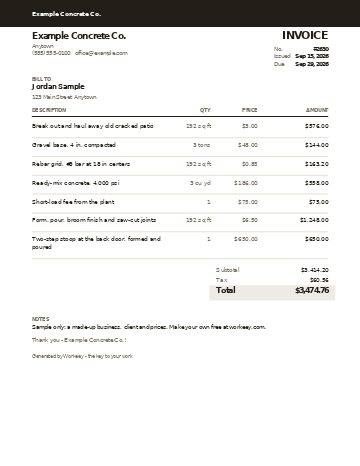
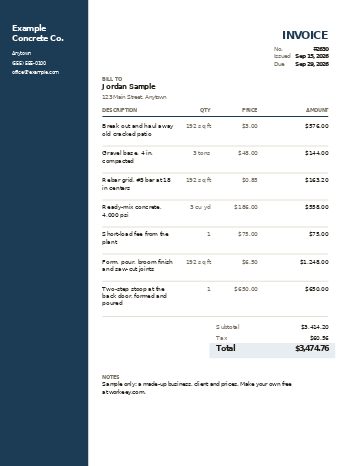
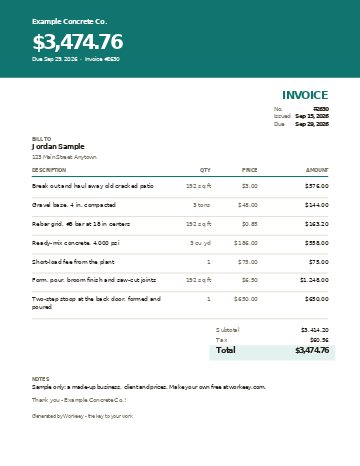
Fill in this invoice online
Change anything, pick a style, and download the PDF — free, no sign-up. What you type isn't sent to Workeey. The PDF is made in your browser.
Send it and get paid with Workeey
- The invoice is emailed from the app with a pay link, and once you connect Stripe the customer can pay by card, Apple Pay, Google Pay or US bank.
- You can see at a glance whether each invoice is draft, sent, paid or overdue.
- Turn on reminder texts for a late one and they go out on a schedule, up to eight, until it's paid.
- Invoicing is free on the free plan.
Already have an invoice? The free invoice checker reads one you paste and says what it is missing.
What goes on a concrete invoice
Describe the slab first: what it is, its size and its thickness. "Back patio, 12 by 16 feet, 4 inches thick" tells the customer and any future buyer what they own. Then list what's under it, because that's what makes concrete last: the depth of the gravel base and whether it was compacted, and the reinforcement, whether rebar, wire mesh or fiber in the mix. Name the mix strength too, such as 4,000 psi.
Concrete itself goes on by the cubic yard. The plant's extra charges, like a short-load fee for a small order or a pump truck for a back yard you can't reach with the chute, belong on their own lines so the customer can see they came from the supplier. Finish the list with the work: forming, pouring, the finish you gave it and the control joints, priced by the square foot.
- Business name, phone, email and license number if required
- Customer name, billing address and the job address
- Invoice number, pour date, invoice date and due date
- What was poured: size, thickness and finish
- Base depth, compaction and reinforcement
- Concrete by the cubic yard, with mix strength
- Plant or pump fees as their own lines
- Tear-out and haul-away, labor by the square foot, tax and total (is labor taxed in your state?)
Copy this concrete invoice template
Copy the lines below into a document or a note on your phone and fill in the brackets. Keep the cure line at the bottom. The most common callback in flatwork is a customer who drove on the new driveway too soon, and having the wait times on the invoice, as well as said out loud, puts that on the record.
Add the cracking line too: control joints decide where concrete cracks, and saying so heads off next winter's call.
- [Business name] · [license # if required] · [phone] · [email]
- Invoice #[2630] · Pour date: [date] · Invoice date: [date] · Due: [date]
- Bill to: [customer] · [billing address] · Job: [address]
- Work: [patio / driveway / walk] · [length × width] · [thickness] · [finish]
- Tear-out and haul-away — [sq ft] × [rate] = [$]
- Base — [tons or yards] × [price], [depth], compacted = [$]
- Reinforcement — [rebar / mesh / fiber] — [sq ft] × [rate] = [$]
- Concrete — [cu yd] × [price], [psi] = [$]
- Plant or pump fees — [short load / pump truck] = [$]
- Form, pour and finish — [sq ft] × [rate] = [$]
- Steps / extras — [$]
- Subtotal [$] · Sales tax [rate]% on [materials] [$] · Total due [$]
- Cure: [days before walking / driving] · Cracking: [control joints note]
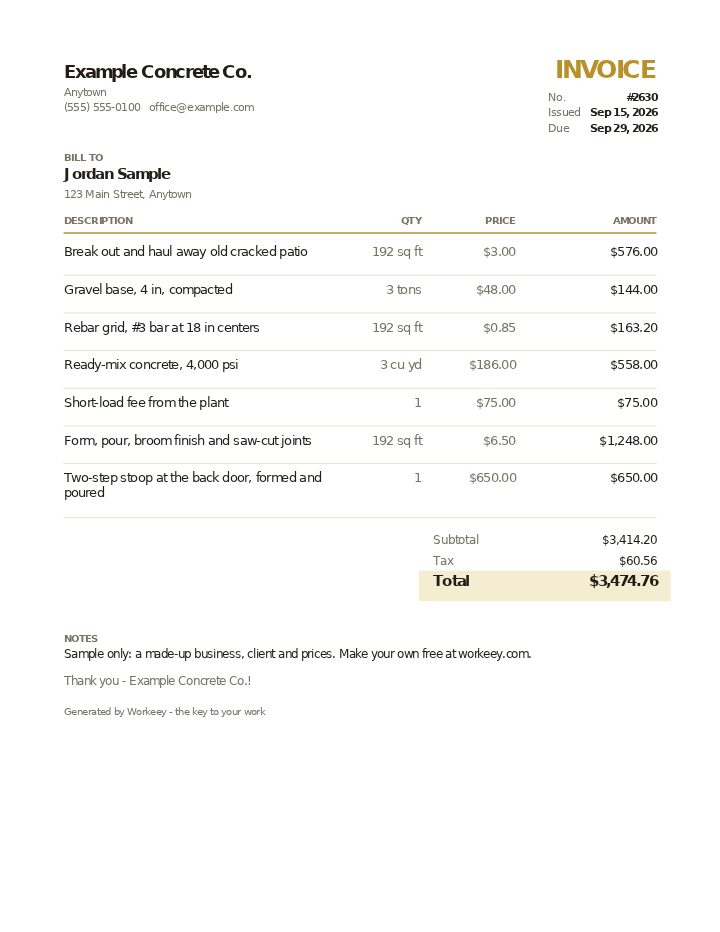
Sample concrete invoice, filled in
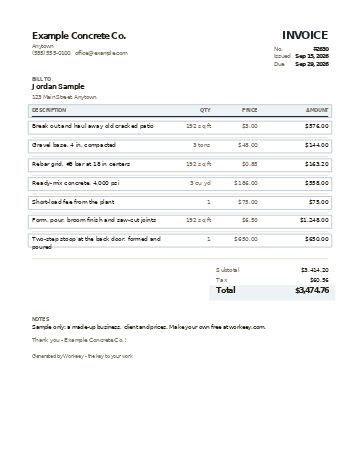
This is the template filled in for replacing a cracked back patio: the old slab broken out and hauled away, a new 12-by-16-foot slab on four inches of compacted gravel with a rebar grid, a broom finish with saw-cut joints, and a two-step stoop poured at the back door the same morning. All of it, from the company to the yard price, is made up. Tax is charged here on the materials only; many states treat a slab as an improvement to real property, so check your rule.
| Qty | Price | Amount | |
|---|---|---|---|
| Break out and haul away old cracked patio | 192 sq ft | $3.00 / sq ft | $576.00 |
| Gravel base, 4 in, compacted | 3 tons | $48.00 / ton | $144.00 |
| Rebar grid, #3 bar at 18 in centers | 192 sq ft | $0.85 / sq ft | $163.20 |
| Ready-mix concrete, 4,000 psi | 3 cu yd | $186.00 / cu yd | $558.00 |
| Short-load fee from the plant | 1 | $75.00 | $75.00 |
| Form, pour, broom finish and saw-cut joints | 192 sq ft | $6.50 / sq ft | $1,248.00 |
| Two-step stoop at the back door, formed and poured | 1 | $650.00 | $650.00 |
| Subtotal | $3,414.20 | ||
| Sales tax 7% on gravel, rebar and concrete ($865.20) | $60.56 | ||
| Total due | $3,474.76 |
Gravel and concrete are billed at cost plus 20 percent: $40.00 a ton became $48.00 and $155.00 a yard became $186.00. A 12-by-16-foot slab at 4 inches takes about 2.4 yards; the stoop and a little extra for waste brought the order to 3. The order was under the plant's minimum, so its short-load fee is passed on at cost. Keep foot traffic off for 2 days and patio furniture off for a week. Payment terms on this sample: due in 14 days, paid by card or bank from the pay link in the invoice email, or by check to Example Concrete Co.
How to invoice concrete work
Invoice the yards you ordered, not the yards you calculated. If the slab took more because the base was low in one corner, the ticket from the plant shows it, and it's easy to explain. Keep that ticket with the job. When the job started from our concrete estimate template, the same lines carry across, and any change like extra tear-out or a thicker slab should be agreed before the pour.
Concrete work has large material costs that land on one day. Many contractors ask for a deposit when they book the pour and bill it as its own invoice. If a deposit was paid, write "Deposit of $[…] received [date]" in the notes of the final invoice and leave only the work still owed on the lines, so the total is the balance due. For commercial or builder work on 30-day terms, our page on net 30 explains how to set the due date.
- Bill concrete by the yard, using the plant's ticket
- Pass plant and pump fees through on their own lines
- Write the base depth and the reinforcement on the invoice
- Agree extra tear-out or thickness before the truck comes
- Put cure times and a cracking note at the bottom
Or do it free in Workeey
Workeey keeps the concrete job with its address, measurements and your notes from the site visit. After the pour, one tap turns the job or its estimate into an invoice, with the customer, address and lines carried over, tax added and an invoice number on it. To set a markup on ready-mix and gravel you can defend, try the markup calculator.
The invoice is emailed from the app with a pay link, and once you connect Stripe the customer can pay by card, Apple Pay, Google Pay or US bank; a small processing fee applies to online payments. You can see at a glance whether each invoice is draft, sent, paid or overdue. Turn on reminder texts for a late one and they go out on a schedule, up to eight, until it's paid. Invoicing is free on the free plan.
More for concrete contractors: pages and free templates
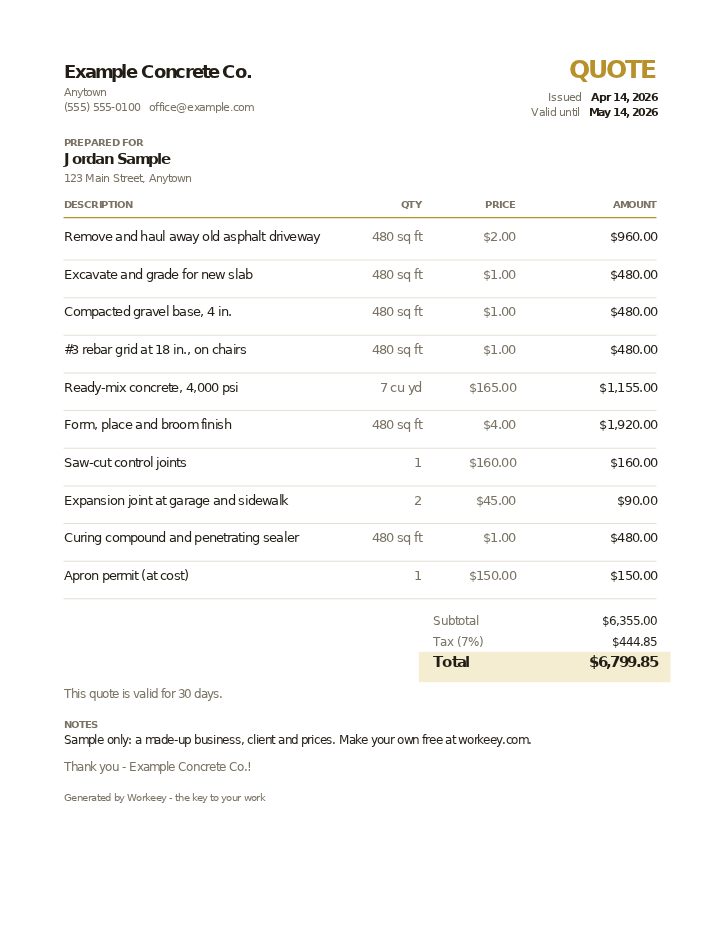
- Concrete estimate template — a free quote sample
- Free invoice template — every field a trade invoice needs
- Free estimate template — copy it, price it, send it
- Free receipt template — a paid-in-full receipt to copy
- Work order template — the job written down before you bill it
- Late payment reminder templates — texts, emails and a letter to copy and send
- All free templates and tools
How do concrete contractors bill?
Most price flatwork by the square foot for the labor, with concrete by the cubic yard, the base and reinforcement as their own lines, and tear-out, pump trucks, plant fees and extras like steps added separately.
What should a concrete invoice include?
Your business details, the customer and job address, the pour date, the size, thickness and finish, base and reinforcement, concrete by the yard and its strength, plant or pump fees, labor, tax, the total, cure times and payment terms.
What is a short-load fee on concrete?
It's a charge from the ready-mix plant when an order is smaller than a full truck, often under a set number of yards. Pass it through on its own line so the customer sees it came from the supplier.
Should a concrete invoice mention cracks?
Yes. All concrete can crack, and control joints are there to guide where. A short note saying so, along with the cure times, keeps a hairline crack from becoming a dispute.