Workeey is built for your phone. Scan the code with your phone to get the Android app, or open workeey.com on your phone. The iPhone app and a desktop version are coming soon.
Get the Workeey app. Same account, same jobs.


Free drywall estimate template, with a basement room quoted by the sheet
A drywall quote is mostly arithmetic, and the customer can follow it if you show your work: the square feet of walls and ceiling, the number of sheets, the level of finish and the number of visits. Copy the free drywall estimate template below, compare it to the filled-in quote for finishing a basement room, and send it before the framing inspector has left the driveway.
Download this estimate template: Word, Excel or PDF
Free to download, with no sign-up and no email. Open the Word file to type over the brackets, or the Excel file to swap in your own lines — the totals follow. Prefer paper? Print the blank PDF and fill it in by pen.
- Word (.docx) — the blank estimate, ready to fill in
- Excel (.xlsx) — the sample lines with amounts, tax and the total that work themselves out
- PDF (.pdf) — the filled-in sample, drawn the way Workeey draws a quote
- Blank PDF (.pdf) — print it and fill it in by pen
- Google Docs — your own copy of the Word file, in your Google Drive (Google asks you to sign in)
- Google Sheets — your own copy of the Excel file, in your Google Drive (Google asks you to sign in)
Fill in this estimate online
Change anything and download the PDF — free, no sign-up. What you type isn't sent to Workeey. The PDF is made in your browser.
Quote it, then invoice it, in Workeey
- Share quote turns it into a quote PDF that's good for 30 days, with your deposit percent printed on it.
- When the primer is dry, one tap turns the estimate into the invoice, which is emailed with a pay link.
- The free plan includes 23 quick estimates a month.
What goes on a drywall estimate
Open with your business name, phone, email and license number if your state requires one, then the customer, the job address, an estimate number, the date and a valid-until date. Describe the space in measurements: the room's length, width and ceiling height, or the wall and ceiling square footage you took off the plans. From that comes the sheet count, and the sheet count is the number most of your price hangs on.
Next, say what kind of board and what finish. Half-inch is standard on walls, with 5/8-inch or sag-resistant board on wide ceilings, moisture-resistant board near bathrooms and fire-rated board where code wants it, like a garage wall shared with the house. State the level of finish: Level 4 for most painted walls, Level 5 where glossy paint or strong side light shows every seam. Then list what's not included, such as framing fixes, insulation, painting beyond primer or texture, so nobody assumes it.
- Business details and license number if required
- Room measurements and the wall and ceiling square footage
- Sheet count, board thickness and type
- Level of finish and any texture
- Corner bead, window returns and other trim
- Primer or paint, cleanup and haul-away
- Number of visits, and what's not included
- Deposit to start, valid-until date and acceptance line
Copy this drywall estimate template
Copy the template into a document or your phone's notes and fill in the brackets. Keep hanging and finishing as two lines. Some customers want to hang the board themselves and hire you only to finish, and splitting the price lets you quote that in a minute.
Write the number of visits on the quote. Customers who expect one day and see you three times start to wonder; customers who were told "three visits, a day apart, for drying" don't.
- [Your business name] · [license # if required] · [phone] · [email]
- Estimate #[…] · Date: […] · Valid until: [date, e.g. 30 days]
- Prepared for: [customer] · [job address]
- Space: [room, L × W × ceiling height] · Walls [sq ft] · Ceiling [sq ft]
- Board: [thickness, type] · Finish: Level [3, 4 or 5] · Texture: [none / type]
- Hang — [sheets] × [rate] = [$]
- Tape and finish — [sheets or sq ft] × [rate] = [$]
- Corner bead / returns — [count] × [rate] = [$]
- Primer — [sq ft] × [rate] = [$]
- Cleanup and haul-away — [$]
- Not included: [framing repairs, insulation, paint, electrical]
- Subtotal [$] · Sales tax [rate]% [$] · Total [$]
- Visits: [number] · Deposit to start: [%] · Accepted by: [name] · [date]
Sample drywall estimate (quote), filled in
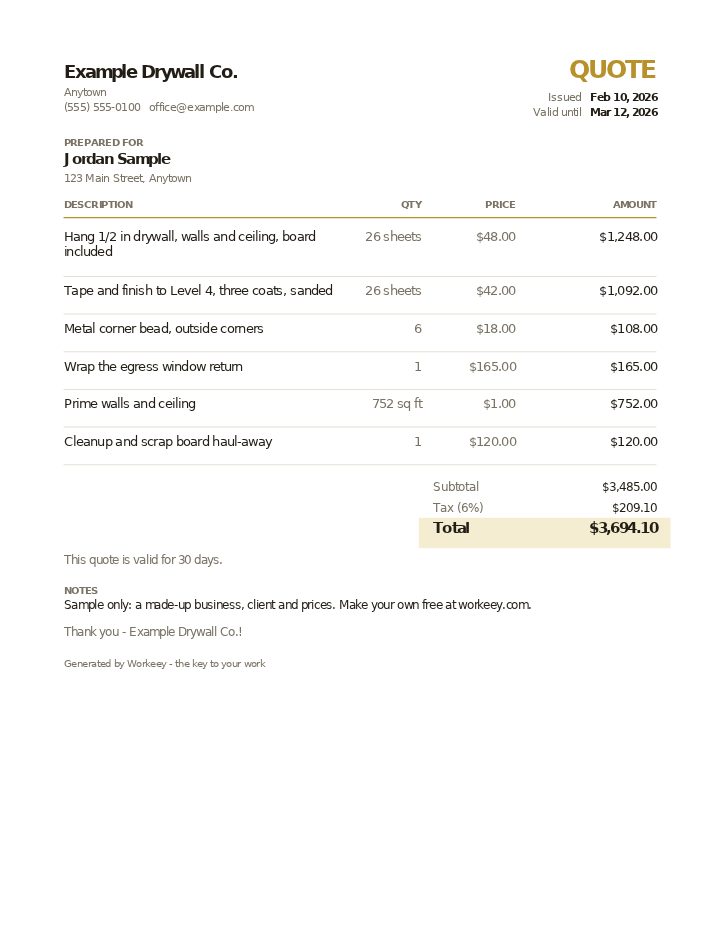
Here is the template filled in for a new basement family room, 12 by 20 feet with an 8-foot ceiling, framed and insulated by others and ready for board. It covers hanging and finishing to Level 4, six outside corners, one egress window return, a coat of primer and cleanup. All the names and numbers are invented, and tax is charged on the whole subtotal to keep the sample simple; your state may tax only the materials.
| Qty | Price | Amount | |
|---|---|---|---|
| Hang 1/2 in drywall, walls and ceiling, board included | 26 sheets | $48.00 / sheet | $1,248.00 |
| Tape and finish to Level 4, three coats, sanded | 26 sheets | $42.00 / sheet | $1,092.00 |
| Metal corner bead, outside corners | 6 | $18.00 | $108.00 |
| Wrap the egress window return | 1 | $165.00 | $165.00 |
| Prime walls and ceiling | 752 sq ft | $1.00 / sq ft | $752.00 |
| Cleanup and scrap board haul-away | 1 | $120.00 | $120.00 |
| Subtotal | $3,485.00 | ||
| Sales tax 6% | $209.10 | ||
| Total | $3,694.10 |
The room is 12 by 20 feet with an 8-foot ceiling: 512 square feet of walls and 240 of ceiling, 752 in all. That is 23.5 sheets of 4-by-8 board, rounded up to 26 for cuts and waste. The $48 hang rate is about $18 of board, screws and adhesive at cost plus a markup, and about $30 of labor at two sheets an hour for two people. Finishing assumes three visits for drying. The quote is valid for 30 days.
How to price a drywall estimate
Measure the room, not the floor. Add up the wall area from the perimeter times the ceiling height, add the ceiling, divide by the sheet size, and round up for waste: around 10 percent on simple rooms and more where there are lots of angles and openings. Then price per sheet for hanging and per sheet or per square foot for finishing, built from your material cost and how many sheets you really hang and finish in a day. Small jobs need a minimum, because three trips for drying cost the same on a closet as on a room.
Finishing is where the time hides. Each coat has to dry, and a high level of finish or a texture adds visits. Price those visits honestly rather than squeezing them into the per-sheet rate. For patches and repairs, a per-patch price by size works better; our guide to how much to charge for drywall repair covers that side, and the estimate vs quote guide explains when your number is firm.
- Measure walls and ceiling, then round sheets up for waste
- Price hanging and finishing as separate lines
- Charge more for high ceilings, stairwells and heavy board
- Count the drying visits and price them in
- Set a minimum for small rooms and patch jobs
Estimate, quote, then invoice — in Workeey
In Workeey the drywall estimate sits inside the job, next to the room measurements and photos of the framing. Tell it what you're hanging and the AI builds an itemized estimate from your own rates: hourly, first hour or call-out, travel, evening and weekend rates, your materials markup and your deposit percent. Board, mud and bead are priced from the web at your markup, and any line you type yourself, like "hang and finish, per sheet", is remembered for next time. The free plan includes 23 quick estimates a month.
Share quote turns it into a quote PDF that's good for 30 days, with your deposit percent printed on it. Share it from your phone or save it, or tap Email to write to the customer from your own mail app. The customer says yes to you directly and doesn't sign anything in the app, and Workeey doesn't collect the deposit. When the primer is dry, one tap turns the estimate into the invoice, which is emailed with a pay link; the drywall invoice template shows what that bill looks like, and invoicing and pricing have the rest.
More for drywall pros: pages and free templates
- How much to charge for drywall repair — a guide to setting your prices
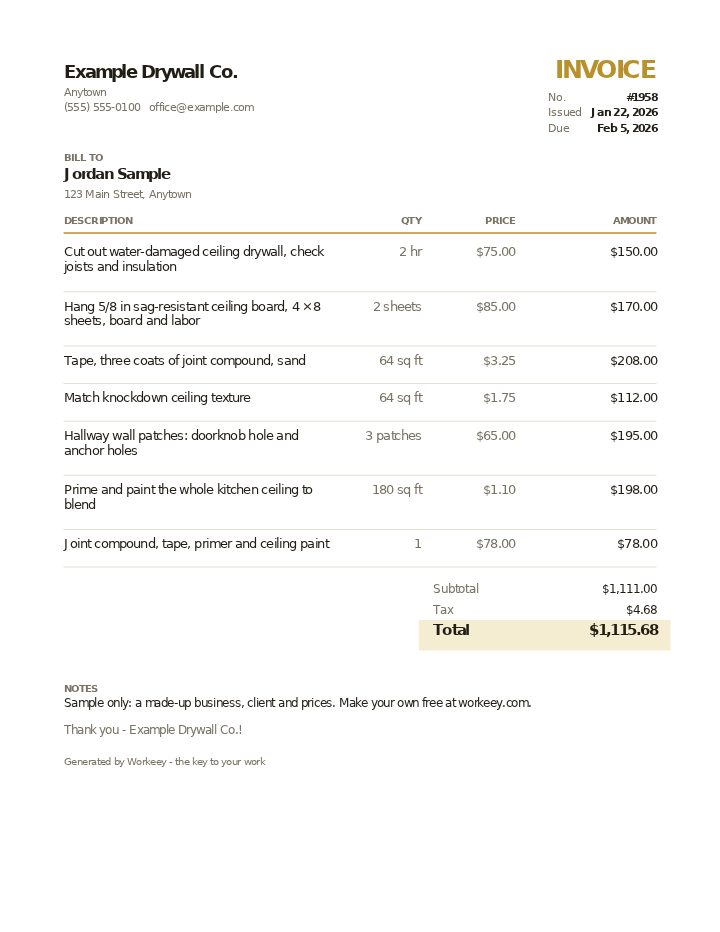
- Drywall invoice template — free, with a filled-in sample
- Free invoice template — every field a trade invoice needs
- Free estimate template — copy it, price it, send it
- Free receipt template — a paid-in-full receipt to copy
- Work order template — the job written down before you bill it
- Late payment reminder templates — texts, emails and a letter to copy and send
- All free templates and tools
How do you estimate a drywall job?
Measure the wall and ceiling area, work out the number of sheets and round up for waste, then price hanging per sheet and finishing per sheet or square foot. Add corner bead, returns, primer, cleanup and the number of visits, then tax and the total.
How many sheets of drywall do I need for a room?
Add the wall area (perimeter times ceiling height) and the ceiling area, then divide by 32 for 4-by-8 sheets or 48 for 4-by-12. Round up and add about 10 percent for cuts and waste.
What level of drywall finish should I quote?
Level 4 suits most painted walls and ceilings. Quote Level 5, a full skim coat, where glossy paint or strong side light will show the joints. Write the level on the estimate so the customer knows what they're paying for.
How long is a drywall estimate good for?
Thirty days is common, since board prices change. Put the valid-until date on the quote and re-price if the customer comes back after it.