Workeey is built for your phone. Scan the code with your phone to get the Android app, or open workeey.com on your phone. The iPhone app and a desktop version are coming soon.
Get the Workeey app. Same account, same jobs.


Free drywall invoice template, with a water-damaged ceiling repair filled in
Drywall work disappears when it's done right. The customer looks up at a smooth ceiling and wonders why a two-sheet patch took three visits. Your invoice is where you show the cut-out, the coats, the texture and the paint that make the repair invisible. Copy the free drywall invoice template below, check it against the filled-in sample for a water-damaged kitchen ceiling, and send it after the final coat of paint.
Download this invoice template: Word, Excel or PDF
Free to download, with no sign-up and no email. Open the Word file to type over the brackets, or the Excel file to swap in your own lines — the totals follow. Prefer paper? Print the blank PDF and fill it in by pen.
- Word (.docx) — the blank invoice, ready to fill in
- Excel (.xlsx) — the sample lines with amounts, tax and the total that work themselves out
- PDF (.pdf) — the filled-in sample, drawn the way Workeey draws an invoice
- Flat-rate PDF (.pdf) — the same job with the hours as one flat price, the same total
- Blank PDF (.pdf) — print it and fill it in by pen
- Google Docs — your own copy of the Word file, in your Google Drive (Google asks you to sign in)
- Google Sheets — your own copy of the Excel file, in your Google Drive (Google asks you to sign in)
Fill in this invoice online
Change anything, pick a style, and download the PDF — free, no sign-up. What you type isn't sent to Workeey. The PDF is made in your browser.
Send it and get paid with Workeey
- Workeey emails the invoice with a pay link, and with Stripe connected the customer can pay by card, Apple Pay, Google Pay or US bank.
- Each invoice shows as draft, sent, paid or overdue.
- Switch on reminder texts for one that's late and they're sent on a schedule, up to eight, until it's paid.
- Invoicing is free on the free plan.
Already have an invoice? The free invoice checker reads one you paste and says what it is missing.
What goes on a drywall invoice
A drywall invoice should walk through the job in the order it happened. Removal comes first: how much damaged board came out and what you checked behind it. Then hanging, by the sheet with its thickness, and finishing, by the square foot with the number of coats. Texture matching is its own skill and its own line, because matching an old knockdown or orange peel finish can take as long as the patch. Paint goes last, with the area painted.
Say the level of finish if you work to one. Level 4 is the usual smooth wall for flat or eggshell paint, while Level 5 adds a skim coat for glossy paint or harsh light. Write the number of visits too, since the drying time between coats is what turns a small repair into three trips. Small patches, like a doorknob hole, are easiest to bill per patch, with a set price for each size.
- Business name, phone, email and license number if required
- Customer, billing address and the job address
- Invoice number, work dates, invoice date and due date
- Removal: area and what was checked behind the board
- Hanging by the sheet, with thickness and type
- Finishing by the square foot, coats and level of finish
- Texture match and paint as their own lines
- Patches by size and count, materials, tax and total (is labor taxed in your state?)
Copy this drywall invoice template
Copy the lines below into a document or onto your phone and fill in the brackets. If the damage came from a leak, write what caused it and that it was fixed before you closed the ceiling. That one line protects you if the stain comes back because the leak didn't stop.
For moisture-resistant or fire-rated board, put the type in the hanging line; it costs more, and the customer should see why.
- [Business name] · [license # if required] · [phone] · [email]
- Invoice #[1958] · Work dates: [dates] · Invoice date: [date] · Due: [date]
- Customer: [name] · [billing address] · Job: [address]
- Cause: [leak, impact, renovation] · Fixed by: [who, date]
- Remove damaged board — [hours or sq ft] × [rate] = [$]
- Hang — [sheets] × [thickness, type] × [rate] = [$]
- Tape and finish — [sq ft] × [rate], [coats], Level [4 or 5] = [$]
- Texture match — [type] — [sq ft] × [rate] = [$]
- Patches — [count] × [size] × [rate] = [$]
- Prime and paint — [sq ft] × [rate] = [$]
- Materials — [compound, tape, primer, paint] = [$]
- Subtotal [$] · Sales tax [rate]% on materials [$] · Total due [$]
- Visits: [count] · Terms: [due date] · Pay by [link or check]
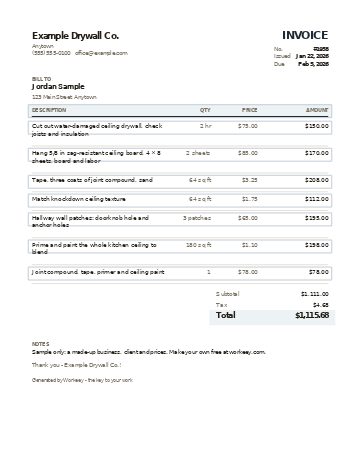
Sample drywall invoice, filled in
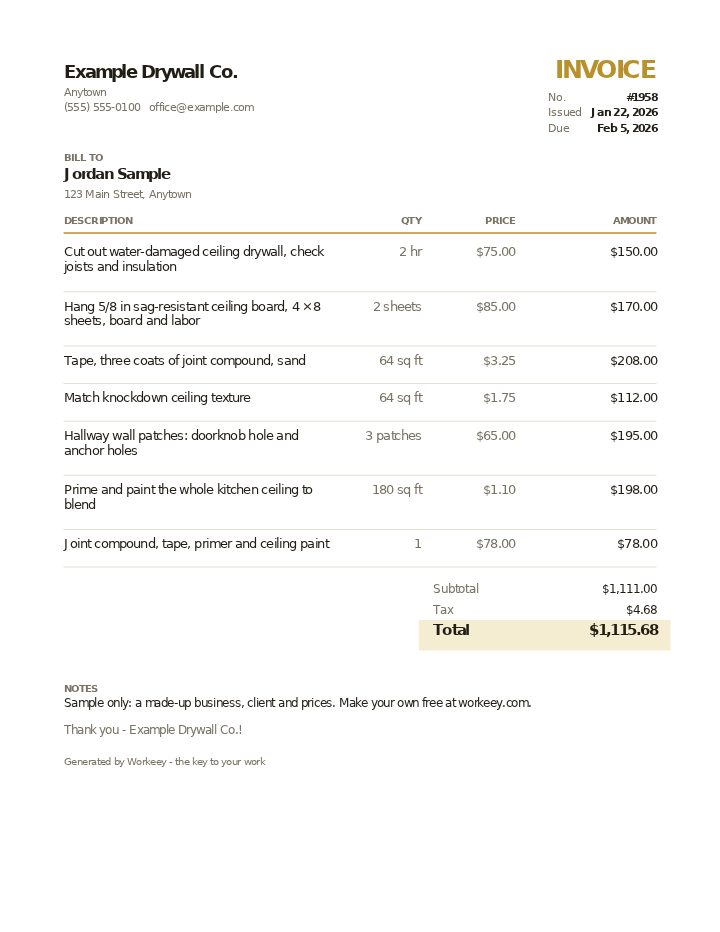
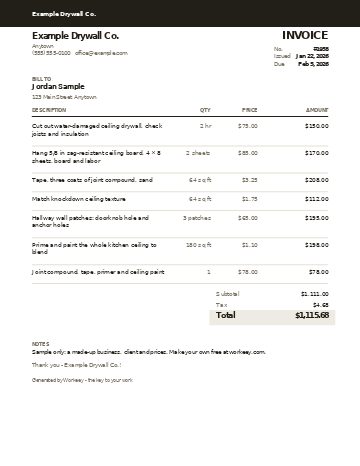
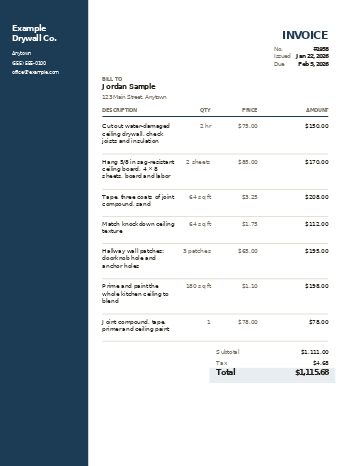
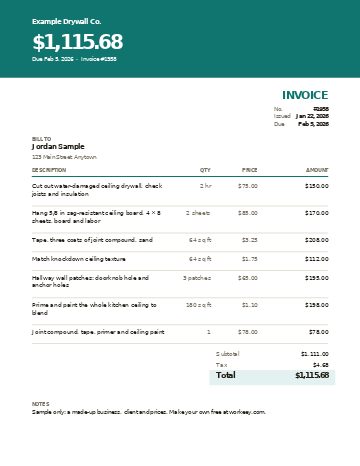
Here's the template filled in for a kitchen ceiling ruined by a leaking shower upstairs: wet board cut out, two new sheets hung, three coats of compound, the knockdown texture matched, the whole ceiling painted to blend, and three hallway wall patches done while there. The contractor, customer and prices are invented, and tax is on materials only here; your state may treat repair labor differently.
| Qty | Price | Amount | |
|---|---|---|---|
| Cut out water-damaged ceiling drywall, check joists and insulation | 2 hr | $75.00 / hr | $150.00 |
| Hang 5/8 in sag-resistant ceiling board, 4 × 8 sheets, board and labor | 2 sheets | $85.00 / sheet | $170.00 |
| Tape, three coats of joint compound, sand | 64 sq ft | $3.25 / sq ft | $208.00 |
| Match knockdown ceiling texture | 64 sq ft | $1.75 / sq ft | $112.00 |
| Hallway wall patches: doorknob hole and anchor holes | 3 patches | $65.00 / patch | $195.00 |
| Prime and paint the whole kitchen ceiling to blend | 180 sq ft | $1.10 / sq ft | $198.00 |
| Joint compound, tape, primer and ceiling paint | 1 | $78.00 | $78.00 |
| Subtotal | $1,111.00 | ||
| Sales tax 6% on materials ($78.00) | $4.68 | ||
| Total due | $1,115.68 |
The leak above the kitchen was repaired by the client's plumber before work started. The job took three visits, a day apart, so each coat of compound could dry. The whole ceiling was painted, not just the patch, so the repair doesn't show as a different shade. The board is included in the per-sheet price; supplies are billed at cost plus 20 percent, $65.00 of them coming to $78.00. Payment terms on this sample: due in 14 days, paid by card or bank from the pay link in the invoice email, or by check to Example Drywall Co.
How to invoice drywall work
Small drywall jobs lose money when they're priced like big ones. A doorknob hole takes a few minutes of work, but three trips for drying, so many finishers set a minimum per patch or per visit and say so up front. For larger work, price hanging by the sheet and finishing by the square foot, and keep those units on the invoice. Our guide to how much to charge for drywall repair walks through typical prices, and the drywall estimate template uses the same lines.
When insurance is paying for water damage, invoice the homeowner, include the claim number, and keep your lines close to the adjuster's: removal, hanging, finishing, texture and paint. Photos of the wet board and the open ceiling help the claim. If the homeowner paid a deposit before you started, write "Deposit of $[…] received [date]" in the invoice notes and put only the remaining work on the lines, so the total is the balance due.
- Bill hanging by the sheet and finishing by the square foot
- Price texture matching as its own line
- Set a minimum for small patches that need several visits
- Write the cause of the damage and that it was fixed
- Put the claim number on any insurance job
Or do it free in Workeey
In Workeey the drywall job keeps the address, your photos of the damage and a note for every visit. After the last coat of paint, one tap turns the job or its estimate into an invoice, with the customer, address and lines carried over, tax added and the number filled in. Working in a basement with no signal, the invoice you make is saved on the phone, ready to email when you're back in signal.
Workeey emails the invoice with a pay link, and with Stripe connected the customer can pay by card, Apple Pay, Google Pay or US bank; a small processing fee applies to online payments. Each invoice shows as draft, sent, paid or overdue. Switch on reminder texts for one that's late and they're sent on a schedule, up to eight, until it's paid. Invoicing is free on the free plan, and pricing shows the rest.
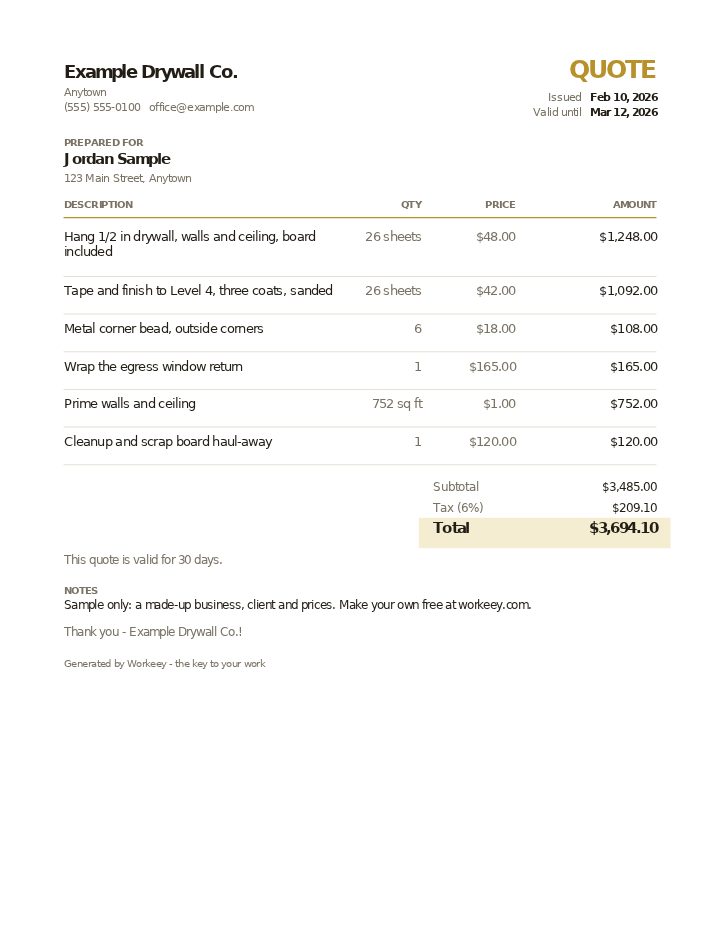
More for drywall pros: pages and free templates
- How much to charge for drywall repair — a guide to setting your prices
- Drywall estimate template — a free quote sample
- Free invoice template — every field a trade invoice needs
- Free estimate template — copy it, price it, send it
- Free receipt template — a paid-in-full receipt to copy
- Work order template — the job written down before you bill it
- Late payment reminder templates — texts, emails and a letter to copy and send
- All free templates and tools
How do drywall contractors charge?
For new work, usually by the sheet hung and the square foot finished, or by the square foot for both. Repairs are often priced per patch by size, with a minimum charge, because each one needs several visits to dry between coats.
What should a drywall repair invoice include?
Your business details, the customer and job address, the work dates, what caused the damage, removal, sheets hung, finishing with coats and level, texture matching, painting, materials, tax, the total and the number of visits.
Why does a small drywall patch need several visits?
Joint compound has to dry between coats, often overnight, and most repairs need two or three coats plus sanding, texture and paint. That's why small repairs often carry a minimum charge.
Do I invoice the insurance company or the homeowner for water damage drywall?
Usually the homeowner, who is the customer, with the claim number on the invoice. Keep your line items close to the adjuster's estimate and include photos of the damage.