Workeey is built for your phone. Scan the code with your phone to get the Android app, or open workeey.com on your phone. The iPhone app and a desktop version are coming soon.
Get the Workeey app. Same account, same jobs.


Free fence estimate template, with a privacy fence priced by the foot
Every fence quote comes down to linear feet, but the client also wants to know what is in each foot: how far apart the posts are, how deep they're set, which wood, and whether the gate will still swing true in ten years. Copy the free fence estimate template below, compare it to the wood privacy fence sample, and send it while the client is still standing at the property line. Or let Workeey itemize it from your rates.
Download this estimate template: Word, Excel or PDF
Free to download, with no sign-up and no email. Open the Word file to type over the brackets, or the Excel file to swap in your own lines — the totals follow. Prefer paper? Print the blank PDF and fill it in by pen.
- Word (.docx) — the blank estimate, ready to fill in
- Excel (.xlsx) — the sample lines with amounts, tax and the total that work themselves out
- PDF (.pdf) — the filled-in sample, drawn the way Workeey draws a quote
- Blank PDF (.pdf) — print it and fill it in by pen
- Google Docs — your own copy of the Word file, in your Google Drive (Google asks you to sign in)
- Google Sheets — your own copy of the Excel file, in your Google Drive (Google asks you to sign in)
Fill in this estimate online
Change anything and download the PDF — free, no sign-up. What you type isn't sent to Workeey. The PDF is made in your browser.
Quote it, then invoice it, in Workeey
- Share quote turns it into a quote PDF good for 30 days, with the deposit percent printed so the client knows what you'll ask for before you order lumber.
- When the last post cap is on, one tap turns the estimate into the invoice, emailed with a pay link.
- The free plan includes 23 quick estimates a month.
What goes on a fence estimate
Fence jobs touch the property line, the neighbors and the town, so the estimate has to be specific. After your business name, phone, email and license number if your state requires one, list the client and address and describe the run: total linear feet, the height, the style and the material. Number it, date it and set an expiry date.
Then cover what clients forget to ask about: how far apart the posts are, how deep they're set and in what, the number and width of gates and their hardware, and whether the old fence comes out. Say who is responsible for finding the property line, that you'll call 811 before digging, who pulls the permit, and what happens if you hit rock or roots where a post has to go. If an HOA has to approve the fence, the estimate should say that is the homeowner's job.
- Business details and license number if your state requires it
- Total linear feet, height, style and material
- Post spacing, post depth and how posts are set
- Each gate with its width and hardware
- Old fence removal and disposal as its own line
- Property line, 811 locate, permit, HOA approval and rock clauses
Copy this fence estimate template
Paste the template into a document or your phone's notes and fill in the brackets. Split the price into the fence per foot, the posts, the gates and the extras, so a client who wants to shorten the run or drop a gate can see exactly what changes.
Sketch the run with its measurements on the paper copy, marking where it starts, where it turns and where the gate goes, so you and the client agree on the layout before a single hole is dug. The skeleton:
- [Your business name] · [license # if required] · [phone] · [email]
- Estimate #[…] · Date: […] · Valid until: [date, e.g. 30 days]
- Prepared for: [client name] · [address]
- Fence: [height] [style] in [material] · Run: [linear feet] · Posts every [ft], set [depth] in [concrete or gravel]
- Fence sections — [linear ft] × [rate per ft] = [$]
- Posts — [count] × [rate] = [$]
- Gate — [width], [hardware] — [count] × [rate] = [$]
- Remove old fence — [linear ft] × [rate] = [$]
- Permit — [$] (at cost) · 811 locate: [date called]
- Not included: [survey, HOA approval, rock beyond (x) posts]
- Subtotal [$] · Sales tax [rate]% [$] · Total [$]
- Deposit to start: [%] · Install: [days, weather permitting]
- Accepted by: [name] · [date]
Sample fence estimate (quote), filled in
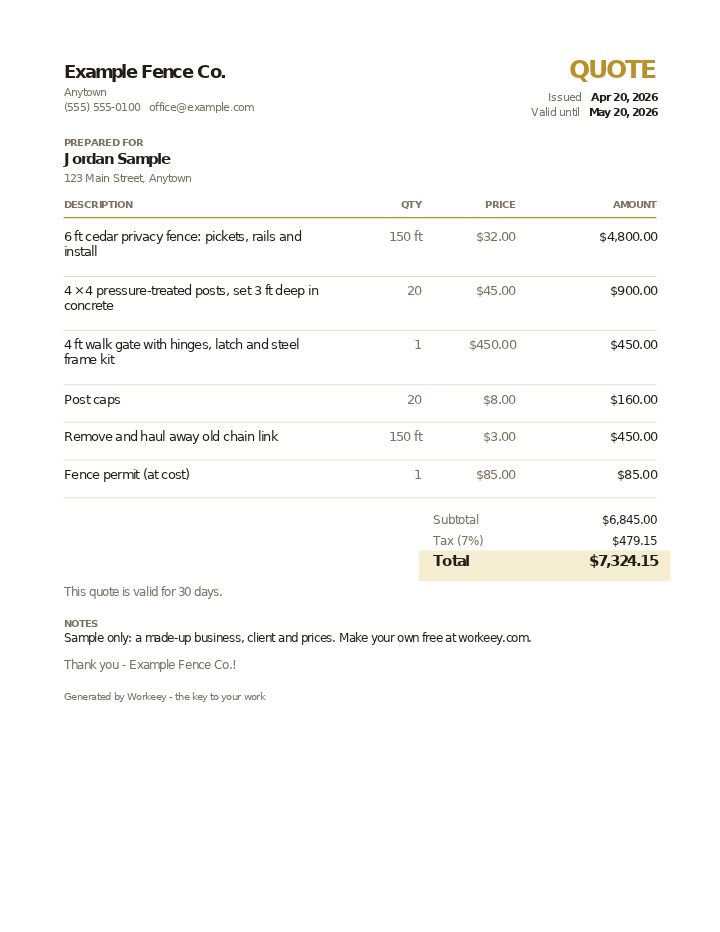
This is the template filled in for 150 feet of 6-foot cedar privacy fence along the back and one side of a yard, with one walk gate, replacing an old chain link fence. The business, the client and the numbers are made up, and the tax is charged on the whole subtotal for simplicity, so check your own state's rule.
| Qty | Price | Amount | |
|---|---|---|---|
| 6 ft cedar privacy fence: pickets, rails and install | 150 ft | $32.00 / ft | $4,800.00 |
| 4 × 4 pressure-treated posts, set 3 ft deep in concrete | 20 | $45.00 | $900.00 |
| 4 ft walk gate with hinges, latch and steel frame kit | 1 | $450.00 | $450.00 |
| Post caps | 20 | $8.00 | $160.00 |
| Remove and haul away old chain link | 150 ft | $3.00 / ft | $450.00 |
| Fence permit (at cost) | 1 | $85.00 | $85.00 |
| Subtotal | $6,845.00 | ||
| Sales tax 7% | $479.15 | ||
| Total | $7,324.15 |
Posts are on 8-foot centers, so the 150-foot run takes 20 posts. The $32 a foot is about $14 of cedar and fasteners at cost, marked up 25%, plus about $14.50 a foot of install time. The gate is priced as one unit because hanging and adjusting it takes as long as a full section. The permit is billed at what the town charged. The quote is valid for 30 days, because lumber prices move.
How to price a fence estimate
Walk the line with a measuring wheel and count the posts from the spacing you'll actually use, instead of dividing by guesswork. Corners, ends and gate posts take extra work and often heavier posts, and a run that steps down a slope takes longer than the same length on flat ground. Build the per-foot rate from materials at your markup plus your install time per foot, and keep posts and gates as separate lines so the math stays visible.
Ground conditions decide whether you make money. Probe the soil along the line if you can, and write a rock or root clause into the estimate with a price per extra post, so hitting a boulder doesn't come out of your pocket. Lumber prices swing, which is why a short expiry matters on fence quotes. Our estimate vs quote guide explains when to call yours firm.
- Measure with a wheel and count posts from the real post spacing
- Price corners, ends and gate posts above line posts
- Add time for slopes, stepping or racking the panels
- Write a per-post charge for rock, roots or old concrete you hit
- Keep the expiry short, since lumber prices move month to month
Estimate, quote, then invoice — in Workeey
Workeey keeps the fence estimate inside the job, with the address, the measured run and your notes about the slope and the neighbor's shed. Describe the fence and the AI itemizes an estimate from your own rates: hourly, first hour or call-out, travel, evening and weekend rates, your markup and your deposit percent. Posts, pickets, concrete and hardware are priced from the web at your markup, and lines you add yourself, like "cedar privacy, per foot", are remembered for the next fence. The free plan includes 23 quick estimates a month.
Share quote turns it into a quote PDF good for 30 days, with the deposit percent printed so the client knows what you'll ask for before you order lumber; send it from your phone, or tap Email to open your own mail app. The client says yes to you and signs nothing in the app, and Workeey doesn't take the deposit. When the last post cap is on, one tap turns the estimate into the invoice, emailed with a pay link. The free invoice template, invoicing and pricing pages have the rest.
More for fence builders: pages and free templates
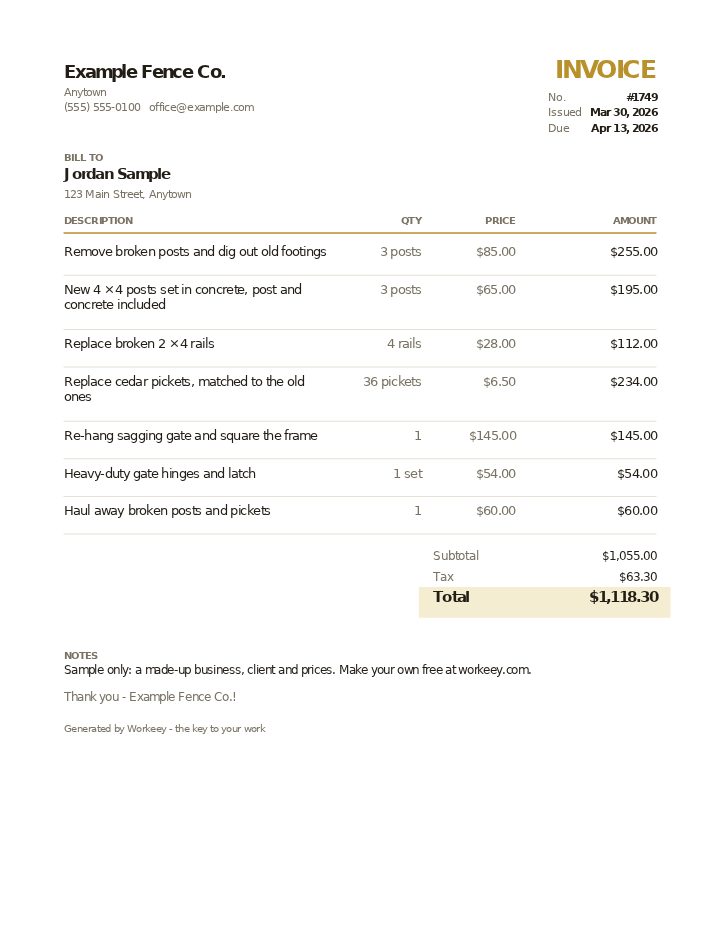
- Fence invoice template — free, with a filled-in sample
- Free invoice template — every field a trade invoice needs
- Free estimate template — copy it, price it, send it
- Free receipt template — a paid-in-full receipt to copy
- Work order template — the job written down before you bill it
- Late payment reminder templates — texts, emails and a letter to copy and send
- All free templates and tools
How do you estimate a fence job?
Measure the run, choose the post spacing, and count posts, gates and corners. Price the fence per linear foot from materials plus install time, then add posts, gates, old fence removal and the permit as their own lines. Add a rock clause and a short expiry, and the quote is ready.
How far apart should fence posts be on an estimate?
Wood privacy fences usually have posts on 6- to 8-foot centers, closer in windy areas or for heavy panels. Write the spacing on the estimate; it sets the post count, and it shows the client you aren't stretching sections to save on posts.
Who is responsible for the property line on a fence quote?
Usually the homeowner. Most fence estimates say the client is responsible for showing where the line is, by survey or markers, and that you install where they direct. Write that down, along with who gets HOA approval if it's needed.
Is a fence quote binding?
Once the client accepts it, a quote is normally treated as the agreed price for the fence it describes. Changes to the run, a new gate, or rock beyond what the quote allows for should be priced and agreed before you do the work.