Workeey is built for your phone. Scan the code with your phone to get the Android app, or open workeey.com on your phone. The iPhone app and a desktop version are coming soon.
Get the Workeey app. Same account, same jobs.


Free junk removal estimate template, with a garage cleanout and shed tear-down
Every junk removal customer asks the same thing: how much to make all of this go away? A written quote that says how much of the truck you expect to fill, what the heavy work costs and which items carry fees answers it, and leaves room for the pile to be bigger or smaller than it looked. Copy the free junk removal estimate template below, check it against the filled-in quote for a garage and an old shed, and send it from the driveway.
Download this estimate template: Word, Excel or PDF
Free to download, with no sign-up and no email. Open the Word file to type over the brackets, or the Excel file to swap in your own lines — the totals follow. Prefer paper? Print the blank PDF and fill it in by pen.
- Word (.docx) — the blank estimate, ready to fill in
- Excel (.xlsx) — the sample lines with amounts, tax and the total that work themselves out
- PDF (.pdf) — the filled-in sample, drawn the way Workeey draws a quote
- Blank PDF (.pdf) — print it and fill it in by pen
- Google Docs — your own copy of the Word file, in your Google Drive (Google asks you to sign in)
- Google Sheets — your own copy of the Excel file, in your Google Drive (Google asks you to sign in)
Fill in this estimate online
Change anything and download the PDF — free, no sign-up. What you type isn't sent to Workeey. The PDF is made in your browser.
Quote it, then invoice it, in Workeey
- Tap Share quote and it becomes a quote PDF, good for 30 days, with the deposit percent printed.
- When the truck pulls away, one tap turns the estimate into the invoice, emailed with a pay link.
- The free plan includes 23 quick estimates a month.
What goes on a junk removal estimate
A junk removal estimate needs your business details, the customer, the pickup address, an estimate number, a date and a valid-until date. Then describe what's going: rooms or areas and the kinds of things in them, like "garage: furniture, boxes, a workbench, bikes". Give the expected volume as a share of your truck and say how big a full load is, because "about a load and a half" means nothing until the customer knows your truck holds around 15 cubic yards.
Price heavy and special work separately. Demolition of a shed, deck or hot tub is labor plus the debris it makes. Appliances with refrigerant, mattresses, tires and electronics carry disposal fees. Say clearly what you won't take, usually paint, chemicals, fuel and asbestos, and how the final price works if the pile turns out smaller or larger than it looked. That rule, in writing, is what keeps a volume quote fair to both of you.
- Business details and any hauling license
- Pickup address, and the areas to clear
- What's going, in plain words
- Expected volume and the size of a full load
- Demolition or heavy carries as their own lines
- Disposal fees for appliances, mattresses, tires, electronics
- What you won't take
- How the final price follows the space used
Copy this junk removal estimate template
Paste the lines below into a document or a note on your phone and fill in the brackets. The volume line works best with photos: take a few on the walk-through and keep them with the quote, so if the customer adds a basement's worth of boxes before pickup day, you both know what was quoted.
Keep the pricing rule line even for small jobs. One sentence saying the bill follows the space used heads off the argument at the truck.
- [Your business name] · [license # if required] · [phone] · [email]
- Estimate #[…] · Date: […] · Valid until: [date, e.g. 30 days]
- Prepared for: [customer] · Pickup: [address]
- Clearing: [areas] · Items: [furniture, boxes, yard waste, …]
- Truck space — [expected loads or fraction] × [price per full load] = [$]
- Full load = [cubic yards] · Final price follows the space used
- Demolition — [shed, deck, hot tub] = [$]
- Debris haul — [loads] × [rate] = [$]
- Disposal fees — [appliances, mattresses, tires, electronics] × [fee] = [$]
- Not taken: [paint, chemicals, fuel, asbestos]
- Subtotal [$] · Sales tax [rate]% [$] · Total [$]
- Deposit to start: [% for demolition jobs] · Pickup date: [date]
- Accepted by: [name] · [date]
Sample junk removal estimate (quote), filled in
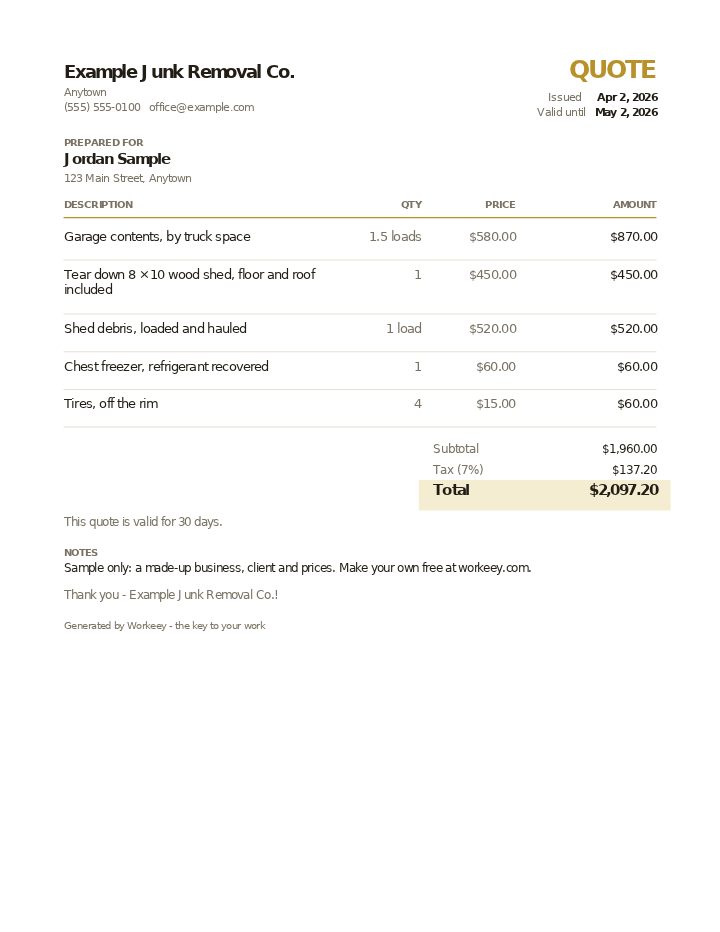
This is the template filled in for a two-part job: clearing a packed two-car garage of old furniture, boxes and a broken mower, and tearing down a rotting 8-by-10-foot wood shed in the back yard and hauling it away, along with a dead chest freezer and four old tires. The company, the customer and the prices are made up, and the sample taxes the whole subtotal for simplicity; check whether your state taxes hauling at all.
| Qty | Price | Amount | |
|---|---|---|---|
| Garage contents, by truck space | 1.5 loads | $580.00 / full load | $870.00 |
| Tear down 8 × 10 wood shed, floor and roof included | 1 | $450.00 | $450.00 |
| Shed debris, loaded and hauled | 1 load | $520.00 / full load | $520.00 |
| Chest freezer, refrigerant recovered | 1 | $60.00 | $60.00 |
| Tires, off the rim | 4 | $15.00 | $60.00 |
| Subtotal | $1,960.00 | ||
| Sales tax 7% | $137.20 | ||
| Total | $2,097.20 |
A full load is about 15 cubic yards. The garage looked like a load and a half on the walk-through; the final bill follows the space actually used, at the same rate, so less junk means a lower price. Shed debris is priced lower per load because it goes straight from the tear-down into the truck, with no carrying through the house. The demolition price covers two workers for about four hours. Paint cans and chemicals in the garage are not included. The quote is valid for 30 days.
How to price a junk removal estimate
Know your costs per load before you quote. Each full truck costs you a dump or transfer fee, fuel, the time of the people loading it and the wear on the truck. Add those up, add your profit, and that's your full-load price; fractions of a load are priced from it, with a minimum for small pickups. The hourly rate calculator helps put a number on the labor part.
Look at density, not only size. A load of loose furniture weighs far less than a load of shingles, concrete or wet yard waste, and many transfer stations charge by the ton, so heavy debris needs a higher per-load price or a weight limit written into the quote. Demolition is labor first: estimate the hours to take the structure apart, then add the debris as loads. See our estimate vs quote guide for when to call a volume price an estimate and when a fixed quote.
- Build your full-load price from dump fees, fuel and labor
- Set a minimum charge for small pickups
- Price heavy debris higher or set a weight limit
- Quote demolition as hours plus the debris it makes
- List disposal fees item by item
Estimate, quote, then invoice — in Workeey
Workeey keeps the junk removal estimate inside the job, with the address and your walk-through photos. Describe the cleanout and the AI drafts an itemized estimate from the rates you set: hourly, first hour or call-out, travel, evening and weekend work, markup and deposit percent. Things you buy for a job are priced from the web at your markup, and your own lines, like "full truck load" or "mattress fee", are remembered for the next quote. The free plan includes 23 quick estimates a month.
Tap Share quote and it becomes a quote PDF, good for 30 days, with the deposit percent printed. Send it from your phone, save it, or tap Email to open your own mail app with it ready. The customer tells you yes; nothing is signed in the app, and Workeey doesn't collect the deposit. When the truck pulls away, one tap turns the estimate into the invoice, emailed with a pay link. The junk removal invoice template shows the bill, and there's more on what Workeey does for junk removal.
More for junk haulers: pages and free templates
- Junk removal software — photo quotes by the load, dump fees as a line
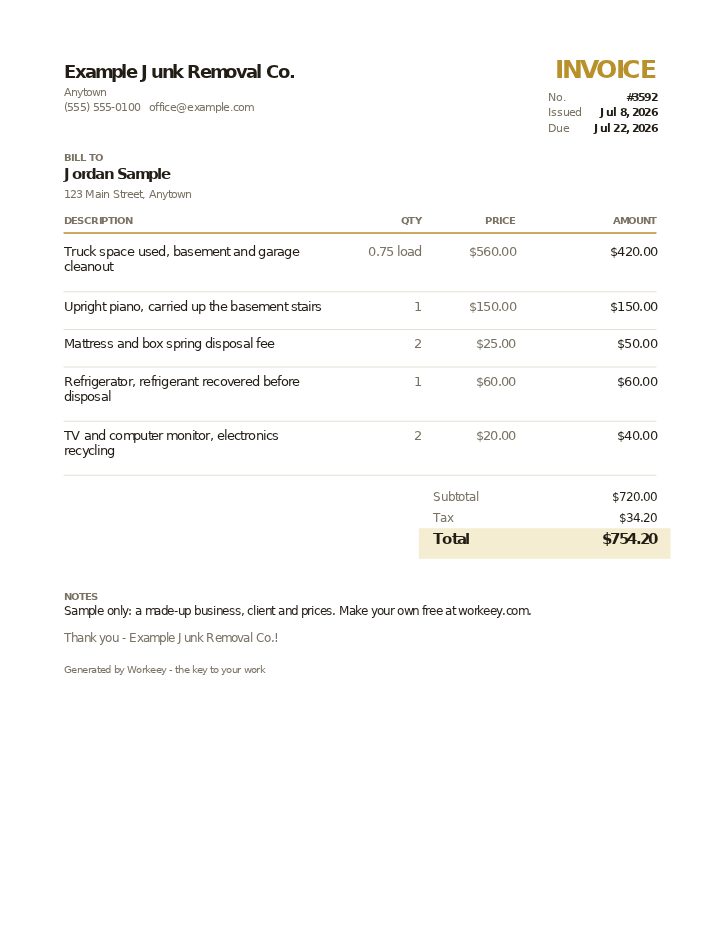
- Junk removal invoice template — free, with a filled-in sample
- Free invoice template — every field a trade invoice needs
- Free estimate template — copy it, price it, send it
- Free receipt template — a paid-in-full receipt to copy
- Work order template — the job written down before you bill it
- Late payment reminder templates — texts, emails and a letter to copy and send
- All free templates and tools
How do you estimate a junk removal job?
Look at everything that's going, judge how much of your truck it will fill, and price it from your full-load rate. Add demolition, heavy carries and disposal fees for items like appliances and mattresses, then say that the final price follows the space actually used.
Can I give a junk removal quote from photos?
Yes, many haulers quote from photos or a video call, as a range or an estimate. Say that the final price is confirmed when you see it, and follow the space actually used when you load.
What if the junk takes less space than I quoted?
Bill the space actually used, at the rate on the quote. Charging less than the quote when the pile was smaller is fair, and customers remember it.
Is a junk removal quote binding?
A quote the customer accepts is normally the agreed price for what it describes. Write how the price changes with volume, and price anything added on pickup day before you load it.