Workeey is built for your phone. Scan the code with your phone to get the Android app, or open workeey.com on your phone. The iPhone app and a desktop version are coming soon.
Get the Workeey app. Same account, same jobs.


Free plumbing estimate template, with a bathroom rough-in quote filled in
Most plumbing work is priced before anyone sees what is under the slab or behind the wall, so the estimate has to say what you are counting on and what happens if you are wrong. Copy the free plumbing estimate template below, compare it with the basement bathroom rough-in sample, and send the number while the homeowner is still comparing plumbers. When the work is done, the plumbing invoice template picks up where this leaves off.
Download this estimate template: Word, Excel or PDF
Free to download, with no sign-up and no email. Open the Word file to type over the brackets, or the Excel file to swap in your own lines — the totals follow. Prefer paper? Print the blank PDF and fill it in by pen.
- Word (.docx) — the blank estimate, ready to fill in
- Excel (.xlsx) — the sample lines with amounts, tax and the total that work themselves out
- PDF (.pdf) — the filled-in sample, drawn the way Workeey draws a quote
- Blank PDF (.pdf) — print it and fill it in by pen
- Google Docs — your own copy of the Word file, in your Google Drive (Google asks you to sign in)
- Google Sheets — your own copy of the Excel file, in your Google Drive (Google asks you to sign in)
Fill in this estimate online
Change anything and download the PDF — free, no sign-up. What you type isn't sent to Workeey. The PDF is made in your browser.
Quote it, then invoice it, in Workeey
- Tap Share quote and the estimate becomes a quote PDF, good for 30 days, that you share from your phone.
- They tell you yes, you do the work, and one tap turns the estimate into the invoice, which Workeey emails with a pay link.
- The free plan includes 23 quick estimates a month.
What goes on a plumbing estimate
A homeowner reading a plumbing quote wants two answers: what will be different when you leave, and what could make the price go up. Start with your business name, phone, email and plumbing license number, then the client and the address of the job. Give the estimate a number and a date, and say how long the price holds, because copper, PEX and fixtures change price from month to month.
Then describe the work by system, the way you would explain it standing in the basement: drains and vents, water supply, gas if there is any, and the fixtures. Separate your labor from parts, and put the permit and the inspection on their own lines. The most useful line on a plumbing estimate is the assumption, for example that the existing main drain is cast iron in good shape. If it turns out to be cracked, everyone already knows that is extra.
- Business name, phone, email and plumbing license number
- Client name and the job address
- Estimate number, date and a valid-until date
- Scope by system: drain, waste and vent, water supply, gas, fixtures
- Labor as hours × rate, parts and materials at your price
- Permit and inspection on their own lines
- Assumptions and exclusions, such as no tile work or wall finishing
- Deposit to start, if you take one, and how the client says yes
Copy this plumbing estimate template
Here is the template as plain text. Paste it into a notes app or a document, replace each bracket, and delete the lines the job does not need. A faucet swap needs three lines; a remodel rough-in needs all of them.
Write the scope so a homeowner can picture it, "new drain and vent for a toilet, sink and shower in the basement", not a code reference. Keep the exclusions line even when it feels obvious. The skeleton:
- [Your business name] · License #[number] · [phone] · [email]
- Estimate #[1001] · Date: [date] · Valid until: [date, e.g. 30 days]
- Prepared for: [client name] · Job address: [address]
- Scope: [what you will install or repair, by system]
- Assumes: [e.g. existing main drain is usable] · Not included: [e.g. tile, drywall, finish fixtures]
- Labor — [task] — [hours] × [rate] = [$]
- [Pipe and fittings] — [lot or feet] × [your price] = [$]
- [Valve or fixture] — [qty] × [your price] = [$]
- Permit — [$] · Inspection visit — [$]
- Subtotal [$] · Sales tax [rate]% [$] · Estimated total [$]
- Deposit to start: [%] · Earliest start: [date]
- Accepted by: [name] · [date]
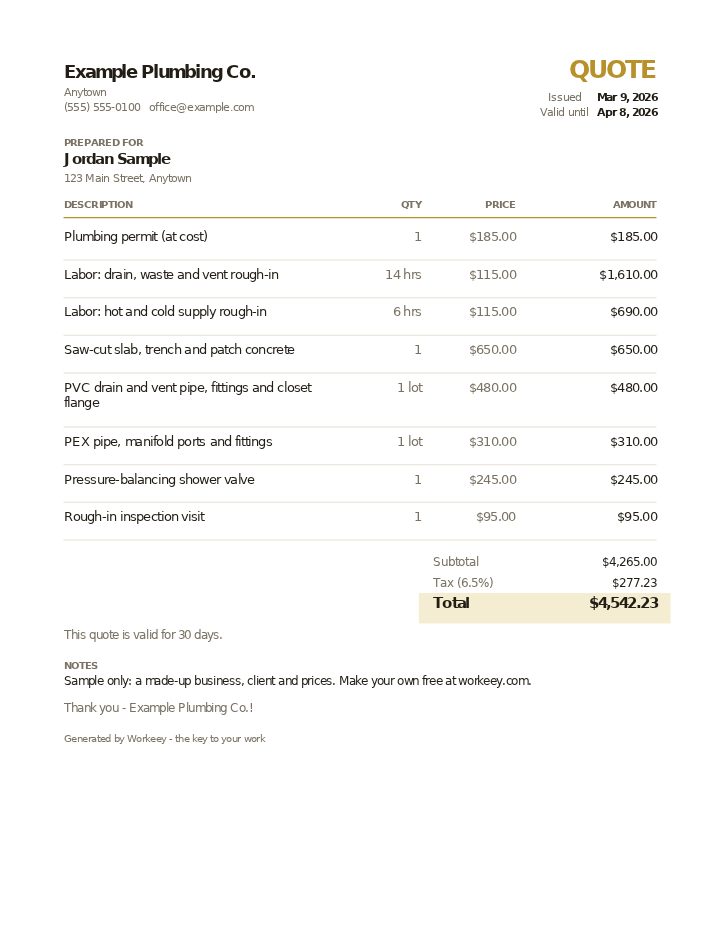
Sample plumbing estimate (quote), filled in
This is the template used on a basement bathroom rough-in: drain, waste and vent lines for a toilet, a vanity and a shower, cut into the slab and tied to the existing stack, plus PEX supply lines and the shower valve. Finish fixtures are left to the client. The business, client and prices are invented. For simplicity this sample taxes the whole subtotal; many states tax only the parts, so check your own rule.
| Qty | Price | Amount | |
|---|---|---|---|
| Plumbing permit (at cost) | 1 | $185.00 | $185.00 |
| Labor: drain, waste and vent rough-in | 14 hrs | $115.00 / hr | $1,610.00 |
| Labor: hot and cold supply rough-in | 6 hrs | $115.00 / hr | $690.00 |
| Saw-cut slab, trench and patch concrete | 1 | $650.00 | $650.00 |
| PVC drain and vent pipe, fittings and closet flange | 1 lot | $480.00 | $480.00 |
| PEX pipe, manifold ports and fittings | 1 lot | $310.00 | $310.00 |
| Pressure-balancing shower valve | 1 | $245.00 | $245.00 |
| Rough-in inspection visit | 1 | $95.00 | $95.00 |
| Subtotal | $4,265.00 | ||
| Sales tax 6.5% | $277.23 | ||
| Total | $4,542.23 |
Labor is 20 hours at $115 an hour: 14 for drains and vents, 6 for supply. Parts carry a 25% markup: the PVC lot cost $384 and is quoted at $480, the shower valve cost $196 and is quoted at $245. The permit is passed through at exactly what the town charges. The slab cut is a flat price because it depends on the saw, not the clock. This quote is valid for 30 days.
How to price a plumbing estimate
Plumbing labor is where estimates go wrong, because the hours hide in places you only find with the floor open. Count the fixtures and the fittings, then think about the access: a crawl space with two feet of clearance takes longer than an open basement, and a slab cut takes longer than either. Price parts from today's supply house numbers, not last year's, and add the markup you can defend when a client asks.
When you cannot see the condition of what you are tying into, quote what you can see and name the rest as an assumption with a price attached if it goes wrong. "If the cast iron stack needs replacing at the tie-in, add $450" reads as honest. A vague "price may change" reads as a trap. Our estimate vs quote guide explains when to call it which.
- Count fixtures and fittings before you count hours
- Add time for access: crawl spaces, slab cuts, finished ceilings
- Price parts from current supplier prices, then add your markup
- Write the riskiest assumption down with a price for the bad case
- Keep the permit and inspection visible so the total is easy to trust
Estimate, quote, then invoice — in Workeey
In Workeey the estimate lives inside the job, next to the client and the address. You set your own rates once: hourly, first hour, call-out, travel, evenings and weekends, your parts markup and your deposit percent. The AI itemizes the estimate from those rates, prices parts like a shower valve from the web at your markup, and remembers the lines you add yourself, like a slab cut, for the next job. The free plan includes 23 quick estimates a month.
Tap Share quote and the estimate becomes a quote PDF, good for 30 days, that you share from your phone; its Email button opens your own mail app. Your deposit percent prints on the quote, but Workeey does not collect deposits, so take it the way you already do. The client doesn't sign anything in the app. They tell you yes, you do the work, and one tap turns the estimate into the invoice, which Workeey emails with a pay link. See Workeey for plumbers, invoicing for plumbers and pricing.
More for plumbers: pages and free templates
- Plumbing software — the whole plumbing business in one app
- Plumbing invoicing — how to bill a plumbing job, step by step
- How to start a plumbing business — a step-by-step guide to going out on your own
- Best apps for plumbers — the apps for this trade compared
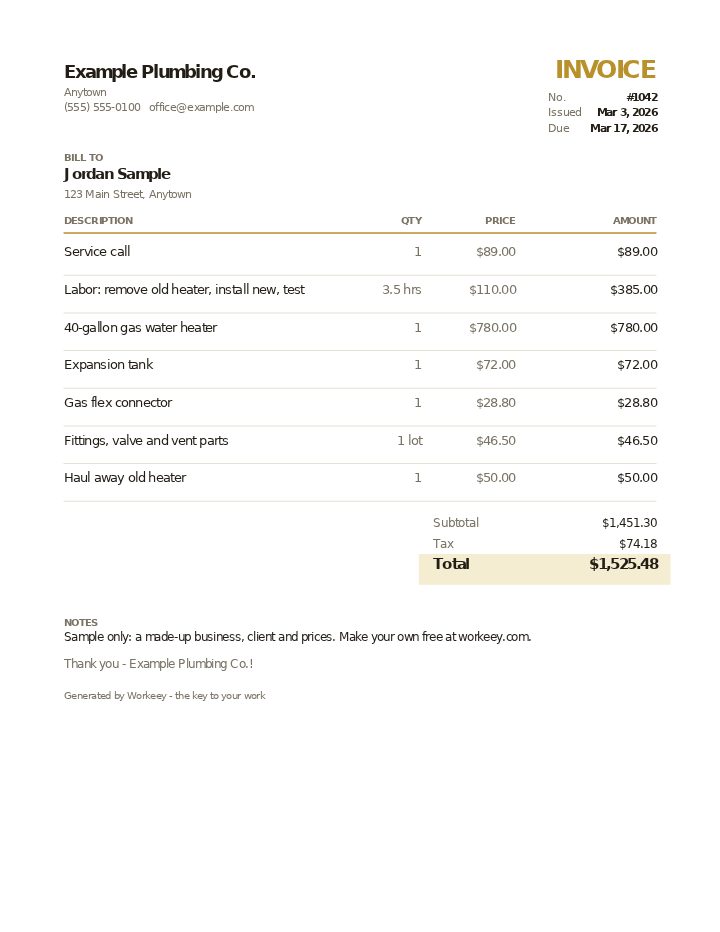
- Plumbing invoice template — free, with a filled-in sample
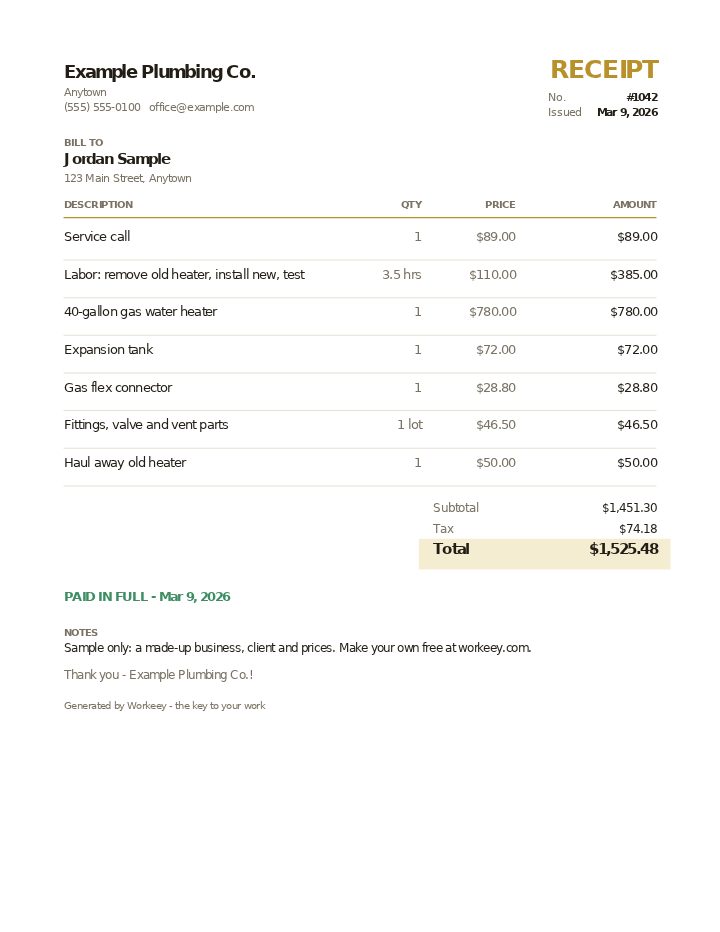
- Plumbing receipt template — a free paid-in-full sample
- Plumbing price book template — free, with sample prices
- Plumbing work order template — free, with a filled-in sample
- Plumber wages by state — what employed plumbers earn in every state, from BLS data
- Free invoice template — every field a trade invoice needs
- Free estimate template — copy it, price it, send it
- Free receipt template — a paid-in-full receipt to copy
- Work order template — the job written down before you bill it
- Late payment reminder templates — texts, emails and a letter to copy and send
- All free templates and tools
How do plumbers estimate a bathroom rough-in?
Count the fixtures and how far each one is from the stack, decide whether the slab or floor has to be opened, then add hours for drain and vent, hours for supply, the parts at your markup, the permit and the inspection visit. Most rough-ins are quoted as one price with those pieces shown.
Should a plumbing estimate include a service call fee?
For small repairs, many plumbers list a service call or first-hour charge so the client knows the minimum. On a project like a rough-in it usually folds into the labor, since the trip is a small part of the job.
How long should a plumbing estimate be valid?
Thirty days is common. Pipe, fittings and water heaters change price often enough that an older number can lose you money, so print the valid-until date on every estimate.
What if I find a problem after the estimate is accepted?
Stop, show the client what you found, give a price for the fix and get their yes before doing it. Then add it as its own line so the final invoice still matches what they agreed to.