Workeey is built for your phone. Scan the code with your phone to get the Android app, or open workeey.com on your phone. The iPhone app and a desktop version are coming soon.
Get the Workeey app. Same account, same jobs.


Free snow removal estimate template, with a season of plowing quoted for one house
A snow removal quote has to settle questions before the first storm, not during it: when you come out, what you clear, and what happens when the forecast says eighteen inches. Copy the free snow removal estimate template below, look at the filled-in seasonal plowing sample for a driveway and walks, and get your list of houses signed up before November. For billing during the winter, start from the free invoice template.
Download this estimate template: Word, Excel or PDF
Free to download, with no sign-up and no email. Open the Word file to type over the brackets, or the Excel file to swap in your own lines — the totals follow. Prefer paper? Print the blank PDF and fill it in by pen.
- Word (.docx) — the blank estimate, ready to fill in
- Excel (.xlsx) — the sample lines with amounts, tax and the total that work themselves out
- PDF (.pdf) — the filled-in sample, drawn the way Workeey draws a quote
- Blank PDF (.pdf) — print it and fill it in by pen
- Google Docs — your own copy of the Word file, in your Google Drive (Google asks you to sign in)
- Google Sheets — your own copy of the Excel file, in your Google Drive (Google asks you to sign in)
Fill in this estimate online
Change anything and download the PDF — free, no sign-up. What you type isn't sent to Workeey. The PDF is made in your browser.
Quote it, then invoice it, in Workeey
- Share quote makes a quote PDF, valid for 30 days, to send from your phone.
- When the client agrees by text or in person, one tap makes the estimate an invoice, emailed with a pay link.
What goes on a snow removal estimate
Snow removal is sold in two ways: a season price that covers every storm, or a per-push price paid each time you plow. Whichever you offer, the estimate should state the trigger depth that brings you out, the area you clear, and the dates the agreement covers. Start with your business name, phone and email, then the client, the property address, an estimate number, the date and when the price expires.
Describe the property the way your driver will see it at four in the morning: a two-car driveway about 60 feet long, the front walk, the steps, and where the snow gets piled. Salt or ice melt is almost always priced per application, because nobody knows how many ice storms are coming. Then add the limits: storms over a set depth, roof clearing, and damage to lawns or hidden objects that were not marked.
- Business name, phone and email
- Client name and property address
- Estimate number, date sent and the last day this price can be accepted
- Season dates, or that the price is per push
- Trigger depth that brings you out, such as 2 inches
- Areas cleared: driveway, apron, walks, steps, mailbox
- Ice melt or salt priced per application
- Heavy-storm charges, exclusions and how the season is paid
Copy this snow removal estimate template
The template is below in plain text. Copy it, fill in each bracket, and drop the lines you do not use. If you only plow per push, delete the season line and put your per-push price in its place.
Be precise about the trigger and the timing. "Plowed when 2 inches or more have fallen, cleared by 7 a.m. on weekdays where possible" stops a lot of early-morning phone calls. The skeleton:
- [Your business name] · [phone] · [email]
- Estimate #[318] · Date: [date] · Valid until: [date, e.g. 30 days]
- Prepared for: [client name] · Property: [address]
- Season: [start date] to [end date] · Trigger: [inches]
- Areas: [driveway size] · [walks] · [steps] · Snow piled at: [location]
- Plowing — [season price, or per push × expected pushes] = [$]
- Walks and steps — [season price or per visit] = [$]
- Ice melt — [applications] × [price per application] = [$]
- Storms over [inches] — [extra charge per storm]
- Not included: [e.g. roof raking, damage to unmarked objects]
- Subtotal [$] · Sales tax [rate]% [$] · Total [$]
- Payment: [e.g. half on signing, half by January 15] · Accepted by: [name] · [date]
Sample snow removal estimate (quote), filled in
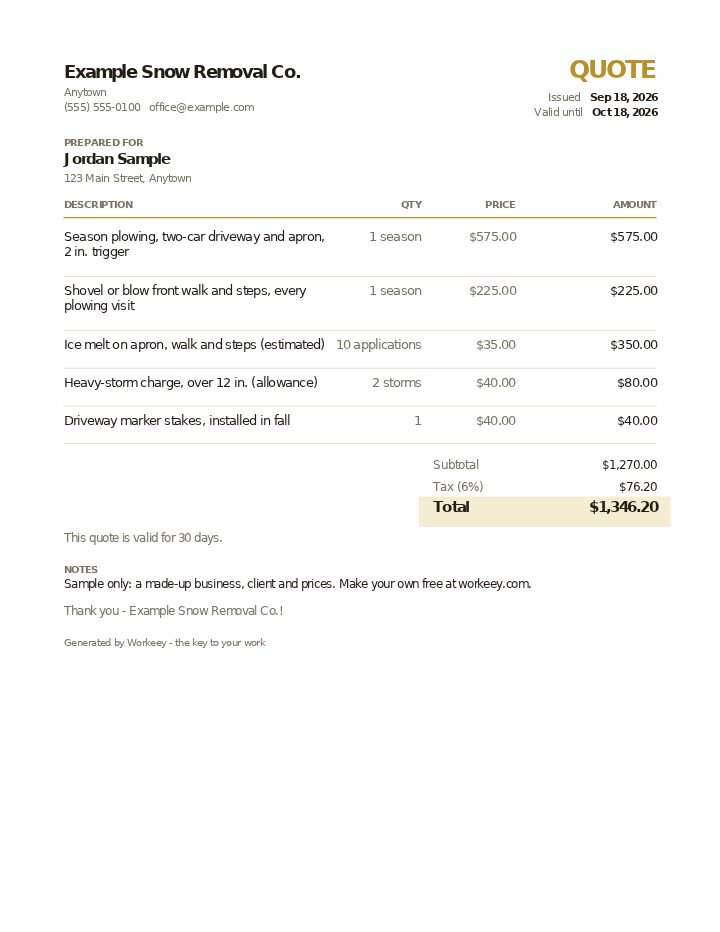
The sample is a season contract for one house: a two-car driveway, the front walk and steps, plowed whenever 2 inches or more fall between November 15 and April 1. Ice melt is estimated at ten applications and billed by the real count, and two heavy storms are allowed for. The business, client and prices are invented, and the sample taxes the whole subtotal for simplicity; whether snow removal is taxable depends on your state.
| Qty | Price | Amount | |
|---|---|---|---|
| Season plowing, two-car driveway and apron, 2 in. trigger | 1 season | $575.00 | $575.00 |
| Shovel or blow front walk and steps, every plowing visit | 1 season | $225.00 | $225.00 |
| Ice melt on apron, walk and steps (estimated) | 10 applications | $35.00 / application | $350.00 |
| Heavy-storm charge, over 12 in. (allowance) | 2 storms | $40.00 / storm | $80.00 |
| Driveway marker stakes, installed in fall | 1 | $40.00 | $40.00 |
| Subtotal | $1,270.00 | ||
| Sales tax 6% | $76.20 | ||
| Total | $1,346.20 |
The season price is based on about 14 plowing visits in a normal winter at roughly $41 a push, rounded to $575. The walks take one worker about 15 minutes a visit. Ice melt is $35 an application, which covers the product at a 30% markup and the stop. Ice melt and heavy storms are billed by the real count at the end of the season. This quote is valid for 30 days.
How to price a snow removal estimate
Start from your own history: how many plowable storms your area gets in an average winter, and how long each property takes, including the drive between them. A per-push price is that time multiplied by your hourly truck rate. A season price is the per-push price multiplied by the expected storms, often a little lower to win the contract, which you keep only if winter behaves.
Season contracts shift the weather risk to you, and per-push shifts it to the client. Many plow operators offer both on the same estimate and let the homeowner pick. Either way, keep ice melt separate, because salt prices and the number of ice storms swing more than snowfall does. Our estimate vs quote guide explains why a season price works best as a firm quote.
- Time each property from the moment you leave the last one
- Price per push first, then build the season price from expected storms
- Keep ice melt per application so a bad ice year does not eat your margin
- Set a storm cap: over a set depth, an extra charge applies
- Ask for part of the season price before the first storm
Estimate, quote, then invoice — in Workeey
In Workeey, each property's snow removal estimate is part of its job, so the address and the client's phone are one tap away on a dark morning. Set up your rates once, including hourly, first hour, call-out, travel, evening and weekend rates, parts markup and deposit percent, and the AI lays out the estimate line by line. Ice melt can be priced from the web at your markup, and your own lines, like a season plowing price, are saved for the next house. On Free, that is 23 quick estimates a month.
Share quote makes a quote PDF, valid for 30 days, to send from your phone; the Email button opens your own mail app. The deposit percent appears on the quote, but collecting it is up to you, since Workeey does not take deposits or partial payments. Workeey also does not bill on a schedule, so a season paid in parts means you send each invoice yourself. When the client agrees by text or in person, one tap makes the estimate an invoice, emailed with a pay link. See card payments and pricing.
More for snow removal pros: pages and free templates
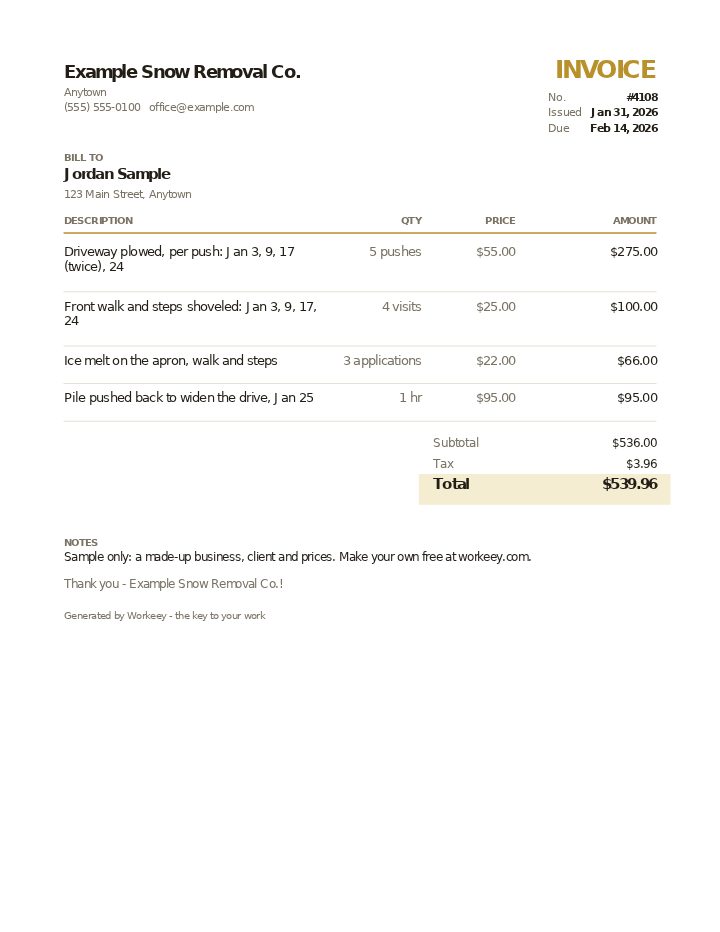
- Snow removal invoice template — free, with a filled-in sample
- Free invoice template — every field a trade invoice needs
- Free estimate template — copy it, price it, send it
- Free receipt template — a paid-in-full receipt to copy
- Work order template — the job written down before you bill it
- Late payment reminder templates — texts, emails and a letter to copy and send
- All free templates and tools
How do you price snow removal for a driveway?
Time how long the driveway takes to plow, including the drive there, and multiply by your truck rate to get a per-push price. For a season price, multiply that by the number of plowable storms you expect in an average winter, and price salt per application on top.
Is a seasonal snow contract better than per push?
For the homeowner, a season contract means a known cost. For you, it pays the same in a light winter and loses in a heavy one. Many operators offer both and add a storm cap so a record winter is not all at their expense.
What is a trigger depth?
It is the snowfall that brings you out, often 1 to 3 inches. Write it on the estimate so the client knows why you did not come for a dusting.
Who pays if the plow damages the lawn or a hidden object?
Most quotes exclude damage to things that were not marked, like landscape lights or a sprinkler head under the snow. Put marker stakes on the estimate and say what you will and will not repair in spring.