Workeey is built for your phone. Scan the code with your phone to get the Android app, or open workeey.com on your phone. The iPhone app and a desktop version are coming soon.
Get the Workeey app. Same account, same jobs.


Free cleaning price list template, with a house cleaning sample
Cleaning clients want a price before anyone walks through the door, and most of them describe their home in bedrooms, not square feet. A house cleaning price list built around home size, type of clean and add-ons lets you answer on the first call. Copy the free cleaning price list template below, see it filled in, and use our house cleaning price guide to set your own numbers.
Download this price list template: Word, Excel or PDF
Free to download, with no sign-up and no email. Open the Word file to type over the brackets, or the Excel file to put your own prices over the sample ones. Prefer paper? Print the blank PDF and fill it in by pen.
- Word (.docx) — the blank price list, ready to fill in
- Excel (.xlsx) — the sample prices, ready to swap for your own
- PDF (.pdf) — the sample prices, ready to print
- Blank PDF (.pdf) — print it and fill it in by pen
- Google Docs — your own copy of the Word file, in your Google Drive (Google asks you to sign in)
- Google Sheets — your own copy of the Excel file, in your Google Drive (Google asks you to sign in)
What goes on a cleaning price list
A cleaning price list does two jobs. It gives a new client a quick number for a standard clean of a home like theirs, and it shows what costs more: a first-time deep clean, a move-out, the inside of an oven. Clients who see the add-ons up front rarely argue about them later.
Pick one main way to price — by bedrooms, by the square foot or by the hour — and give every line its unit. Say plainly what a standard clean covers, so the deep clean has something to be deeper than. Then the rules: any minimum, the discount for weekly or every-other-week visits, and the date you set the prices.
- Service name: standard, deep, move-in or move-out
- What's included in each clean, room by room
- The price and its unit: per home size, per sq ft, per hour or per item
- Your minimum or trip charge, if you have one
- Evenings and weekends, if you price them higher
- What's extra: inside the oven, fridge or cabinets, windows, laundry
- The date the prices were set
Copy this cleaning price list template
Copy this into a document you can text to a new client or print to leave behind. Put standard cleans first, by home size, since that's what most callers ask about; deep and move-out cleans next; then a short block of add-ons so clients can build their own visit.
If you clean by the hour for some jobs, give the hourly rate its own line and say whether it is per cleaner. A home bigger or busier than described gets a written estimate first; the cleaning estimate template shows one. The skeleton:
- [Your business name] · [phone] · Prices as of [date] · US dollars
- Standard cleaning
- [Home size] — [what's included] — $[price] per visit
- Deep and move-out cleaning
- [Service] — [what's included] — $[price] [per visit / per sq ft]
- Add-ons
- [Add-on] — [what's included] — $[price] [each / per window / per load]
- Hourly rate: $[rate] per cleaner per hour
- Weekly or every-two-weeks visits: $[…] off each visit
- Trip charge / minimum: $[…]
- Evenings and weekends: [+…%]
- Prices are a starting point; a written estimate confirms the job price
Sample house cleaning price list, filled in
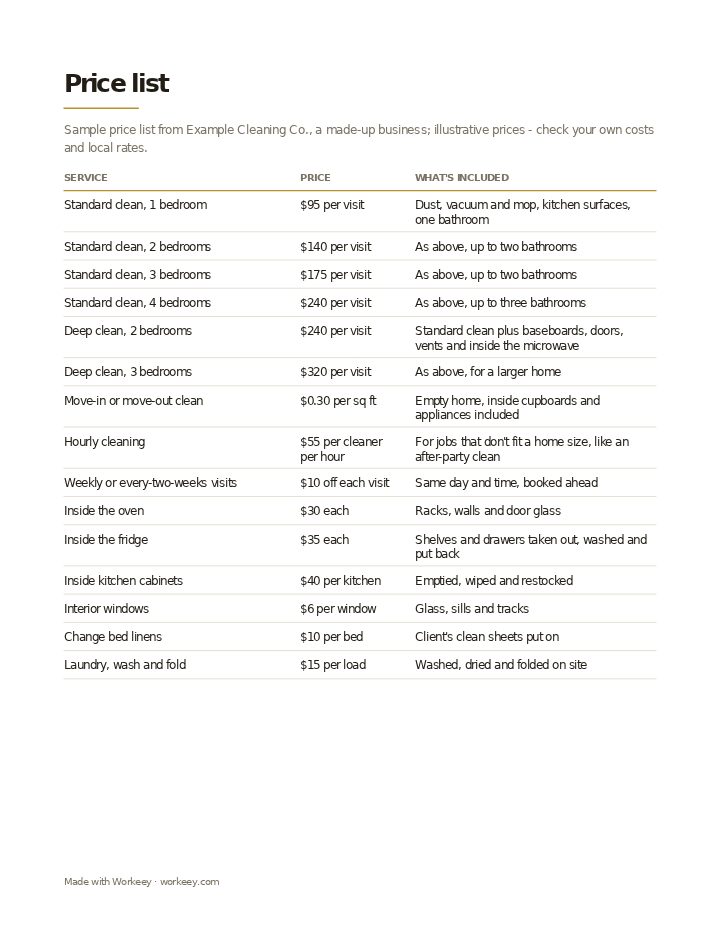
Here is the template filled in for a small residential cleaning business that prices by bedrooms. Standard cleans assume a home in normal shape; deep cleans add baseboards, doors, vents and the build-up a regular clean skips. Add-ons are priced one at a time so a client can pick.
| Price | What's included | |
|---|---|---|
| Standard clean, 1 bedroom | $95 per visit | Dust, vacuum and mop, kitchen surfaces, one bathroom |
| Standard clean, 2 bedrooms | $140 per visit | As above, up to two bathrooms |
| Standard clean, 3 bedrooms | $175 per visit | As above, up to two bathrooms |
| Standard clean, 4 bedrooms | $240 per visit | As above, up to three bathrooms |
| Deep clean, 2 bedrooms | $240 per visit | Standard clean plus baseboards, doors, vents and inside the microwave |
| Deep clean, 3 bedrooms | $320 per visit | As above, for a larger home |
| Move-in or move-out clean | $0.30 per sq ft | Empty home, inside cupboards and appliances included |
| Hourly cleaning | $55 per cleaner per hour | For jobs that don't fit a home size, like an after-party clean |
| Weekly or every-two-weeks visits | $10 off each visit | Same day and time, booked ahead |
| Inside the oven | $30 each | Racks, walls and door glass |
| Inside the fridge | $35 each | Shelves and drawers taken out, washed and put back |
| Inside kitchen cabinets | $40 per kitchen | Emptied, wiped and restocked |
| Interior windows | $6 per window | Glass, sills and tracks |
| Change bed linens | $10 per bed | Client's clean sheets put on |
| Laundry, wash and fold | $15 per load | Washed, dried and folded on site |
A made-up price list, not averages, Workeey data or what Workeey users charge. The prices sit inside the published ranges our house cleaning price guide records: HomeGuide's how much to charge for house cleaning (updated December 11, 2025) for bedrooms, the hourly rate and add-ons; HomeAdvisor's house cleaning cost guide (updated June 19, 2026) for move-out per square foot and the weekly discount; HomeAdvisor's deep cleaning guide (updated June 20, 2026) for the three-bedroom deep clean.
How to build a cleaning price list (or flat-rate price book)
Flat prices by home size are hourly prices with the guesswork done once. Time a few standard cleans of each size, multiply the hours by your hourly rate, add supplies per visit, and round. A two-bedroom that takes about two and a half hours at $55 is $137.50 of labor before supplies and the drive, which is why the sample says $140. Use the hourly rate calculator if you're not sure what your hour is worth.
A first visit almost always runs longer, so many cleaners book every new client as a deep clean first and move to the standard price after. Write that rule on the list. Keep the weekly discount in dollars per visit so it's simple to apply.
- Choose one main unit — bedrooms, square feet or hours — and convert the rest to it
- Flat price = hours × hourly rate + supplies, rounded up to a clean number
- Make the first visit a deep clean, then move to the regular price
- Price add-ons one by one so clients can build the visit they want
- Re-time your cleans and check supply costs every six months
Your price list, inside Workeey
In Workeey you save your rates once in Settings: hourly rate, travel per 20 minutes, a call-out charge (the least any job costs), the first hour, extra for evenings and weekends as a percent, your parts markup and a deposit percent. A quick estimate prices each clean from them, so a Saturday move-out and a weekday standard clean follow the same rules.
Each line you add by hand, like “Inside the oven, $30”, is remembered with its price and shows up as a one-tap chip on the next job, most-used first, so your add-on list builds itself. Send the estimate from your phone as a quote PDF. The client agrees with you by text or in person, never inside the app, and a single tap turns it into the invoice. Free includes 23 quick estimates a month (unlimited on Pro) and unlimited invoicing, no card. More for cleaners on the cleaning business software page.
More for cleaners: pages and free templates
- Cleaning business software — visits and invoices in one app
- Invoicing for cleaning businesses — per visit or per month, add-ons on their own lines
- How much to charge for house cleaning — a guide to setting your prices
- How to start a cleaning business — a step-by-step guide to going out on your own
- Best apps for a cleaning business — the apps for this trade compared
- House cleaning invoice template — free, with a filled-in sample
- House cleaning estimate template — a free quote sample
- House cleaning receipt template — a free paid-in-full sample
- House cleaning price book — the common jobs with starting hours and parts prices, priced from your rate
- Free invoice template — every field a trade invoice needs
- Free estimate template — copy it, price it, send it
- Free receipt template — a paid-in-full receipt to copy
- Work order template — the job written down before you bill it
- Late payment reminder templates — texts, emails and a letter to copy and send
- All free templates and tools
How do I make a house cleaning price list?
List your standard clean by home size, your deep and move-out cleans, and a short set of add-ons, each with a price and a unit. Time real cleans to set the prices and put the date at the top.
Should cleaners charge by the hour or by the house?
Most clients prefer a set price per home because they know the cost before you arrive. Hourly suits jobs you can't size from a description. Many cleaners quote flat by bedrooms and keep an hourly rate for everything else.
Should I put my cleaning prices on my website?
Starting prices for a standard clean by home size help callers decide quickly. Mark them “from”, list a couple of popular add-ons, and say you confirm the price once you've seen the home or a few photos.
How often should I update my cleaning price list?
Every six months, or sooner when supplies or fuel go up. Give regular clients notice before a new price applies to their visits.