Workeey is built for your phone. Scan the code with your phone to get the Android app, or open workeey.com on your phone. The iPhone app and a desktop version are coming soon.
Get the Workeey app. Same account, same jobs.


Free Electrical Estimate Template, with an electrical quote for an EV charger
Clients shopping for an electrician usually have two or three quotes on the table, and the one they pick is often the one they understand. An electrical quote that shows the circuit, the wire run and the permit makes your number easy to compare. Copy the free electrical estimate template below, check it against the EV charger sample, and send it today. When the job is done, the electrician invoice template covers the bill.
Download this estimate template: Word, Excel or PDF
Free to download, with no sign-up and no email. Open the Word file to type over the brackets, or the Excel file to swap in your own lines — the totals follow. Prefer paper? Print the blank PDF and fill it in by pen.
- Word (.docx) — the blank estimate, ready to fill in
- Excel (.xlsx) — the sample lines with amounts, tax and the total that work themselves out
- PDF (.pdf) — the filled-in sample, drawn the way Workeey draws a quote
- Blank PDF (.pdf) — print it and fill it in by pen
- Google Docs — your own copy of the Word file, in your Google Drive (Google asks you to sign in)
- Google Sheets — your own copy of the Excel file, in your Google Drive (Google asks you to sign in)
Fill in this estimate online
Change anything and download the PDF — free, no sign-up. What you type isn't sent to Workeey. The PDF is made in your browser.
Quote it, then invoice it, in Workeey
- Share quote turns it into a quote PDF, good for 30 days, that you send from your phone.
- The client says yes to you, and after the inspection one tap makes the invoice, which Workeey emails with a pay link for card or bank.
- Free includes 23 quick estimates a month.
What goes on an electrical estimate
An electrical estimate has to do something an invoice does not: it has to make the client comfortable letting you into their panel. Put your business name, phone, email and electrical license number at the top. Under that, the client, the job address, an estimate number, a date and the date the price expires.
Then describe the work in terms the homeowner already uses. "New 60 amp circuit from the main panel to a hardwired charger on the garage wall" is clearer than a list of part numbers. Show the run length, because wire is priced by the foot and the distance from the panel drives the price more than anything else. Name what you checked, like whether the panel has room and the service can carry the load, and what is not included, like patching drywall or a service upgrade.
- Business name, phone, email and electrical license number
- Client name, job address, estimate number, date and expiry
- Scope in plain words: circuit size, where it runs, what it feeds
- Wire by the foot with the gauge, breaker and devices at your price
- Labor as hours × rate or one flat price
- Permit, load calculation and the inspection visit
- Exclusions, such as a panel or service upgrade if one turns out to be needed
- Deposit to start, and the line where the client accepts
Copy this electrical estimate template
The template below is plain text, so it pastes into anything. Change each bracket to your own details and drop lines that do not apply; a receptacle swap needs no permit line, and a subpanel needs every line plus a few more.
If the job depends on panel capacity, keep the load line in. It tells the client why the price could change. The skeleton:
- [Your business name] · License #[number] · [phone] · [email]
- Estimate #[2001] · Date: [date] · Valid until: [date, e.g. 30 days]
- Prepared for: [client name] · Job address: [address]
- Scope: [circuit or device, amps, from where to where]
- Panel check: [room for breaker yes/no] · Load: [fits on existing service yes/no]
- Labor — [hours] × [rate] = [$], or Flat price — [job] = [$]
- [Wire gauge and type] — [feet] × [price per foot] = [$]
- [Breaker, device or equipment] — [qty] × [your price] = [$]
- Permit — [$] · Inspection visit — [$]
- Not included: [e.g. service upgrade, drywall patching]
- Subtotal [$] · Sales tax [rate]% [$] · Estimated total [$]
- Deposit to start: [%] · Accepted by: [name] · [date]
Sample electrical estimate (quote), filled in
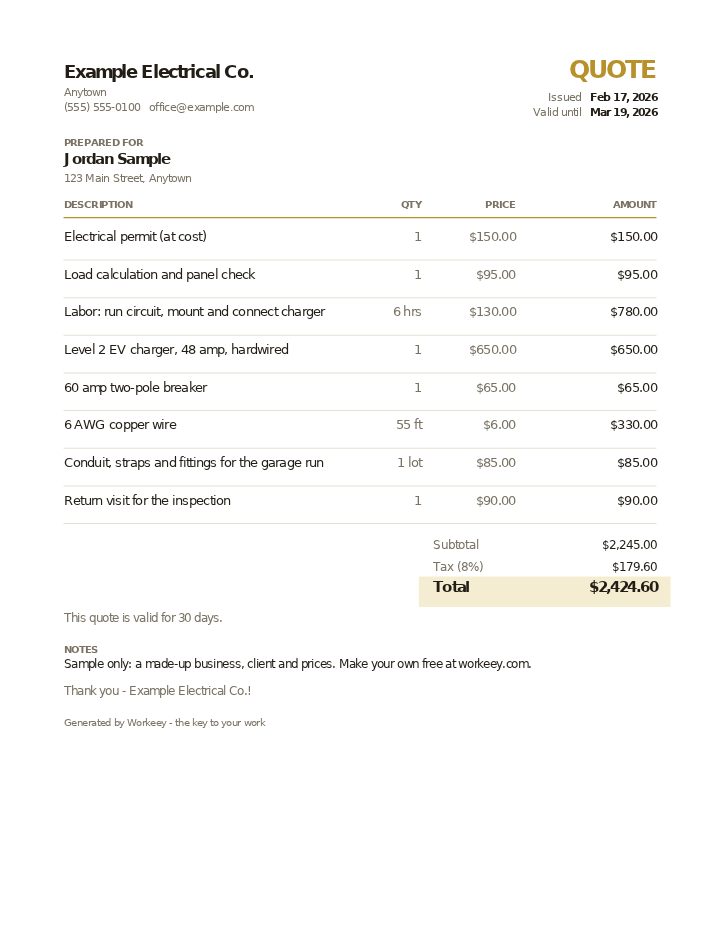
Here is the template filled in for a Level 2 EV charger: a new 60 amp circuit from a basement panel to the garage, about 55 feet of wire in conduit, a hardwired 48 amp charger the electrician supplies, and the permit and inspection. The panel had space and the load calculation passed. Business, client and prices are made up. The sample taxes the whole subtotal to keep it simple; in many states labor is not taxed, so check yours.
| Qty | Price | Amount | |
|---|---|---|---|
| Electrical permit (at cost) | 1 | $150.00 | $150.00 |
| Load calculation and panel check | 1 | $95.00 | $95.00 |
| Labor: run circuit, mount and connect charger | 6 hrs | $130.00 / hr | $780.00 |
| Level 2 EV charger, 48 amp, hardwired | 1 | $650.00 | $650.00 |
| 60 amp two-pole breaker | 1 | $65.00 | $65.00 |
| 6 AWG copper wire | 55 ft | $6.00 / ft | $330.00 |
| Conduit, straps and fittings for the garage run | 1 lot | $85.00 | $85.00 |
| Return visit for the inspection | 1 | $90.00 | $90.00 |
| Subtotal | $2,245.00 | ||
| Sales tax 8% | $179.60 | ||
| Total | $2,424.60 |
Labor is six hours at $130, based on a 55-foot run through an unfinished basement. Equipment and materials carry about a 20% markup: the charger cost $540 and is quoted at $650, the wire cost $5 a foot and is quoted at $6. The permit is billed at what the city charges. If the panel had been full, a service upgrade would have been a separate quote. This quote is valid for 30 days.
How to price an electrical estimate
Walk the route before you price it. The difference between fishing a wire through a finished wall and stapling it along open joists can be half a day, and the client cannot see that from the kitchen. Measure the run, add ten percent for the bends and the drop, then price the wire by the foot so the distance is on the page.
Decide before you quote whether the client supplies the equipment. If they bought their own charger, fixture or generator, quote labor only and say so; if you supply it, mark it up like any other material and own the warranty on the install. Look in the panel on the first visit, too. A full panel or an undersized service is the surprise that sinks electrical quotes, and the estimate vs quote guide shows how to word that risk.
- Measure the actual wire run, then add about 10% for bends and slack
- Open the panel cover on the first visit and note the space and service size
- Say clearly who supplies the equipment and who warranties it
- Price the permit at cost and the time pulling it as labor
- Quote a service upgrade separately rather than hiding it in a range
Estimate, quote, then invoice — in Workeey
Workeey keeps the estimate inside the job, so the client, the address and your notes from the panel check are on the same screen. Enter your rates once, from your hourly rate and first hour to call-out, travel, evening and weekend rates, parts markup and deposit percent, and the AI itemizes the estimate from them. Parts like the breaker and wire are priced from the web at your markup, and a line you add yourself, like a load calculation, is remembered. Free includes 23 quick estimates a month.
Share quote turns it into a quote PDF, good for 30 days, that you send from your phone; the Email button opens your own mail app. The deposit percent prints on the quote, and you collect it yourself, because Workeey does not take deposits or partial payments. There is no online signature. The client says yes to you, and after the inspection one tap makes the invoice, which Workeey emails with a pay link for card or bank (payments). More in Workeey for electricians and invoicing for electricians.
More for electricians: pages and free templates
- Electrician software — the whole electrical business in one app
- Invoicing for electricians — permits, panels and per-device rates on one bill
- How to price electrical work — a guide to setting your prices
- How to start an electrical business — a step-by-step guide to going out on your own
- Best apps for electricians — the apps for this trade compared
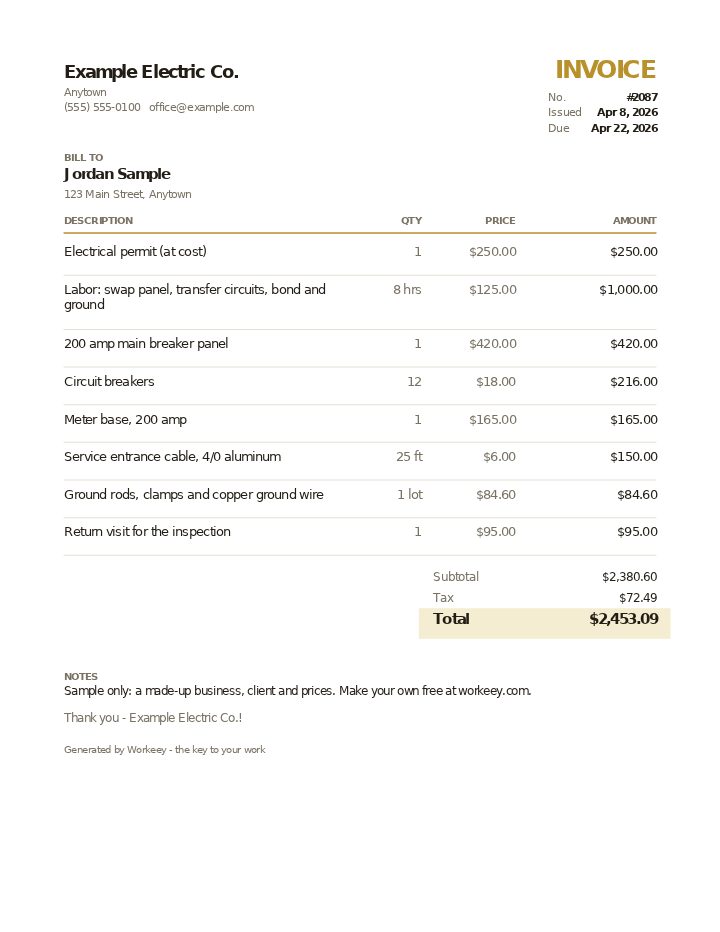
- Electrician invoice template — free, with a filled-in sample
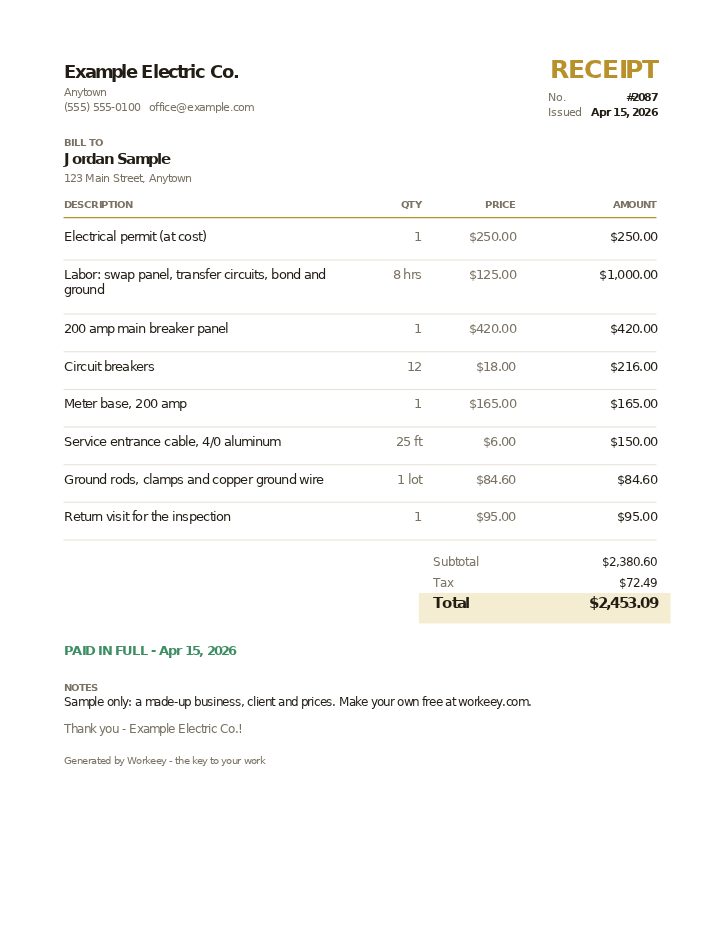
- Electrical receipt template — a free paid-in-full sample
- Electrical price list template — free, with sample prices
- Electrical work order template — free, with a filled-in sample
- Electrician wages by state — what employed electricians earn in every state, from BLS data
- Free invoice template — every field a trade invoice needs
- Free estimate template — copy it, price it, send it
- Free receipt template — a paid-in-full receipt to copy
- Work order template — the job written down before you bill it
- Late payment reminder templates — texts, emails and a letter to copy and send
- All free templates and tools
How much does an electrician charge to install an EV charger?
It depends mostly on the distance from the panel and whether the panel has room. A simple run in an attached garage is often in the low thousands including the charger; a long run or a service upgrade can double it. That is why the run length belongs on the quote.
Is an electrical quote binding?
A written quote the client accepts is generally treated as the agreed price for the scope described, which is why the scope and exclusions matter. For anything you could not see, write the assumption down. Rules vary by state, so check yours for large jobs.
Should the license number be on an electrical estimate?
Many states require it on estimates and contracts, and clients look for it.
Should I charge for an electrical estimate?
Many electricians quote small jobs free and charge a diagnostic or site-visit fee for troubleshooting or big projects, sometimes credited back if the client hires them. Whatever you choose, say it before the visit.