Workeey is built for your phone. Scan the code with your phone to get the Android app, or open workeey.com on your phone. The iPhone app and a desktop version are coming soon.
Get the Workeey app. Same account, same jobs.


Free electrical invoice template for electricians, with a worked sample
Electrical jobs carry costs a client never sees happen: the permit you pulled, the hours waiting on the inspector, the wire that disappeared into the wall. A good electrical invoice puts each of those on its own line so the price makes sense. Copy the free electrician invoice template below, check it against the panel upgrade sample, and send it. Or let Workeey build it from the job you just finished.
Download this invoice template: Word, Excel or PDF
Free to download, with no sign-up and no email. Open the Word file to type over the brackets, or the Excel file to swap in your own lines — the totals follow. Prefer paper? Print the blank PDF and fill it in by pen.
- Word (.docx) — the blank invoice, ready to fill in
- Excel (.xlsx) — the sample lines with amounts, tax and the total that work themselves out
- PDF (.pdf) — the filled-in sample, drawn the way Workeey draws an invoice
- Flat-rate PDF (.pdf) — the same job with the hours as one flat price, the same total
- Blank PDF (.pdf) — print it and fill it in by pen
- Google Docs — your own copy of the Word file, in your Google Drive (Google asks you to sign in)
- Google Sheets — your own copy of the Excel file, in your Google Drive (Google asks you to sign in)
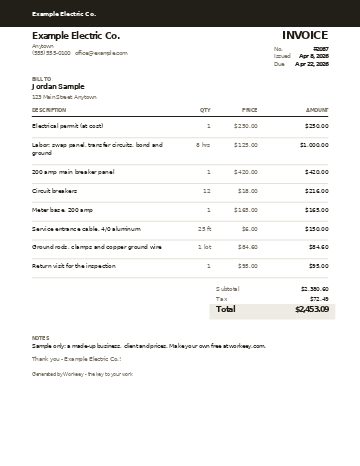
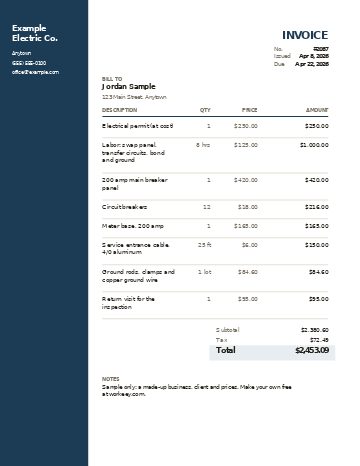
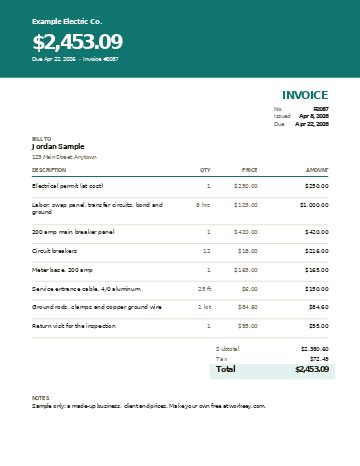
Fill in this invoice online
Change anything, pick a style, and download the PDF — free, no sign-up. What you type isn't sent to Workeey. The PDF is made in your browser.
Send it and get paid with Workeey
- Workeey emails the invoice to the client with a pay link, and after you connect Stripe they can pay by card, Apple Pay, Google Pay or US bank from that email.
- You see every invoice as draft, sent, paid or overdue.
- For a client who goes quiet, switch on reminder texts for that invoice and they go out on a schedule until it is paid, eight at most.
- Invoicing is free on the free plan.
Already have an invoice? The free invoice checker reads one you paste and says what it is missing.
What goes on an electrician invoice
Clients pay faster when they can follow the bill, and electrical work is hard for them to follow because most of it ends up behind drywall or inside a gray box. Lead with your business name, phone, email and address, and print your electrical license number, since many states require it on contracts and invoices and homeowners check it. Below that, the client's name, billing address and the service address where the work was done.
Next come the invoice number, the date you sent it and the date it is due. Then the work, broken into the pieces a homeowner can picture: the permit, your labor, the panel or device, the breakers, the wire by the foot, and the inspection. If you pulled a permit, put its number on the invoice. It shows the job was done to code.
- Business name, phone, email, address and electrical license number
- Client name, billing address and the service address
- Invoice number, date sent and a due date
- Permit fee, and the permit number, as its own line
- Labor as hours × rate, or one flat price for the job
- Panel, breakers, devices and fixtures, one line each at your price
- Wire and conduit by the foot, with the size if it matters to the job
- Inspection or utility coordination visits, subtotal, sales tax and total due (is labor taxed in your state?)
Copy this electrician invoice template
Below is the template as plain text. Paste it into a document or a notes app, swap every bracket for your own details, and cut the lines that do not fit the job. A GFCI swap needs no permit or wire line; a garage subpanel needs both.
Describe materials the way the homeowner would say them, "200 amp main breaker panel", not a catalog number, and give wire a length so the price per foot is visible. The skeleton:
- [Business name] · License #[number] · [phone] · [email] · [address]
- Invoice #[2001] · Sent: [date] · Due: [date, e.g. 14 days out]
- Bill to: [client name] · [billing address] · Service address: [where the work was]
- Scope: [one sentence, e.g. upgraded 100A service to 200A] · Work date: [date]
- Permit — [permit #] — [$] (at cost)
- Labor — [hours] × [rate] = [$], or Flat price — [job] = [$]
- [Panel or device] — [qty] × [your price] = [$]
- [Breakers] — [qty] × [your price] = [$]
- [Wire size and type] — [feet] × [price per foot] = [$]
- Inspection visit — [$] (if you charge for meeting the inspector)
- Subtotal [$] · Sales tax [rate]% on [taxable items] [$] · Total due [$]
- Terms: due [date] · Pay by [card or bank pay link] or [check to your business] · [warranty on workmanship]
Sample electrician invoice, filled in
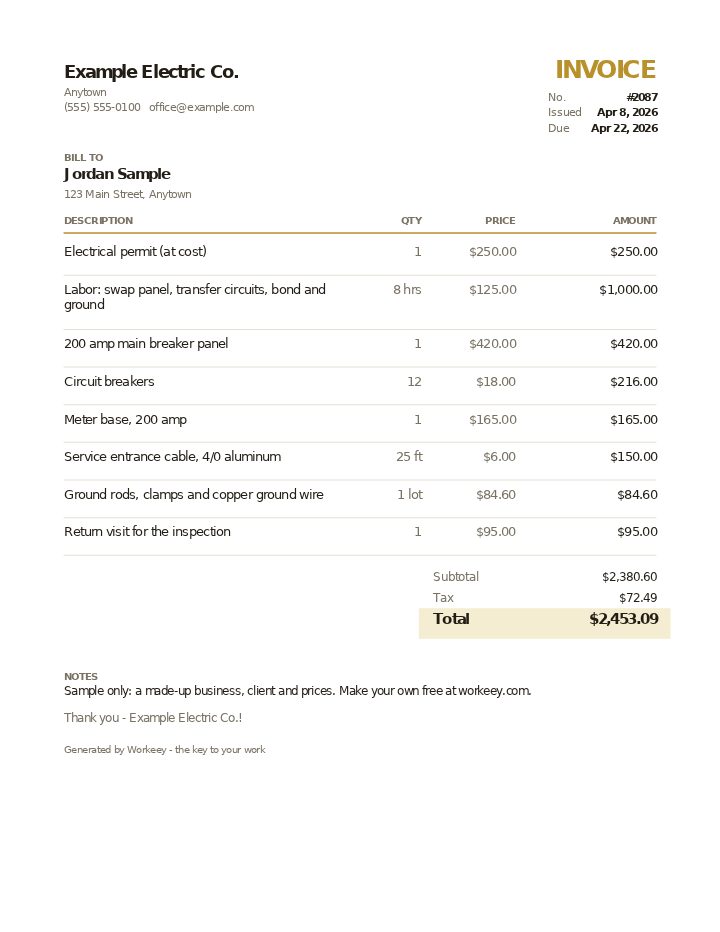
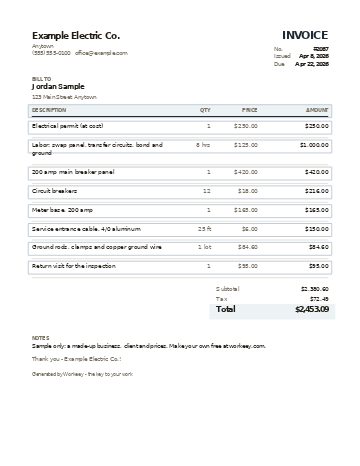
This is the template filled in for a 200 amp panel upgrade on a single-family house. The business, the client and the prices are invented, so use your own. The permit is passed through at cost and kept off the tax, the labor is billed by the hour, and only the materials are taxed. Tax rules vary by state, so confirm yours.
| Qty | Price | Amount | |
|---|---|---|---|
| Electrical permit (at cost) | 1 | $250.00 | $250.00 |
| Labor: swap panel, transfer circuits, bond and ground | 8 hrs | $125.00 / hr | $1,000.00 |
| 200 amp main breaker panel | 1 | $420.00 | $420.00 |
| Circuit breakers | 12 | $18.00 | $216.00 |
| Meter base, 200 amp | 1 | $165.00 | $165.00 |
| Service entrance cable, 4/0 aluminum | 25 ft | $6.00 / ft | $150.00 |
| Ground rods, clamps and copper ground wire | 1 lot | $84.60 | $84.60 |
| Return visit for the inspection | 1 | $95.00 | $95.00 |
| Subtotal | $2,380.60 | ||
| Sales tax 7% on materials ($1,035.60) | $72.49 | ||
| Total due | $2,453.09 |
Materials carry a 20% markup: the panel cost $350 and bills at $420, each breaker cost $15 and bills at $18. The permit is billed at exactly what the city charged, with no markup. Payment terms on this sample: due in 14 days, paid by card or bank from the pay link in the invoice email, or by check to Example Electric Co.
How to invoice electrical work
Quote before you open anything, then invoice against the quote. Panel swaps and rewires tend to turn up surprises, like aluminum branch wiring, a missing ground or a buried junction box. When that happens, stop, tell the client what you found and what it adds, and get a yes before you do it. Then add it as a labeled change line. Our estimate vs quote guide explains which one to give.
Separate the money that is yours from the money that passes through you. A permit fee, a utility fee or an engineering letter is not your profit, and showing it at cost builds trust. Equipment like an EV charger or a generator can cost the client more than your labor does, so on jobs like that, asking for a deposit before you order it is common; bill the deposit as its own invoice and show it as paid on the final one. Set a firm due date, and if it slips, our late-payment reminder templates have the wording.
- Put the permit number on the invoice, and bill the permit at cost
- Get a yes before extra work, then list it as its own change line
- Give wire a length and a price per foot instead of one lump
- Ask for a deposit before ordering big equipment like a charger or generator
- Send the invoice the day the inspection passes, with a real due date
Or do it free in Workeey
Typing every invoice from scratch means copying the client's address again, working out the next number and doing the tax on a calculator. Workeey's invoicing skips that. When the job is done, one tap makes the invoice from it, with the client, the address and the lines already filled in, tax added and the number assigned. If you gave the client an estimate, that turns into the invoice in one tap as well.
Workeey emails the invoice to the client with a pay link, and after you connect Stripe they can pay by card, Apple Pay, Google Pay or US bank from that email. You see every invoice as draft, sent, paid or overdue. For a client who goes quiet, switch on reminder texts for that invoice and they go out on a schedule until it is paid, eight at most. Invoicing is free on the free plan; pricing covers the rest, and Workeey for electricians shows the whole app.
More for electricians: pages and free templates
- Electrician software — the whole electrical business in one app
- Invoicing for electricians — permits, panels and per-device rates on one bill
- How to price electrical work — a guide to setting your prices
- How to start an electrical business — a step-by-step guide to going out on your own
- Best apps for electricians — the apps for this trade compared
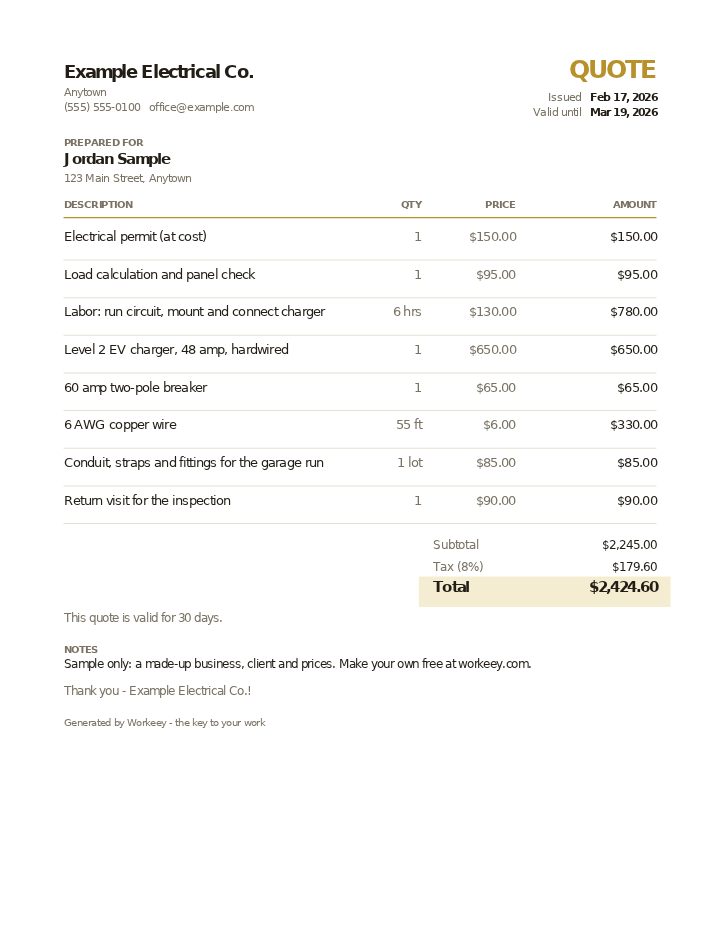
- Electrical estimate template — a free quote sample
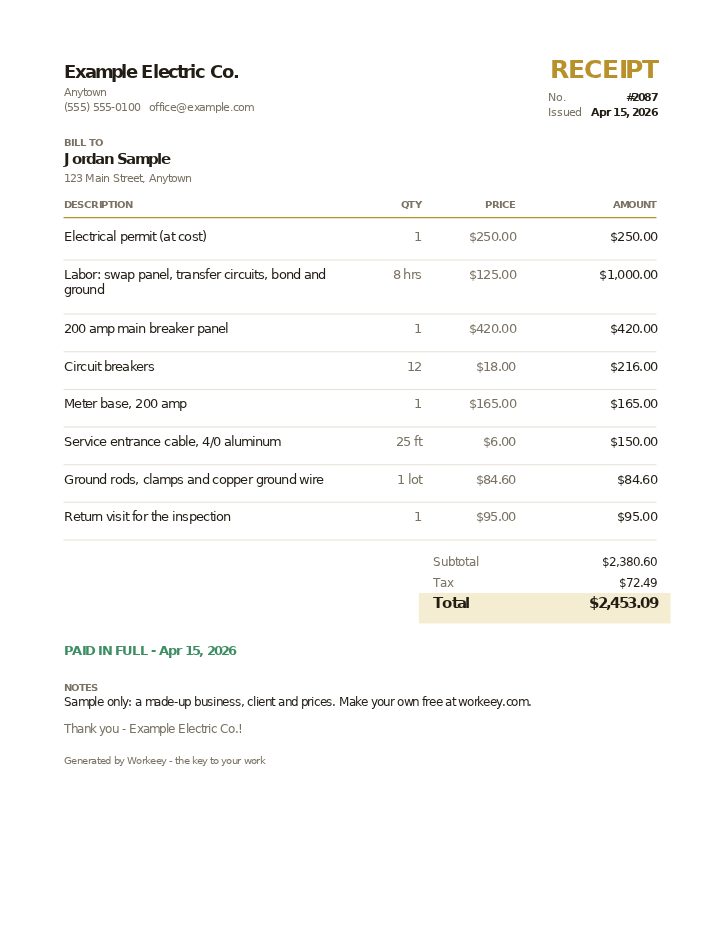
- Electrical receipt template — a free paid-in-full sample
- Electrical price list template — free, with sample prices
- Electrical work order template — free, with a filled-in sample
- Electrician wages by state — what employed electricians earn in every state, from BLS data
- Free invoice template — every field a trade invoice needs
- Free estimate template — copy it, price it, send it
- Free receipt template — a paid-in-full receipt to copy
- Work order template — the job written down before you bill it
- Late payment reminder templates — texts, emails and a letter to copy and send
- All free templates and tools
Do I need my license number on an electrical invoice?
In many states, yes: licensed electricians are often required to show the license number on contracts, estimates and invoices. Even where it is not required, printing it costs nothing and reassures the client. Check your state licensing board for the exact rule.
Should an electrician mark up the permit fee?
Most bill the permit at cost and charge for the time spent pulling it as labor or a small admin line. Showing the permit at exactly what the city charged keeps the invoice easy to trust.
How do electricians bill for wire?
By the foot, at your price per foot, with the size and type named, for example 25 ft of 4/0 aluminum. For small amounts of common wire, some electricians roll it into a materials lot instead.
Is labor taxable on an electrical invoice?
It depends on the state. Some tax only materials, some tax labor on repairs but not on new construction, and a few tax both. Keep labor and materials on separate lines so you can tax the right part either way.