Workeey is built for your phone. Scan the code with your phone to get the Android app, or open workeey.com on your phone. The iPhone app and a desktop version are coming soon.
Get the Workeey app. Same account, same jobs.


Free handyman price list template, with sample prices
A handyman price list is the sheet you wish you had the last time a caller asked what you charge to hang a TV. It puts your common jobs, hourly rate, minimum and trip charge on one page, so every answer is the same. Copy the free template below, compare it with the filled-in sample, and set your own numbers with our handyman price guide.
Download this price list template: Word, Excel or PDF
Free to download, with no sign-up and no email. Open the Word file to type over the brackets, or the Excel file to put your own prices over the sample ones. Prefer paper? Print the blank PDF and fill it in by pen.
- Word (.docx) — the blank price list, ready to fill in
- Excel (.xlsx) — the sample prices, ready to swap for your own
- PDF (.pdf) — the sample prices, ready to print
- Blank PDF (.pdf) — print it and fill it in by pen
- Google Docs — your own copy of the Word file, in your Google Drive (Google asks you to sign in)
- Google Sheets — your own copy of the Excel file, in your Google Drive (Google asks you to sign in)
What goes on a handyman price list
Most handyman work arrives as small, familiar jobs: mount this, patch that, swap the faucet. A price list turns each into a flat price you have already thought through, and keeps an hourly rate for the jobs you can't size from the doorway.
Write each line so a homeowner could read it without you there: the job, what the price covers — the fixture, or only the labor? — and the unit beside every price. Then add the rules for every visit: the minimum, the trip charge, what a Saturday costs, and the date you set the prices, so an old sheet never quietly undercharges.
- Service name, in the words a client would use
- What's included, and whether materials are in the price
- The price and its unit: flat, per hour, per item or per window
- Your minimum visit or trip charge
- Evenings and weekends, if you charge more for them
- What's extra: materials, haul-away, a second visit for drying time
- The date the prices were set
Copy this handyman price list template
Copy the template as plain text into a note, a document or a spreadsheet, and replace every bracket. Group the lines the way clients ask for them — mounting and assembly, fixtures and small plumbing, doors, walls and outside work — so you can find a price in seconds while the caller waits.
Keep it short: twenty lines you actually quote beat a hundred you never use. When a client sends a whole list of repairs, the handyman estimate template takes over. The skeleton:
- [Your business name] · [phone] · Prices as of [date] · US dollars
- Mounting and assembly
- [Service] — [what's included] — $[price] [flat / per item]
- Fixtures and small plumbing
- [Service] — [what's included] — $[price] [flat / per hour]
- Doors, walls and outside
- [Service] — [what's included] — $[price] [flat / per window]
- Hourly rate after the first hour: $[rate] per hour
- Materials: [at cost / cost plus your markup]
- Trip charge / minimum: $[…]
- Evenings and weekends: [+…%]
- Prices are a starting point; a written estimate confirms the job price
Sample handyman price list, filled in
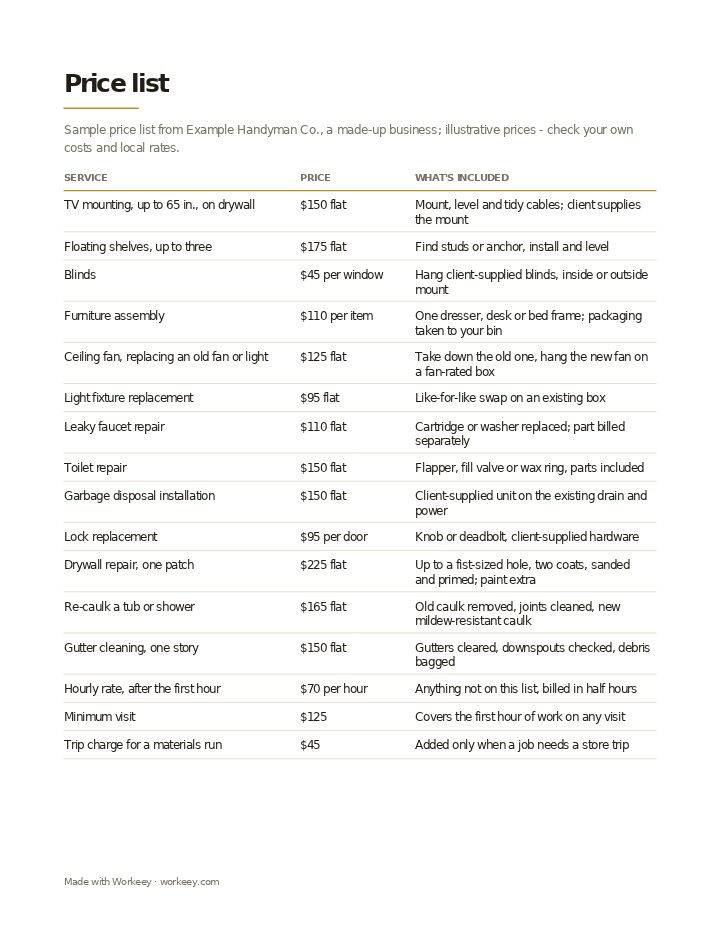
Here is the template filled in for a one-person handyman business. Small jobs are priced flat for the labor, with the client's own part unless the line says otherwise; the hourly rate covers anything not on the sheet, and the minimum sits at the bottom.
| Price | What's included | |
|---|---|---|
| TV mounting, up to 65 in., on drywall | $150 flat | Mount, level and tidy cables; client supplies the mount |
| Floating shelves, up to three | $175 flat | Find studs or anchor, install and level |
| Blinds | $45 per window | Hang client-supplied blinds, inside or outside mount |
| Furniture assembly | $110 per item | One dresser, desk or bed frame; packaging taken to your bin |
| Ceiling fan, replacing an old fan or light | $125 flat | Take down the old one, hang the new fan on a fan-rated box |
| Light fixture replacement | $95 flat | Like-for-like swap on an existing box |
| Leaky faucet repair | $110 flat | Cartridge or washer replaced; part billed separately |
| Toilet repair | $150 flat | Flapper, fill valve or wax ring, parts included |
| Garbage disposal installation | $150 flat | Client-supplied unit on the existing drain and power |
| Lock replacement | $95 per door | Knob or deadbolt, client-supplied hardware |
| Drywall repair, one patch | $225 flat | Up to a fist-sized hole, two coats, sanded and primed; paint extra |
| Re-caulk a tub or shower | $165 flat | Old caulk removed, joints cleaned, new mildew-resistant caulk |
| Gutter cleaning, one story | $150 flat | Gutters cleared, downspouts checked, debris bagged |
| Hourly rate, after the first hour | $70 per hour | Anything not on this list, billed in half hours |
| Minimum visit | $125 | Covers the first hour of work on any visit |
| Trip charge for a materials run | $45 | Added only when a job needs a store trip |
Illustrative prices only: not averages, not Workeey data, not what Workeey users charge. Every line sits inside a published range from our handyman price guide's sources — the job prices inside HomeGuide's handyman price list, and the hourly rate, minimum and trip charge inside its ranges for self-employed handymen (HomeGuide handyman prices, written August 29, 2023). HomeAdvisor's handyman cost guide (updated June 19, 2026) gives $50 to $150 an hour.
How to build a handyman price list (or flat-rate price book)
A flat price is an hourly price you've done the math on in advance. Time a job you do often, multiply the hours by your rate, add the materials at your markup, and round up for setup, cleanup and the drive. A grab bar that takes an hour and a quarter at $70 is worth more than $87.50 once you count unloading the truck. The hourly rate calculator finds the rate; the markup calculator sets the materials price.
Keep the trip charge and the minimum apart from the job prices, so a client comparing your fixture swap with someone else's compares the swap, not your drive. And date the sheet: a list nobody has reviewed in two years pays you a little less every month.
- Price your twenty most-asked jobs flat, and keep an hourly rate for the rest
- Flat price = hours × rate + materials × markup + a margin for setup and travel
- State the minimum once at the bottom instead of padding every small job
- Say whether materials are included on every line that could go either way
- Review the list every six months, and whenever your supplier's prices jump
Your price list, inside Workeey
In Workeey's Settings you save your rates once: your hourly rate, travel per 20 minutes, a call-out charge that is the least any job costs, the first hour, extra for evenings and weekends as a percent, your parts markup and a deposit percent. A quick estimate prices each handyman job from those numbers, so the TV mount you quote on Monday follows the same rules as the faucet on Friday.
Every line you add by hand — say, “Assemble dresser, $110” — is remembered with its price and waits as a one-tap chip on the next job, most-used first, so your price list builds itself from the work you actually do. The estimate goes from your phone as a quote PDF. Your client tells you yes directly; nothing is signed in the app, and one tap makes the invoice. The free plan has 23 quick estimates a month (unlimited on Pro) and unlimited invoicing, with no card. More on the handyman software page.
More for handymen: pages and free templates
- Handyman software — a day of small jobs in one app
- Invoicing for handymen — every task its own line
- How much to charge for handyman work — a guide to setting your prices
- How to start a handyman business — a step-by-step guide to going out on your own
- Best apps for a handyman business — the apps for this trade compared
- Handyman invoice template — free, with a filled-in sample
- Handyman estimate template — a free quote sample
- Handyman receipt template — a free paid-in-full sample
- Handyman work order template — free, with a filled-in sample
- Handyman price book — the common jobs with starting hours and parts prices, priced from your rate
- Free invoice template — every field a trade invoice needs
- Free estimate template — copy it, price it, send it
- Free receipt template — a paid-in-full receipt to copy
- Work order template — the job written down before you bill it
- Late payment reminder templates — texts, emails and a letter to copy and send
- All free templates and tools
Should a handyman list prices or quote every job?
Both. The list covers the jobs you do every week, so you can answer on the phone; anything bigger or harder to see gets a written estimate after you've looked.
What is a flat-rate price book for a handyman?
It's a price list where each common job has one set price instead of an hourly guess. The price is built from how long the job usually takes you, your hourly rate and the materials, so the client knows the cost before you start and you keep the benefit of being quick.
Should I put my handyman prices on my website?
A few starting prices, like “TV mounting from $150”, answer the most common question and filter out bargain hunters. Add “from” to anything that varies, and say a written estimate sets the final price.
How often should a handyman update a price list?
Look at it every six months, and right away when a material you use often goes up or you notice one job always runs long. Put the date on the sheet so you and the client know which version they were quoted.