Workeey is built for your phone. Scan the code with your phone to get the Android app, or open workeey.com on your phone. The iPhone app and a desktop version are coming soon.
Get the Workeey app. Same account, same jobs.


Free handyman estimate template, with a repair list quoted line by line
Handyman calls rarely come as one job. They come as a list on the fridge, and the client wants to know what the whole list costs and which items they could skip. A handyman estimate that prices each task on its own line answers both. Copy the free handyman estimate template below, look at the filled-in repair list, and send it before you leave the driveway. For the bill afterward, use the handyman invoice template.
Download this estimate template: Word, Excel or PDF
Free to download, with no sign-up and no email. Open the Word file to type over the brackets, or the Excel file to swap in your own lines — the totals follow. Prefer paper? Print the blank PDF and fill it in by pen.
- Word (.docx) — the blank estimate, ready to fill in
- Excel (.xlsx) — the sample lines with amounts, tax and the total that work themselves out
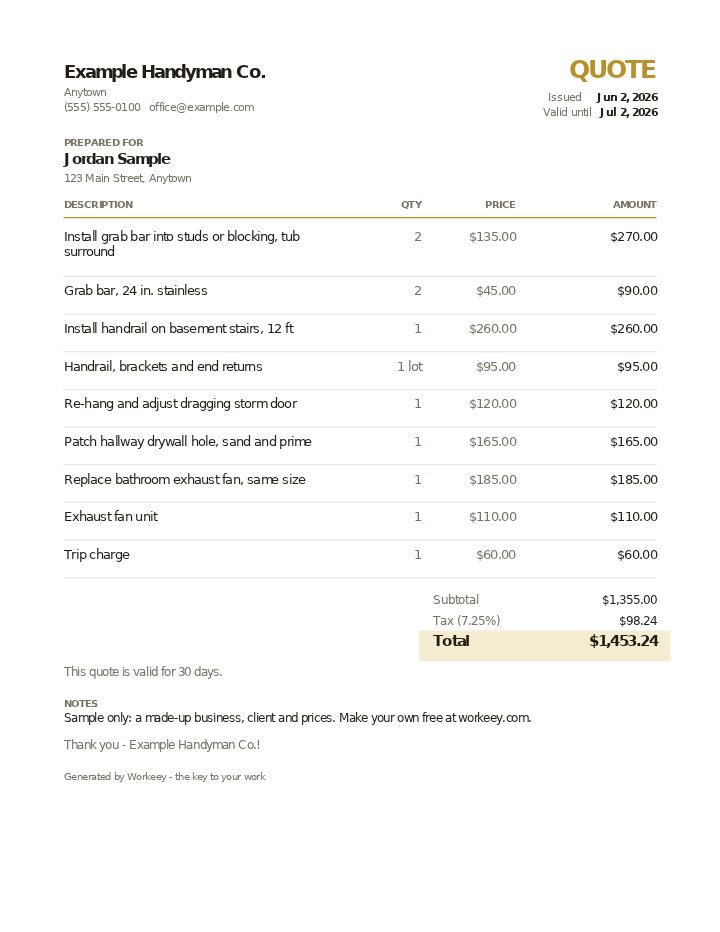
- PDF (.pdf) — the filled-in sample, drawn the way Workeey draws a quote
- Blank PDF (.pdf) — print it and fill it in by pen
- Google Docs — your own copy of the Word file, in your Google Drive (Google asks you to sign in)
- Google Sheets — your own copy of the Excel file, in your Google Drive (Google asks you to sign in)
Fill in this estimate online
Change anything and download the PDF — free, no sign-up. What you type isn't sent to Workeey. The PDF is made in your browser.
Quote it, then invoice it, in Workeey
- Share quote makes it a quote PDF that holds for 30 days and goes out from your phone.
- Free includes 23 quick estimates a month.
What goes on a handyman estimate
The point of a handyman estimate is to let the client pick. Give every task its own line and its own price, so if the total is more than they planned, they can cross off the drywall patch and keep the grab bars. Lumping six repairs into one number forces a yes or no on all of them, and the answer is often no.
Put your name, phone and email at the top, plus a license or registration number if your state or city requires one for the size of work you do. Then the client, the address, an estimate number, a date and when the price runs out. Under each task, say what you will do in one line, and list materials you will buy separately, so the client knows whether a quoted price includes the part or not.
- Your name or business, phone, email and any license or registration number
- Client name, address, estimate number, date and expiry
- One line per task with its own price, so tasks can be dropped
- Materials you will buy, listed apart from the labor
- A trip charge or minimum, if you use one
- What is not included, such as painting a patched wall
- Deposit to start, if any, and how the client accepts
Copy this handyman estimate template
Below is the template as plain text. Copy it, change the brackets, and add or remove task lines to match the list you were handed. Most handyman estimates run from three to ten lines.
Price tasks flat when you know how long they take, and by the hour when you do not, like chasing a sticky door that might need a new hinge or a planed edge. Mark which is which. The skeleton:
- [Your business name] · [license or registration # if required] · [phone] · [email]
- Estimate #[4001] · Date: [date] · Valid until: [date, e.g. 30 days]
- Prepared for: [client name] · Address: [address]
- Task 1: [what you will do] — flat [$]
- Task 2: [what you will do] — [hours] × [rate] = [$]
- Materials: [item] — [qty] × [your price] = [$]
- Trip charge: [$] · Minimum visit: [$ or hours]
- Not included: [e.g. painting after patching]
- Subtotal [$] · Sales tax [rate]% [$] · Estimated total [$]
- Deposit to start: [%] · Accepted by: [name] · [date]
Sample handyman estimate (quote), filled in
Here is the template used on a safety list for an older homeowner: two grab bars in the tub surround, a handrail on the basement stairs, a storm door that drags, a hole in the hallway drywall and a noisy bath fan. Each task is priced flat, the parts are listed below their task, and the trip charge is separate. Business, client and prices are made up. The sample taxes the whole subtotal for simplicity, so check what your state taxes.
| Qty | Price | Amount | |
|---|---|---|---|
| Install grab bar into studs or blocking, tub surround | 2 | $135.00 | $270.00 |
| Grab bar, 24 in. stainless | 2 | $45.00 | $90.00 |
| Install handrail on basement stairs, 12 ft | 1 | $260.00 | $260.00 |
| Handrail, brackets and end returns | 1 lot | $95.00 | $95.00 |
| Re-hang and adjust dragging storm door | 1 | $120.00 | $120.00 |
| Patch hallway drywall hole, sand and prime | 1 | $165.00 | $165.00 |
| Replace bathroom exhaust fan, same size | 1 | $185.00 | $185.00 |
| Exhaust fan unit | 1 | $110.00 | $110.00 |
| Trip charge | 1 | $60.00 | $60.00 |
| Subtotal | $1,355.00 | ||
| Sales tax 7.25% | $98.24 | ||
| Total | $1,453.24 |
Each flat price is the hours the task usually takes at $75 an hour, rounded to a whole dollar, plus a little for setup and cleanup: two grab bars are about three and a half hours together. Materials carry a 20% markup over store price. The drywall patch is primed but not painted; the client is painting the hallway. This quote is valid for 30 days.
How to price a handyman estimate
Most handyman pricing comes down to knowing how long small things really take. Time yourself on the tasks you do every week, like a grab bar, a faucet, a door, a patch, and turn those times into flat prices. A flat price is easier for the client to say yes to, and when you get faster, the extra margin is yours.
Watch the jobs that cost time without looking like work: a drywall patch needs a return visit for the second coat, and a grab bar on tile takes longer than one on drywall. Price the return trip into the task. Set a minimum so a single fifteen-minute fix still pays for the drive. The estimate vs quote guide explains whether a flat line is a quote or an estimate.
- Time your common tasks and turn them into flat prices
- Add the return visit to any task that needs drying time
- Price tile, plaster and old houses higher than new drywall
- Use a trip charge or minimum so small lists still pay
- Keep materials on their own lines so clients see what they are buying
Estimate, quote, then invoice — in Workeey
Workeey puts the estimate inside the job, so the list, the client and the address stay together. Set your rates once: hourly, first hour, call-out, travel, evenings and weekends, parts markup and deposit percent. The AI itemizes the estimate from them, prices parts like a grab bar from the web at your markup, and remembers lines you type yourself, like a storm door adjustment, so the next one is already priced. Free includes 23 quick estimates a month.
Share quote makes it a quote PDF that holds for 30 days and goes out from your phone; the Email button opens your own mail app. A deposit percent prints on the quote, though Workeey does not collect deposits. The client doesn't sign anything in the app; they tell you which tasks they want, you adjust, and after the work one tap turns the estimate into the invoice, emailed with a pay link. See Workeey for handymen, invoicing for handymen and pricing.
More for handymen: pages and free templates
- Handyman software — a day of small jobs in one app
- Invoicing for handymen — every task its own line
- How much to charge for handyman work — a guide to setting your prices
- How to start a handyman business — a step-by-step guide to going out on your own
- Best apps for a handyman business — the apps for this trade compared
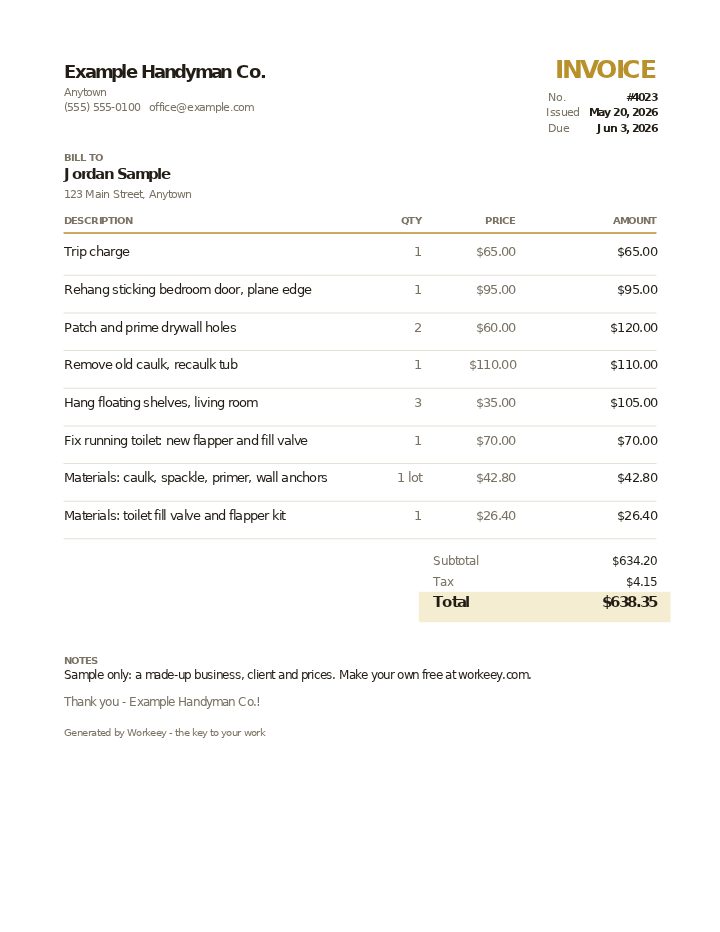
- Handyman invoice template — free, with a filled-in sample
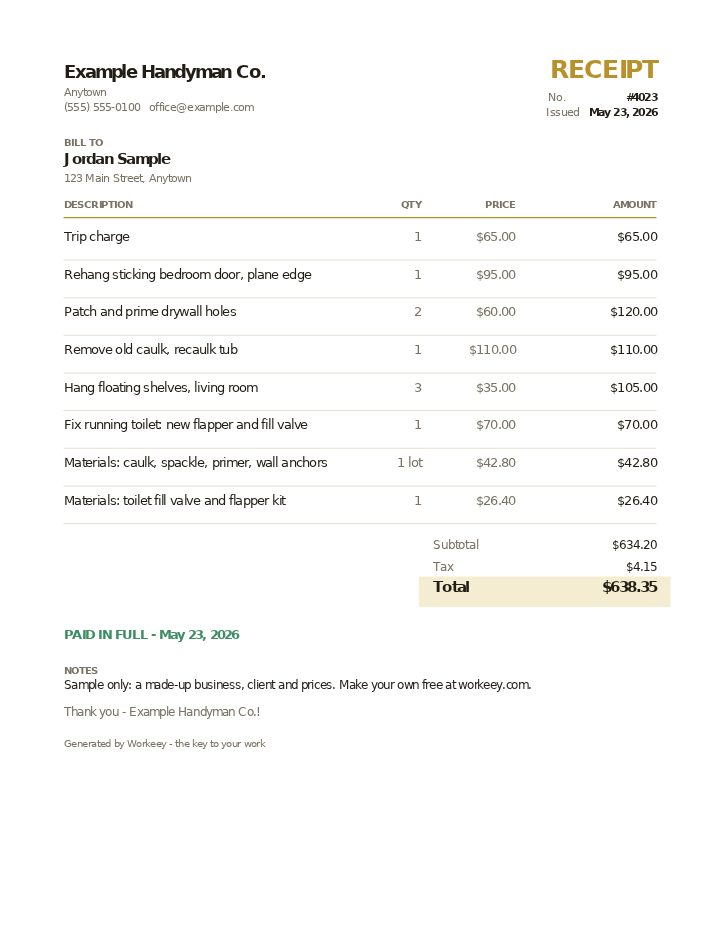
- Handyman receipt template — a free paid-in-full sample
- Handyman price list template — free, with sample prices
- Handyman work order template — free, with a filled-in sample
- Handyman wages by state — what employed general maintenance and repair workers earn in every state, from BLS data
- Free invoice template — every field a trade invoice needs
- Free estimate template — copy it, price it, send it
- Free receipt template — a paid-in-full receipt to copy
- Work order template — the job written down before you bill it
- Late payment reminder templates — texts, emails and a letter to copy and send
- All free templates and tools
Should a handyman charge by the hour or by the job?
Both work. Flat prices per task are easier for clients and reward you for being quick; hourly suits jobs you cannot size, like troubleshooting. Many handymen quote flat and keep an hourly rate for the unknowns.
Do handymen charge for estimates?
Most give free estimates for a normal list, and some charge a trip fee that is credited if the client books the work. Say which you do when they call.
Is a handyman quote binding?
Once the client accepts, a written quote is usually treated as the price for the work it describes. If a task turns out different once you open it up, tell the client and agree the new price before you continue.
Do I need a license to give a handyman estimate?
It depends on your state and the size of the job. Many states let handymen do small repairs without a contractor license up to a dollar limit, and electrical, plumbing or gas work usually needs a licensed trade. Check your state board.