Workeey is built for your phone. Scan the code with your phone to get the Android app, or open workeey.com on your phone. The iPhone app and a desktop version are coming soon.
Get the Workeey app. Same account, same jobs.


Free handyman invoice template, with a punch list sample
A handyman visit is rarely one job. It is a door that sticks, two holes in the drywall, a running toilet and three shelves, all in one afternoon. The invoice should show each one, so the client sees six small fair prices instead of one big surprise. Copy the free handyman invoice template below, check it against the sample, and send it. Or let Workeey build it from your finished job.
Download this invoice template: Word, Excel or PDF
Free to download, with no sign-up and no email. Open the Word file to type over the brackets, or the Excel file to swap in your own lines — the totals follow. Prefer paper? Print the blank PDF and fill it in by pen.
- Word (.docx) — the blank invoice, ready to fill in
- Excel (.xlsx) — the sample lines with amounts, tax and the total that work themselves out
- PDF (.pdf) — the filled-in sample, drawn the way Workeey draws an invoice
- Blank PDF (.pdf) — print it and fill it in by pen
- Google Docs — your own copy of the Word file, in your Google Drive (Google asks you to sign in)
- Google Sheets — your own copy of the Excel file, in your Google Drive (Google asks you to sign in)
Fill in this invoice online
Change anything, pick a style, and download the PDF — free, no sign-up. What you type isn't sent to Workeey. The PDF is made in your browser.
Send it and get paid with Workeey
- Workeey sends the invoice by email with a pay link in it.
- Invoicing is free on the free plan.
Already have an invoice? The free invoice checker reads one you paste and says what it is missing.
What goes on a handyman invoice
Most handyman clients are homeowners, landlords and older folks who hired you because they trust you, and a tidy invoice keeps that trust. Start with your name or business name, phone, email and address. If your state or town licenses or registers handymen, add that number. Then the client's name, the billing address and the property address, since landlords often have you at a rental across town.
Give the invoice a number, a date and a due date. Then list the work the way you walked it: one line per task, with a flat price or the time it took. Put store-bought materials on their own lines, and the trip charge or visit minimum on another. When the client reads it, they should be able to point at each line and remember you doing it.
- Your name or business name, phone, email, address, and license or registration number if your area has one
- Client name, billing address and the property address
- Invoice number, date and due date
- Trip charge or visit minimum, as its own line
- Every task on its own line, as a flat price or hours × rate
- Materials from the store, at your price, with receipts kept
- Subtotal, sales tax where it applies, and the total due (is labor taxed in your state?)
- How to pay, and any guarantee you give on your work
Copy this handyman invoice template
This is the template in plain lines. Paste it anywhere, fill in the brackets and drop what you do not use. The task lines are the heart of it, so copy that line as many times as the visit needs. Ten small jobs means ten task lines, not one line that says "misc. repairs".
Name each task by what it fixed and where: "rehang hall closet door" means something to the client, "carpentry" does not. Keep the store receipt photo with your records in case anyone asks. The skeleton:
- [Your name / business] · [license or registration #, if any] · [phone] · [email]
- Invoice #[4001] · Date: [visit date] · Due: [date]
- Bill to: [client name] · [billing address] · Property: [address you worked at]
- Trip charge / visit minimum — [$]
- Task: [what and where] — [flat price], or [hours] × [rate] = [$]
- Task: [what and where] — [qty] × [price each] = [$] (repeat for every task)
- Materials: [item] — [qty] × [your price] = [$] (receipt on file)
- Subtotal [$] · Sales tax [rate]% on [taxable items] [$] · Total due [$]
- Terms: due [date] · Pay by [card or bank pay link] or [check to you] · [guarantee on your work, if any]
- Still on the list for next time: [tasks you did not get to]
Sample handyman invoice, filled in
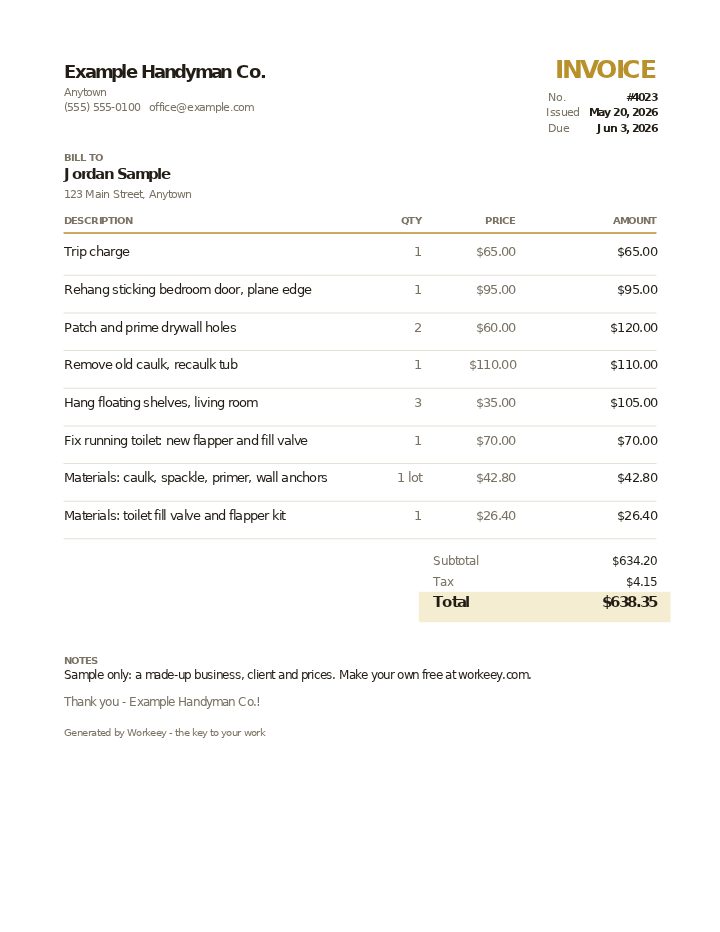
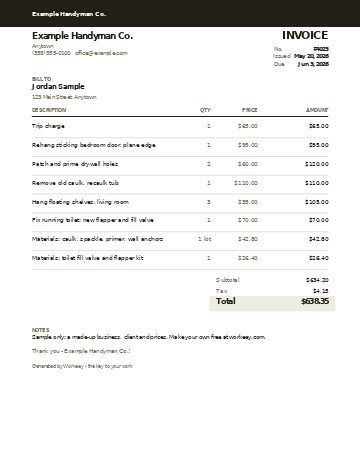
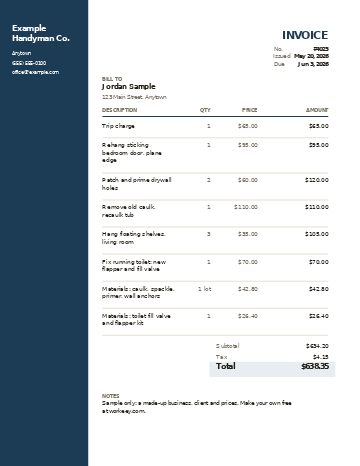
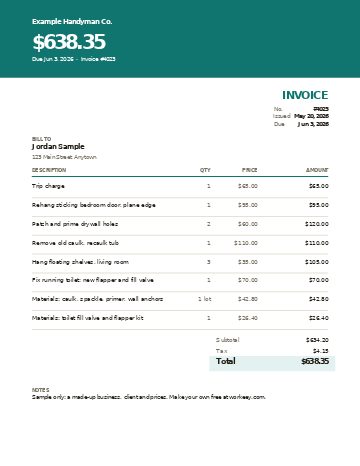
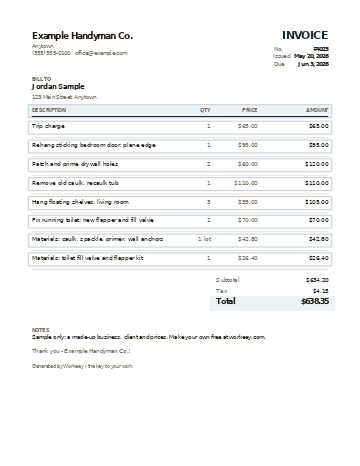
Here is the template used for a typical punch list visit at a house a client is getting ready to rent out. The business, the client and the prices are invented. Each task has its own flat price, the trip charge sits on its own line, and the materials bought on the way are listed separately and are the only taxed lines. Whether labor is taxed depends on your state, so check before you copy that.
| Qty | Price | Amount | |
|---|---|---|---|
| Trip charge | 1 | $65.00 | $65.00 |
| Rehang sticking bedroom door, plane edge | 1 | $95.00 | $95.00 |
| Patch and prime drywall holes | 2 | $60.00 | $120.00 |
| Remove old caulk, recaulk tub | 1 | $110.00 | $110.00 |
| Hang floating shelves, living room | 3 | $35.00 | $105.00 |
| Fix running toilet: new flapper and fill valve | 1 | $70.00 | $70.00 |
| Materials: caulk, spackle, primer, wall anchors | 1 lot | $42.80 | $42.80 |
| Materials: toilet fill valve and flapper kit | 1 | $26.40 | $26.40 |
| Subtotal | $634.20 | ||
| Sales tax 6% on materials ($69.20) | $4.15 | ||
| Total due | $638.35 |
The store receipt came to $62.91, and materials bill at cost plus 10%, which makes $69.20. The trip charge covers the drive and is the minimum for any visit. Payment terms on this sample: due in 14 days, paid by card or bank from the pay link in the invoice email, or by check to Example Handyman Co.
How to invoice handyman work
Walk the list with the client before you start, agree a price on each task, and write it down. Small jobs are where misunderstandings breed: "fix the door" can mean a loose hinge screw or a new door. A short written list with prices, even a quick estimate, means the invoice holds no surprises. If you find something else while you are there, ask first, then add it as its own line.
Decide how you charge for small jobs and stick to it. A trip charge or a one or two hour minimum protects you from driving across town to tighten one cabinet hinge. For store runs, keep every receipt and bill materials at a small markup for the time spent shopping; for a bigger project like a deck repair, ask for money for materials up front and invoice it on its own. Clients who hire handymen often pay on the spot, so send the invoice before you pack up. If one goes past due, our late-payment reminder templates give you polite wording.
- Agree a price on each task before you pick up a tool
- Set a trip charge or visit minimum and say it when you book
- Keep every store receipt and bill materials on their own lines
- Add anything extra only after the client says yes
- Send the invoice before you leave, and list what is left for next time
Or do it free in Workeey
Writing out a ten-line punch list invoice by hand after a long day is where mistakes creep in. Workeey's invoicing makes the invoice from the finished job in one tap. The client, the property address and every task line come across, tax is added and the invoice gets its number. If you priced the list as an estimate first, one tap converts it into the invoice.
Workeey sends the invoice by email with a pay link in it; connect Stripe and the client can pay by card, Apple Pay, Google Pay or US bank straight from their inbox. Your invoices sit under draft, sent, paid or overdue, so a landlord who owes you for three visits does not slip by. You can switch on reminder texts for an invoice, and the client gets them on a schedule until it is paid, never more than eight. Invoicing is free on the free plan; pricing has the details, and Workeey for handymen shows everything else.
More for handymen: pages and free templates
- Handyman software — a day of small jobs in one app
- Invoicing for handymen — every task its own line
- How much to charge for handyman work — a guide to setting your prices
- How to start a handyman business — a step-by-step guide to going out on your own
- Best apps for a handyman business — the apps for this trade compared
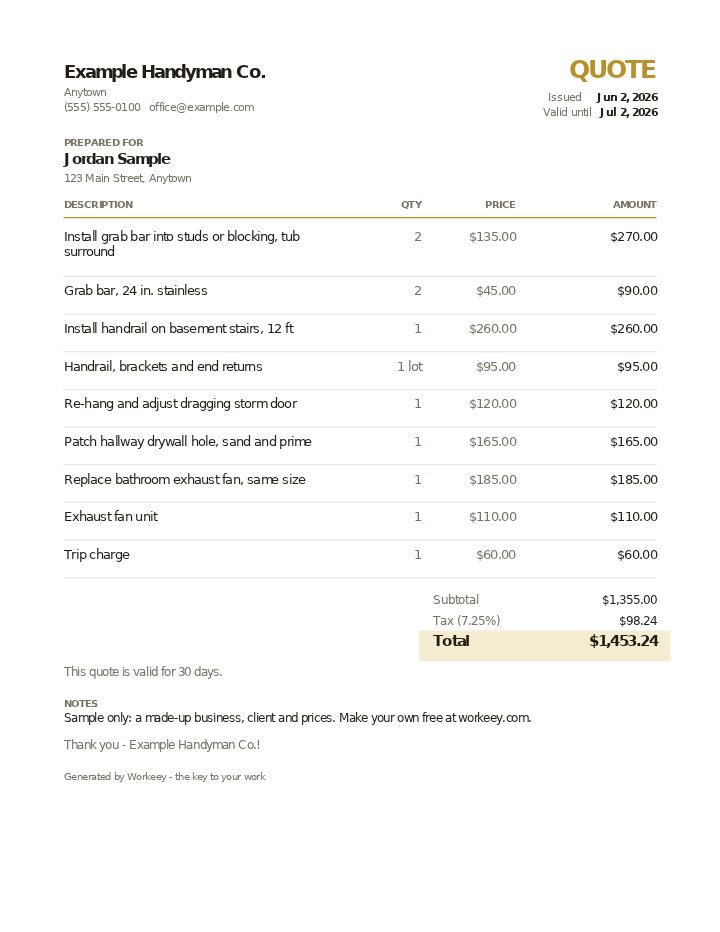
- Handyman estimate template — a free quote sample
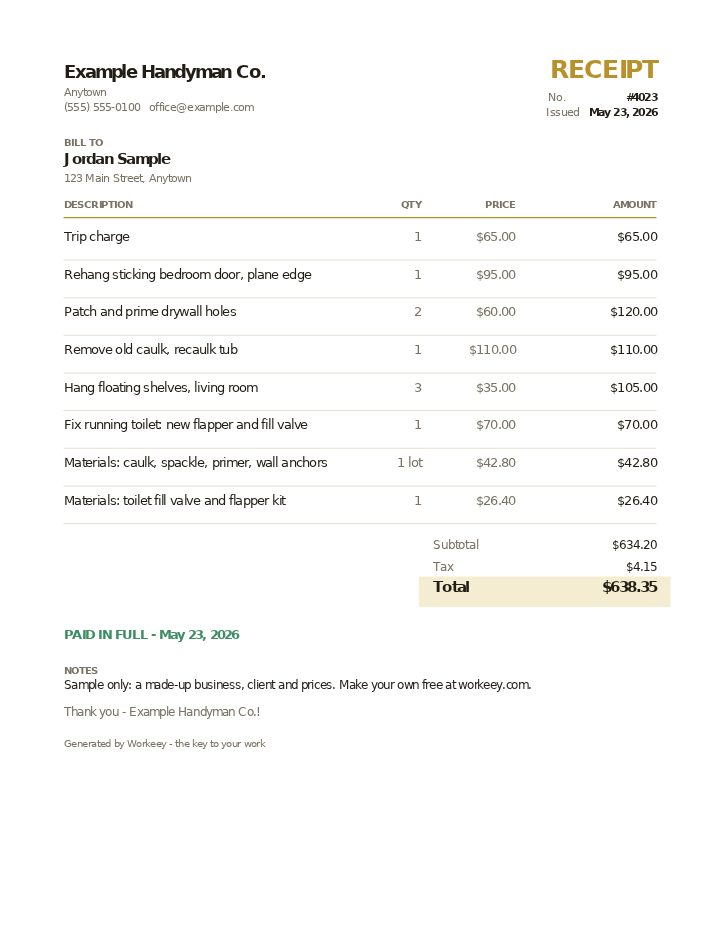
- Handyman receipt template — a free paid-in-full sample
- Handyman price list template — free, with sample prices
- Handyman work order template — free, with a filled-in sample
- Handyman wages by state — what employed general maintenance and repair workers earn in every state, from BLS data
- Free invoice template — every field a trade invoice needs
- Free estimate template — copy it, price it, send it
- Free receipt template — a paid-in-full receipt to copy
- Work order template — the job written down before you bill it
- Late payment reminder templates — texts, emails and a letter to copy and send
- All free templates and tools
How do handymen charge for small jobs?
Most use a flat price per task, an hourly rate, or a mix, plus a trip charge or a minimum for any visit. The minimum covers the drive and setup so a five-minute fix is still worth the trip.
Should I list every task separately on a handyman invoice?
Yes. One line per task, named by what and where, lets the client match each price to something they can see. A single "repairs" line invites questions and slows payment.
Can a handyman charge more than the receipt for materials?
Many do, adding a small markup for the time spent buying and hauling materials. Keep the receipts, list the materials on their own lines, and be ready to explain your markup if asked.
Do handymen charge sales tax?
It depends on your state. Some tax only the materials, some tax certain repair labor as well, and some tax neither. Keep tasks and materials on separate lines so you can tax the right part.