Workeey is built for your phone. Scan the code with your phone to get the Android app, or open workeey.com on your phone. The iPhone app and a desktop version are coming soon.
Get the Workeey app. Same account, same jobs.


Free general contractor estimate template, with a basement finish bid by trade
A general contractor's estimate is a stack of other people's prices plus yours. Breaking the bid out by trade, naming the allowances and showing a clear overhead and profit line lets the owner compare you to the next contractor line for line instead of by the bottom number alone. Copy the free general contractor estimate template below and check it against the sample basement finish bid. For the final bill, use the free invoice template.
Download this estimate template: Word, Excel or PDF
Free to download, with no sign-up and no email. Open the Word file to type over the brackets, or the Excel file to swap in your own lines — the totals follow. Prefer paper? Print the blank PDF and fill it in by pen.
- Word (.docx) — the blank estimate, ready to fill in
- Excel (.xlsx) — the sample lines with amounts, tax and the total that work themselves out
- PDF (.pdf) — the filled-in sample, drawn the way Workeey draws a quote
- Blank PDF (.pdf) — print it and fill it in by pen
- Google Docs — your own copy of the Word file, in your Google Drive (Google asks you to sign in)
- Google Sheets — your own copy of the Excel file, in your Google Drive (Google asks you to sign in)
Fill in this estimate online
Change anything and download the PDF — free, no sign-up. What you type isn't sent to Workeey. The PDF is made in your browser.
Quote it, then invoice it, in Workeey
- Share quote produces a quote PDF that stays good for 30 days.
- Twenty-three quick estimates a month come with the free plan.
What goes on a general contractor estimate
An owner hiring a general contractor is buying coordination: one price, one schedule and one person responsible for every trade. Your estimate should show that by listing the work in trade divisions, such as site work, framing, electrical, mechanical, drywall, finishes and general conditions, with a price for each. Head it with your business name, license number, phone and email, then the owner, the project address, a bid number, the date and how long the price holds.
Allowances belong on their own lines with the amount and what it covers, because they are where owners get surprised. Say plainly that if the owner picks a more expensive floor than the allowance, the difference is added, and if they spend less, it comes off. Finish with the plans or drawings the bid is based on, the permit, the exclusions and the payment schedule.
- Business name, license number, phone and email
- Owner name and project address
- Bid or estimate number, date and a valid-until date
- The plans, drawings or walk-through the price is based on
- Work broken into trades, own crew and subcontractors
- Allowances with their amount and what happens if the owner goes over
- General conditions: permit, dumpster, supervision, cleanup
- Overhead and profit, exclusions, payment schedule and acceptance
Copy this general contractor estimate template
Use the text below as your bid form. Fill in the brackets, keep one line per trade, and delete trades the project does not touch.
Write a scope sentence for each trade so the subs and the owner read the same thing: "Electrical: 12 recessed lights, 14 outlets, two new 20-amp circuits, smoke and CO detectors to code." The skeleton:
- [Your business name] · License #[number] · [phone] · [email]
- Bid #[1309] · Date: [date] · Valid until: [date, e.g. 30 days]
- Owner: [name] · Project: [address] · Based on: [plans dated / walk-through on date]
- General conditions — [permit, dumpster, supervision] = [$]
- [Trade, e.g. framing and insulation] — [own crew / sub name] — [scope] = [$]
- [Trade, e.g. electrical] — [sub] — [scope] = [$]
- [Trade, e.g. drywall, paint, trim] — [scope] = [$]
- Allowance: [item, e.g. flooring] — [quantity] × [allowance rate] = [$]
- Overhead and profit — [%] of [which lines] = [$]
- Not included: [e.g. furniture moving, appliances, design changes]
- Subtotal [$] · Sales tax [rate]% [$] · Total [$]
- Payment schedule: [e.g. deposit %, at rough-in, at drywall, at completion]
- Accepted by: [name] · [date]
Sample general contractor estimate (quote), filled in
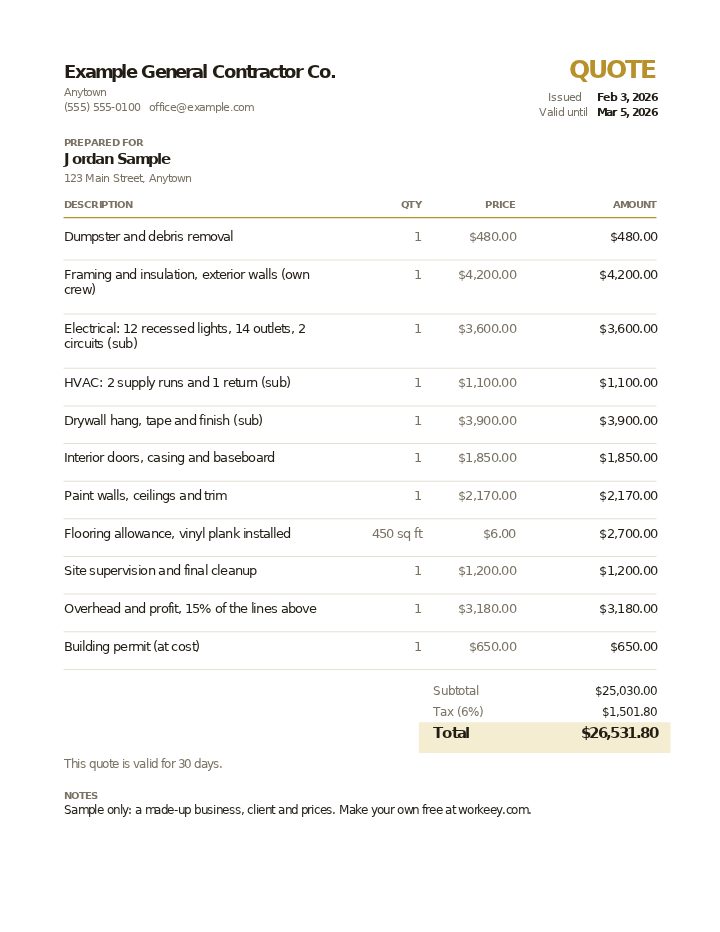
This sample is a bid to finish a 450 square foot basement: framing and insulating the outside walls, a licensed electrician's wiring, two heating and cooling runs, drywall, doors and trim, paint, and a vinyl plank floor carried as an allowance. The permit is at cost and kept out of the markup. The business, client and prices are invented, and tax is applied to the whole subtotal to keep it simple; contract work is taxed very differently from state to state.
| Qty | Price | Amount | |
|---|---|---|---|
| Dumpster and debris removal | 1 | $480.00 | $480.00 |
| Framing and insulation, exterior walls (own crew) | 1 | $4,200.00 | $4,200.00 |
| Electrical: 12 recessed lights, 14 outlets, 2 circuits (sub) | 1 | $3,600.00 | $3,600.00 |
| HVAC: 2 supply runs and 1 return (sub) | 1 | $1,100.00 | $1,100.00 |
| Drywall hang, tape and finish (sub) | 1 | $3,900.00 | $3,900.00 |
| Interior doors, casing and baseboard | 1 | $1,850.00 | $1,850.00 |
| Paint walls, ceilings and trim | 1 | $2,170.00 | $2,170.00 |
| Flooring allowance, vinyl plank installed | 450 sq ft | $6.00 / sq ft | $2,700.00 |
| Site supervision and final cleanup | 1 | $1,200.00 | $1,200.00 |
| Overhead and profit, 15% of the lines above | 1 | $3,180.00 | $3,180.00 |
| Building permit (at cost) | 1 | $650.00 | $650.00 |
| Subtotal | $25,030.00 | ||
| Sales tax 6% | $1,501.80 | ||
| Total | $26,531.80 |
Subcontractor lines are their quotes as received. The nine lines above the overhead and profit line add up to $21,200, and overhead and profit is 15% of that, $3,180. The permit is passed through at cost with no markup. The flooring allowance is $6 a square foot installed; a pricier floor adds the difference and a cheaper one takes it off. This quote is valid for 30 days.
How to price a general contractor estimate
Get written numbers from your subs before you send the bid, and give each sub the same scope sentence you put on your estimate. Price your own crew's work by hours and materials like any trade. Then add general conditions, the costs of running the job that belong to no trade: permit, dumpster, portable toilet, protection, supervision and final cleanup. Contractors who skip these end up paying for them out of profit.
Overhead and profit is usually a percentage of the work, often 10 to 20 percent for small remodels. Showing it as one line is honest and makes it easy to adjust for a change order later. Decide whether you mark up allowances and the permit, and say so. The estimate vs quote guide explains how a bid differs from a rough estimate.
- Get written sub quotes against the same scope you give the owner
- Price general conditions as their own line, every time
- Show overhead and profit as one clear percentage line
- Carry undecided finishes as allowances with a stated rate
- Tie the payment schedule to milestones the owner can see
Estimate, quote, then invoice — in Workeey
Workeey stores each general contractor estimate inside the job, next to the owner's details and the project address. You enter your rates once, from hourly and first hour to call-out, travel, evenings and weekends, parts markup and deposit percent, and the AI itemizes the estimate from them. Materials are priced from the web at your markup. Lines you type yourself, like a sub's drywall price or "site supervision and cleanup", are remembered for the next bid. Twenty-three quick estimates a month come with the free plan.
Share quote produces a quote PDF that stays good for 30 days; share it from your phone, or tap Email to open your own mail app with it. The deposit percent prints on the quote, and you collect it your own way, because Workeey does not take deposits or partial payments. The owner doesn't sign anything in the app; they accept with you directly, and when the project is ready to bill, one tap turns the estimate into an invoice that Workeey emails with a pay link. See the free estimate template and pricing.
More for general contractors: pages and free templates
- Best invoice apps for contractors — the apps for this trade compared
- Contractor receipt template — a free paid-in-full sample
- Free invoice template — every field a trade invoice needs
- Free estimate template — copy it, price it, send it
- Free receipt template — a paid-in-full receipt to copy
- Work order template — the job written down before you bill it
- Late payment reminder templates — texts, emails and a letter to copy and send
- All free templates and tools
What is the difference between a bid and an estimate?
In construction a bid is usually a firm price submitted to win a project, often against other contractors, while an estimate can be a rough figure. On small jobs the words are used loosely, so say on the paper whether the price is fixed.
How much should a general contractor mark up?
Many small-project contractors use 10 to 20 percent for overhead and profit on top of costs. The right number is whatever covers your office, insurance, vehicles and time, plus the profit you need.
Should I show subcontractor prices to the owner?
You don't have to show each sub by name, but breaking the bid out by trade helps the owner compare bids and makes change orders easier to price later.
How do allowances work on a construction estimate?
An allowance is a set amount for something the owner has not picked yet, like flooring or light fixtures. If the final choice costs more, the difference is added to the invoice; if it costs less, it is credited.