Workeey is built for your phone. Scan the code with your phone to get the Android app, or open workeey.com on your phone. The iPhone app and a desktop version are coming soon.
Get the Workeey app. Same account, same jobs.


Free painting invoice template, with a sample interior repaint
Painting clients see the finished walls, not the six hours of patching and taping that came before them. A good painting invoice shows both: the prep, the coats, the gallons and the supplies, each on its own line. Copy the free template below, compare it with the filled-in interior repaint, and send yours today. For a general version, see the free invoice template, or let Workeey's invoicing build it from the finished job.
Download this invoice template: Word, Excel or PDF
Free to download, with no sign-up and no email. Open the Word file to type over the brackets, or the Excel file to swap in your own lines — the totals follow. Prefer paper? Print the blank PDF and fill it in by pen.
- Word (.docx) — the blank invoice, ready to fill in
- Excel (.xlsx) — the sample lines with amounts, tax and the total that work themselves out
- PDF (.pdf) — the filled-in sample, drawn the way Workeey draws an invoice
- Flat-rate PDF (.pdf) — the same job with the hours as one flat price, the same total
- Blank PDF (.pdf) — print it and fill it in by pen
- Google Docs — your own copy of the Word file, in your Google Drive (Google asks you to sign in)
- Google Sheets — your own copy of the Excel file, in your Google Drive (Google asks you to sign in)
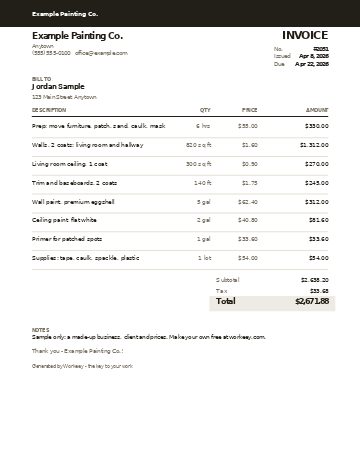
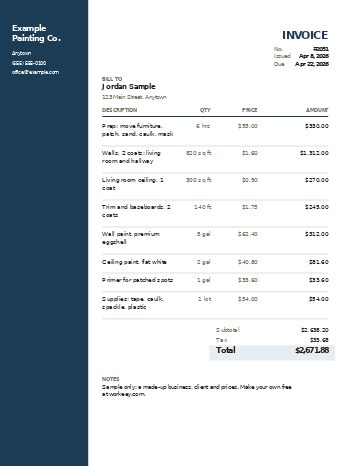
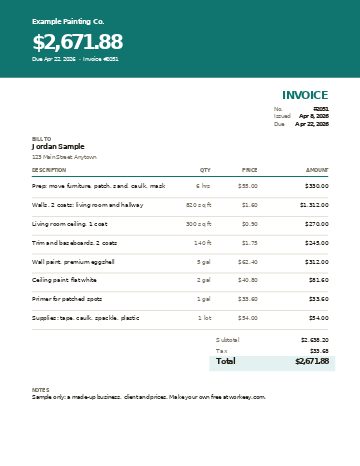
Fill in this invoice online
Change anything, pick a style, and download the PDF — free, no sign-up. What you type isn't sent to Workeey. The PDF is made in your browser.
Send it and get paid with Workeey
- Workeey emails the invoice to your client with a pay link in it.
- Each invoice moves through draft, sent, paid and overdue, so you always know which houses still owe you.
- For a slow payer, switch on reminder texts for that invoice and they go out on a schedule until it's paid, eight at most.
- Invoicing is free on the free plan.
Already have an invoice? The free invoice checker reads one you paste and says what it is missing.
What goes on a painting invoice
Most arguments over a paint bill start with a single line that says "Paint living room — $2,600." The client remembers two days of rolling and wonders where the rest went. Break the job into the pieces you actually priced: prep, wall coats, ceilings, trim and doors, and the paint and supplies you bought.
Put your business name, phone and email at the top, plus your contractor license number where your state requires one for painting. Then the client, the address of the house you painted, an invoice number, the date and a due date. Write down which rooms you painted and the colors and sheens used. That line saves you a phone call a year from now, when they want a touch-up and can't remember whether the hallway was eggshell or satin.
- Your business name, phone, email, and license number if your state asks for it
- Client name, billing address, and the address of the painted home
- Invoice number, date sent, and due date
- Rooms or areas painted, with the color names and sheens used
- Prep work: patching, sanding, caulking, masking, moving furniture
- Coats on walls, ceilings, trim and doors, by the square foot, linear foot, room or hour
- Paint by the gallon and supplies as one lot, priced with your markup
- Subtotal, sales tax on the taxable part, total due, and how to pay (is labor taxed in your state?)
Copy this painting invoice template
Paste these lines into a document or your notes app and fill in the brackets. Use whichever unit you bid in. If you priced walls by the square foot, keep square feet here; if you priced the whole room as one number, write the room and the number.
Leave the color line in even when it feels like extra typing. Brand, color name and sheen are the three things anyone needs to match the paint later.
- [Business name] · [license #] · [phone] · [email]
- Invoice #[2051] · Sent: [date] · Due: [date]
- Bill to: [client name] · [billing address] · Painted at: [home address]
- Areas: [rooms, e.g. living room, hallway] · Colors: [brand, color name, sheen]
- Prep — [hours] × [rate] = [$] (patch, sand, caulk, mask)
- Walls, [number] coats — [sq ft] × [rate per sq ft] = [$]
- Ceilings — [sq ft] × [rate] = [$]
- Trim and doors — [linear ft or count] × [rate] = [$]
- [Paint product] — [gallons] × [your price per gallon] = [$]
- Supplies — [tape, caulk, plastic, patch] = [$]
- Subtotal [$] · Sales tax [rate]% on [taxable part] [$] · Total due [$]
- Terms: [due date] · Pay by [pay link or check to business name] · [touch-up promise, if any]
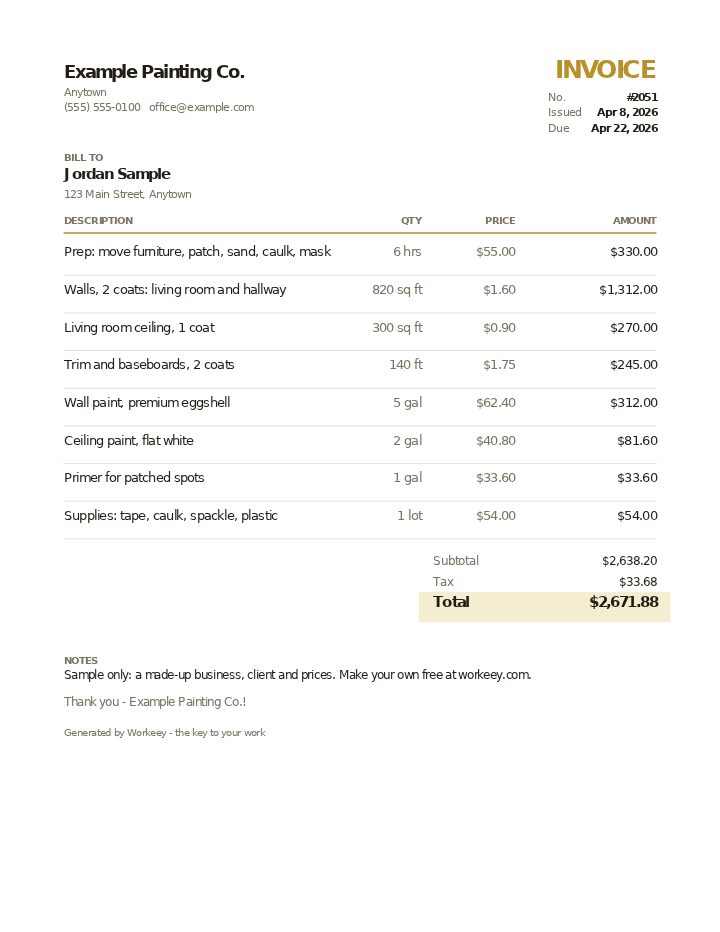
Sample painting invoice, filled in
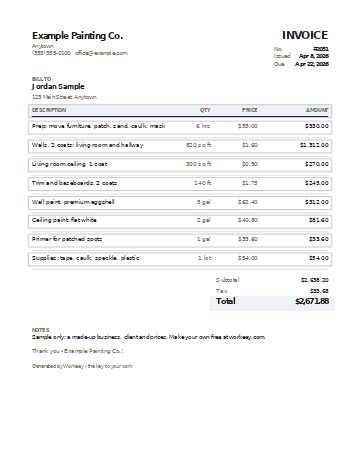
Here is the template on a common job: a living room and hallway repainted in two coats, with the living room ceiling freshened and the trim redone. The business, the client and the prices are made up. The wall price per square foot covers both coats, the paint is billed by the gallon, and tax is charged only on the paint and supplies, which is how many states handle it. Some states tax the whole painting bill, so check yours.
| Qty | Price | Amount | |
|---|---|---|---|
| Prep: move furniture, patch, sand, caulk, mask | 6 hrs | $55.00 / hr | $330.00 |
| Walls, 2 coats: living room and hallway | 820 sq ft | $1.60 / sq ft | $1,312.00 |
| Living room ceiling, 1 coat | 300 sq ft | $0.90 / sq ft | $270.00 |
| Trim and baseboards, 2 coats | 140 ft | $1.75 / ft | $245.00 |
| Wall paint, premium eggshell | 5 gal | $62.40 / gal | $312.00 |
| Ceiling paint, flat white | 2 gal | $40.80 / gal | $81.60 |
| Primer for patched spots | 1 gal | $33.60 / gal | $33.60 |
| Supplies: tape, caulk, spackle, plastic | 1 lot | $54.00 | $54.00 |
| Subtotal | $2,638.20 | ||
| Sales tax 7% on paint and supplies ($481.20) | $33.68 | ||
| Total due | $2,671.88 |
Paint and primer are billed at cost plus 20%: the wall paint cost $52.00 a gallon and bills at $62.40, the ceiling paint cost $34.00 and bills at $40.80, and the primer cost $28.00 and bills at $33.60. The price per square foot of wall already covers both coats. Payment terms on this sample: due in 14 days, paid by card or bank from the pay link in the invoice email, or by check to Example Painting Co.
How to invoice painting work
Walk the rooms with the client before you pack up. Painting is a job people judge with their eyes, and a five-minute walk-through turns into a client who pays the invoice instead of sending a list of complaints next week. Fix anything they point out, then send the invoice while the drop cloths are still in the truck.
Be clear about extras before you do them. Painters lose money on the drywall repair nobody priced or the third coat a dark red wall needed. Say it out loud, agree the price, and put it on the invoice as its own line. On a big exterior job, ask for a deposit before you buy paint, bill it as a separate invoice, and show it as paid on the final one. If a client goes quiet after the due date, our late-payment reminder templates have the words, from a friendly nudge to a final notice.
- Do a walk-through and fix touch-ups before you invoice
- Bill in the same unit you quoted: square foot, room or hour
- Price extra coats and drywall repairs before you do them, then list them
- Write the colors and sheens on the invoice for future touch-ups
- Set a real due date and follow up the day after it passes
Or do it free in Workeey
In Workeey, the job already holds the client, the address and the lines you priced, so turning a finished job into an invoice is one tap. The invoice gets its number on its own and tax is added. If you started with an estimate, that same tap carries every line from the estimate onto the invoice.
Workeey emails the invoice to your client with a pay link in it. Connect Stripe and they can pay by card, Apple Pay, Google Pay or US bank account straight from the email; a small processing fee applies to online payments. Each invoice moves through draft, sent, paid and overdue, so you always know which houses still owe you. For a slow payer, switch on reminder texts for that invoice and they go out on a schedule until it's paid, eight at most. Invoicing is free on the free plan, and pricing covers the rest.
More for painters: pages and free templates
- Painting business software — quotes, prep days and the final bill
- Invoicing for painters — prep, coats and the balance after a deposit
- How to price painting jobs — a guide to setting your prices
- How to start a painting business — a step-by-step guide to going out on your own
- Best apps for painting contractors — the apps for this trade compared
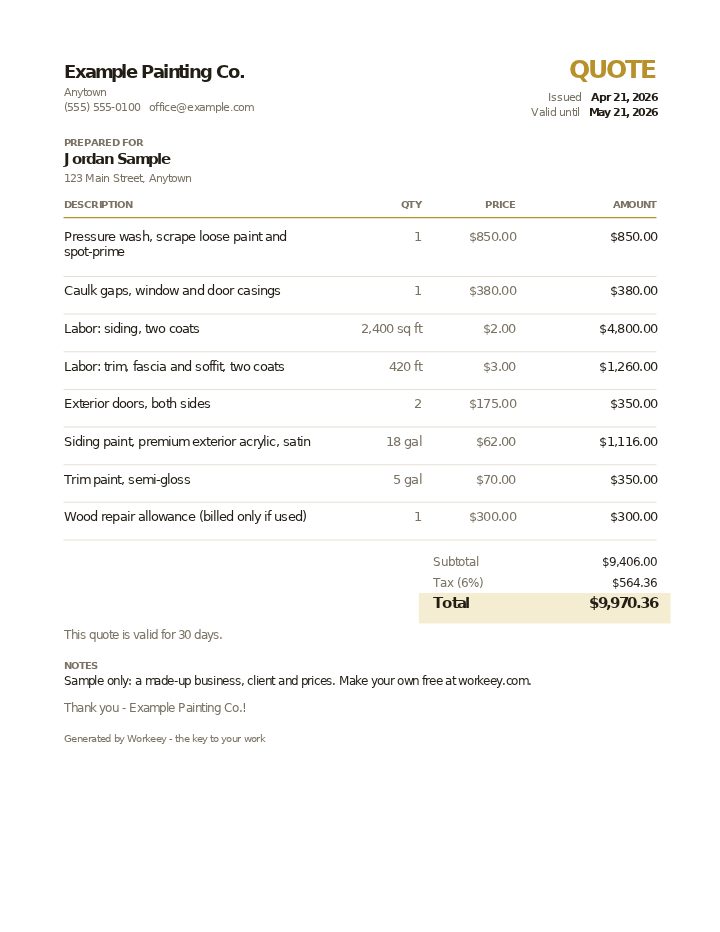
- Painting estimate template — a free quote sample
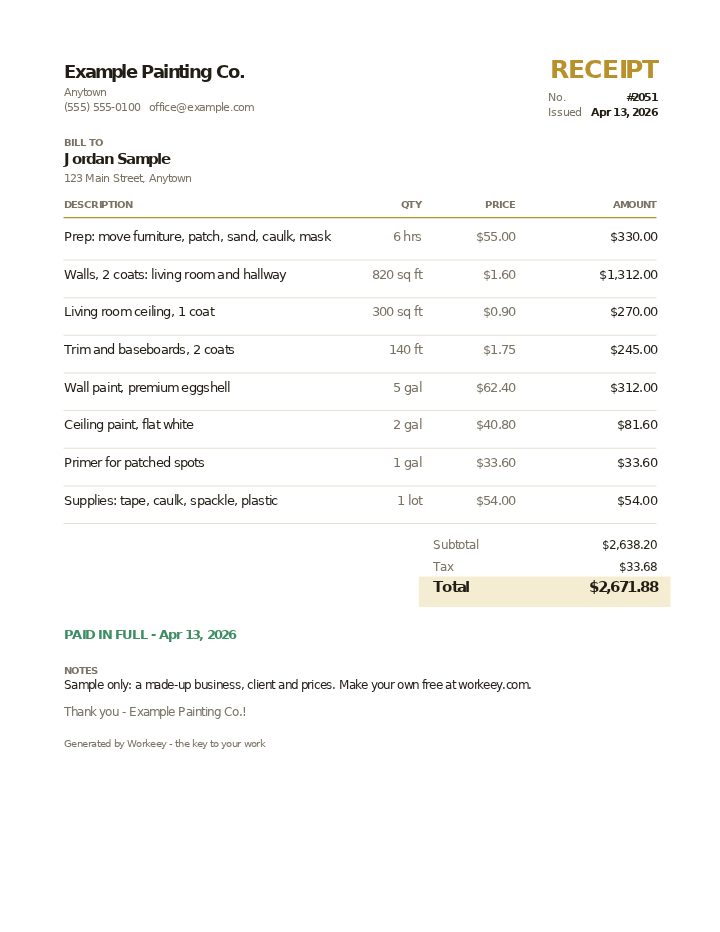
- Painting receipt template — a free paid-in-full sample
- Painter wages by state — what employed painters earn in every state, from BLS data
- Free invoice template — every field a trade invoice needs
- Free estimate template — copy it, price it, send it
- Free receipt template — a paid-in-full receipt to copy
- Work order template — the job written down before you bill it
- Late payment reminder templates — texts, emails and a letter to copy and send
- All free templates and tools
How do painters write an invoice?
List the prep, each coat on walls, ceilings and trim in the unit you quoted, the paint by the gallon and the supplies as one line. Then the subtotal, any sales tax and the total due.
Should a painting invoice list paint separately from labor?
Usually, yes. A separate paint line shows the client what the material cost, and in many states only materials are taxable, so splitting them keeps the tax right. If you bid one all-in price, a single line works, but write the paint brand and color under it.
How much do painters mark up paint?
Many painters add 10 to 25% over what they paid, to cover the store runs, returns and leftover cans. Whatever you add, build it into the price per gallon instead of showing a separate markup line.
When should a painter get paid?
Small interior jobs are usually paid when the work is done, with a 7 or 14 day due date. On bigger jobs many painters take a deposit before buying paint and bill the rest at the end.