Workeey is built for your phone. Scan the code with your phone to get the Android app, or open workeey.com on your phone. The iPhone app and a desktop version are coming soon.
Get the Workeey app. Same account, same jobs.


Free flooring invoice template, with a hardwood refinish filled in
Floors are priced by the square foot, and a flooring invoice should be too. When the client can see the measured area, the rate per foot and the extras like stair treads, trim and patched boards on their own lines, the total explains itself. Copy the free flooring invoice template below, compare it with the filled-in sample for a sand-and-refinish job, and send it once the last coat has cured.
Download this invoice template: Word, Excel or PDF
Free to download, with no sign-up and no email. Open the Word file to type over the brackets, or the Excel file to swap in your own lines — the totals follow. Prefer paper? Print the blank PDF and fill it in by pen.
- Word (.docx) — the blank invoice, ready to fill in
- Excel (.xlsx) — the sample lines with amounts, tax and the total that work themselves out
- PDF (.pdf) — the filled-in sample, drawn the way Workeey draws an invoice
- Blank PDF (.pdf) — print it and fill it in by pen
- Google Docs — your own copy of the Word file, in your Google Drive (Google asks you to sign in)
- Google Sheets — your own copy of the Excel file, in your Google Drive (Google asks you to sign in)
Fill in this invoice online
Change anything, pick a style, and download the PDF — free, no sign-up. What you type isn't sent to Workeey. The PDF is made in your browser.
Send it and get paid with Workeey
- Workeey emails the invoice to the client with a pay link.
- You see every invoice as draft, sent, paid or overdue, and for one that's slipping you can switch on reminder texts, which go out on a schedule, up to eight, until it's paid.
- Invoicing is free on the free plan.
Already have an invoice? The free invoice checker reads one you paste and says what it is missing.
What goes on a flooring invoice
A flooring invoice should describe the floor as clearly as the estimate did. Say which rooms, the measured square footage, and the product: the species and finish for hardwood, or the brand, line and color for vinyl plank, tile or carpet. The client will need that line for a warranty claim or a matching repair.
Then split the job the way the work actually happened. Prep is its own line, whether that's tearing out carpet, leveling a subfloor or sanding. Installation or finishing goes by the square foot. Stairs are counted by the tread, trim by the linear foot, and transitions by the piece. Anything you found once the floor was open, like soft subfloor or rotten boards, gets a line with a quantity so the client can see why the total moved.
- Business name, phone, email and license number if your state requires one
- Client name, billing address and the job address
- Invoice number, date, due date and the estimate it came from
- Rooms covered and the measured square footage
- Product details: species, brand, line, color, finish
- Prep, install or finishing by the square foot
- Stairs by the tread, trim by the foot, transitions by the piece
- Repairs found on the job, furniture moving and haul-away
Copy this flooring invoice template
Copy these lines into a document and fill the brackets. Keep the square footage on every rate line, even if the client only cares about the total: when a room was measured at 210 square feet and someone remembers it as smaller, the number in writing settles it.
If the client bought the material, say so in the scope line: you're billing labor only, and your warranty covers the install, not the product.
- [Business name] · [license # if required] · [phone] · [email]
- Invoice #[1876] · Date: [date] · Due: [date] · Estimate #: [if any]
- Bill to: [client] · [billing address] · Job: [address]
- Scope: [rooms] · [measured sq ft] · Product: [species / brand, line, color, finish]
- Prep or tear-out — [sq ft] × [rate] = [$]
- Install or finish — [sq ft] × [rate] = [$]
- Materials supplied by us — [qty] × [your price] = [$]
- Stairs — [treads] × [rate per tread] = [$]
- Trim / transitions — [ft or pieces] × [rate] = [$]
- Repairs found on the job — [qty] × [agreed rate] = [$]
- Furniture moving / haul-away — [$]
- Subtotal [$] · Sales tax [rate]% on [what is taxable] [$] · Total due [$]
- Workmanship warranty: [term] · Cure time: [days before rugs] · Terms: [due date]
Sample flooring invoice, filled in
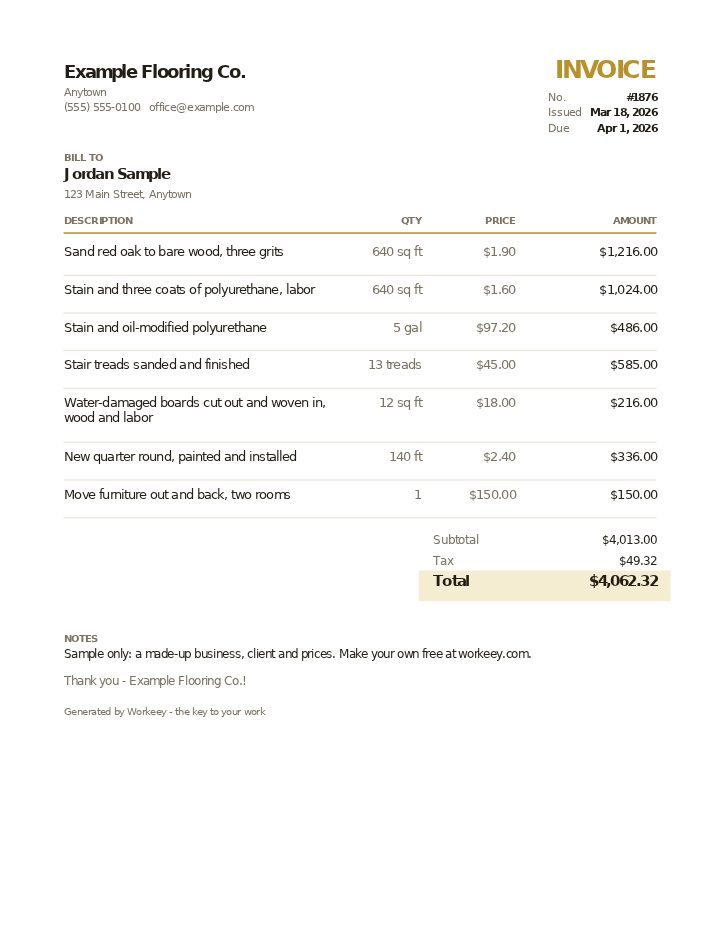
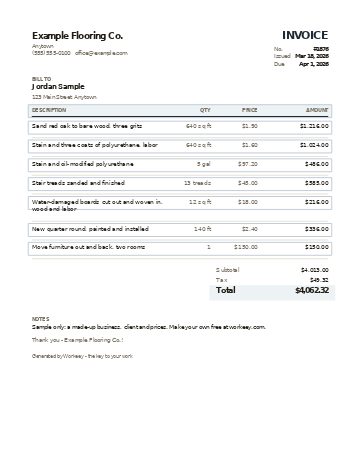
This is the template filled in for a sand-and-refinish job on red oak: 640 square feet across the living room, dining room and hall, sanded to bare wood, stained and given three coats of oil-modified polyurethane, plus the 13 stair treads, new quarter round and a small patch of water-damaged boards. The business, the client and the numbers are made up. Tax is charged here on the finish materials and trim only; how flooring labor is taxed depends on your state.
| Qty | Price | Amount | |
|---|---|---|---|
| Sand red oak to bare wood, three grits | 640 sq ft | $1.90 / sq ft | $1,216.00 |
| Stain and three coats of polyurethane, labor | 640 sq ft | $1.60 / sq ft | $1,024.00 |
| Stain and oil-modified polyurethane | 5 gal | $97.20 / gal | $486.00 |
| Stair treads sanded and finished | 13 treads | $45.00 / tread | $585.00 |
| Water-damaged boards cut out and woven in, wood and labor | 12 sq ft | $18.00 / sq ft | $216.00 |
| New quarter round, painted and installed | 140 ft | $2.40 / ft | $336.00 |
| Move furniture out and back, two rooms | 1 | $150.00 | $150.00 |
| Subtotal | $4,013.00 | ||
| Sales tax 6% on finish materials and trim ($822.00) | $49.32 | ||
| Total due | $4,062.32 |
Stain and finish are billed at cost plus 20 percent: $81.00 a gallon became $97.20. The area is the measured floor of the living room, dining room and hall, not the room sizes rounded up. The 12 square feet of new boards replaced water damage found by the kitchen doorway once the old finish came off; the client saw it and agreed the price per square foot before the boards were cut. Payment terms on this sample: due in 14 days, paid by card or bank from the pay link in the invoice email, or by check to Example Flooring Co.
How to invoice flooring work
Measure the floor yourself before you price it and again when the job is done, and invoice the measured number. If the final measure differs from the estimate, the per-foot rate stays the same and only the area changes, which is easy to explain on one line. Our flooring estimate template uses the same per-foot lines, so the two documents match.
Material is often the largest number on an install. On a big order, many flooring pros ask the client to pay for the material up front on its own invoice, then bill the labor at the end. If they did, write "Material invoice #[…] paid [date]" in the notes of the final invoice and leave only the work still owed on the lines, so the total is the balance. Put cure time on the invoice too, since the client walking on a wet coat is the most common callback in refinishing.
- Invoice the measured square footage, not the listing's room sizes
- Give stairs, trim and transitions their own counted lines
- Agree a per-foot price for subfloor or board repairs before work starts
- Name the product exactly, for the client's warranty and future repairs
- Write the cure time and when rugs and furniture can go back
Or do it free in Workeey
With Workeey the flooring job holds the address, the room measurements and your notes. When the floor is done, one tap turns the job or its estimate into an invoice, with the client, the address and every per-foot line carried across, tax added and the invoice numbered for you. To check that your per-foot rate covers your costs, the hourly rate calculator and markup calculator help.
Workeey emails the invoice to the client with a pay link. Once you connect Stripe, they can pay by card, Apple Pay, Google Pay or US bank from that link, and a small processing fee applies to online payments. You see every invoice as draft, sent, paid or overdue, and for one that's slipping you can switch on reminder texts, which go out on a schedule, up to eight, until it's paid. Invoicing is free on the free plan.
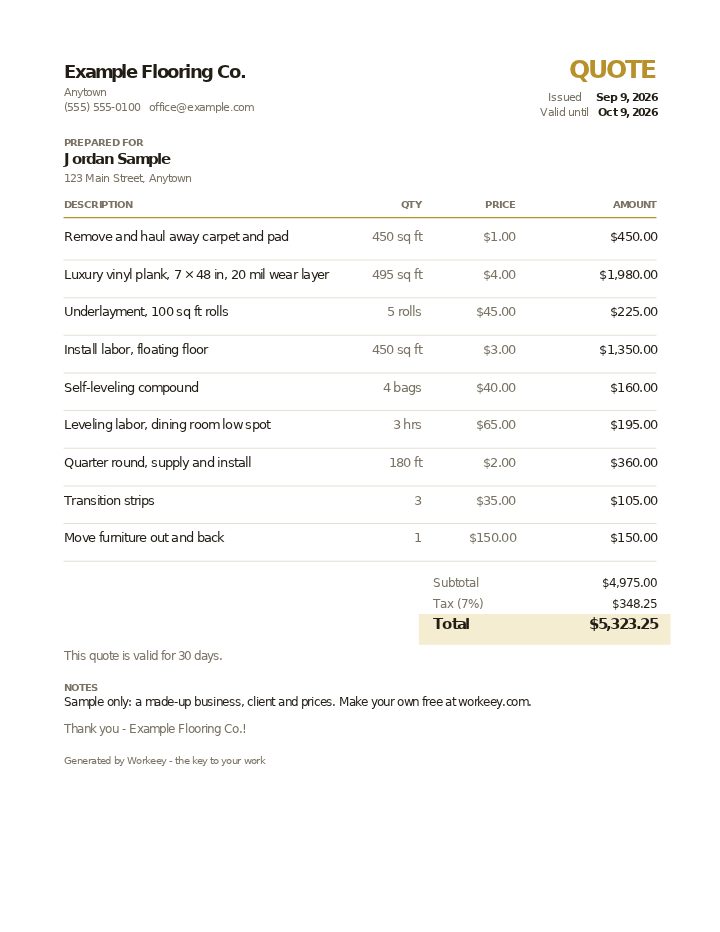
More for flooring installers: pages and free templates
- Flooring estimate template — a free quote sample
- Free invoice template — every field a trade invoice needs
- Free estimate template — copy it, price it, send it
- Free receipt template — a paid-in-full receipt to copy
- Work order template — the job written down before you bill it
- Late payment reminder templates — texts, emails and a letter to copy and send
- All free templates and tools
How do flooring contractors charge?
Mostly by the square foot, with separate rates for prep, installation or refinishing. Stairs are priced per tread, trim per linear foot, and extras like furniture moving, subfloor repair and haul-away are their own lines.
What should a flooring invoice include?
Your business details, the client and job address, the rooms and measured square footage, the exact product, each part of the work with its quantity and rate, materials you supplied, tax if it applies, the total, the warranty and the payment terms.
Should I charge for materials separately on a flooring invoice?
Listing materials on their own line makes the bill easier to understand and lets you tax them correctly where only materials are taxable. Many pros bill a large material order up front on its own invoice and the labor when the job is finished.
How much should I charge to refinish hardwood floors?
It varies a lot by region and condition. Work out your own rate from your costs and time per square foot, then add stairs, stain, repairs and furniture moving as separate lines rather than one bigger per-foot number.