Workeey is built for your phone. Scan the code with your phone to get the Android app, or open workeey.com on your phone. The iPhone app and a desktop version are coming soon.
Get the Workeey app. Same account, same jobs.


Free HVAC invoice template, with an AC repair sample
HVAC invoices get questioned more than most, usually over two lines: the diagnostic fee and the refrigerant. Both are fair charges, and both read better when the invoice says what they are. Copy the free HVAC invoice template below, compare it to the AC repair sample, and send it before you pull out of the driveway. Or have Workeey build it from the job.
Download this invoice template: Word, Excel or PDF
Free to download, with no sign-up and no email. Open the Word file to type over the brackets, or the Excel file to swap in your own lines — the totals follow. Prefer paper? Print the blank PDF and fill it in by pen.
- Word (.docx) — the blank invoice, ready to fill in
- Excel (.xlsx) — the sample lines with amounts, tax and the total that work themselves out
- PDF (.pdf) — the filled-in sample, drawn the way Workeey draws an invoice
- Flat-rate PDF (.pdf) — the same job with the hours as one flat price, the same total
- Blank PDF (.pdf) — print it and fill it in by pen
- Google Docs — your own copy of the Word file, in your Google Drive (Google asks you to sign in)
- Google Sheets — your own copy of the Excel file, in your Google Drive (Google asks you to sign in)
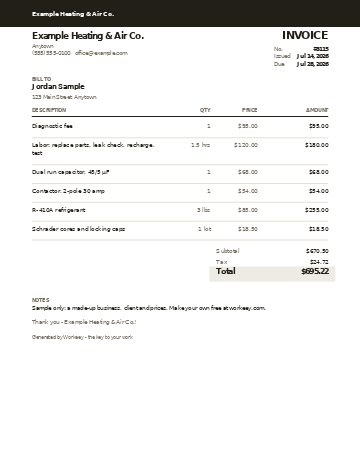
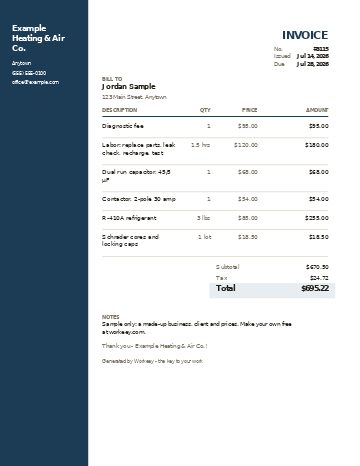
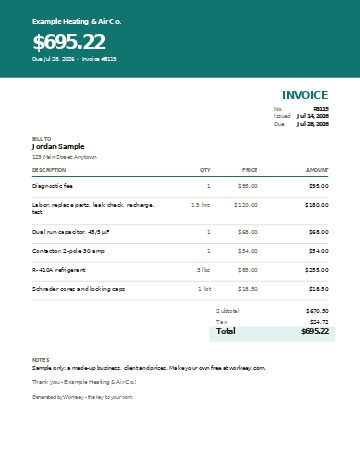
Fill in this invoice online
Change anything, pick a style, and download the PDF — free, no sign-up. What you type isn't sent to Workeey. The PDF is made in your browser.
Send it and get paid with Workeey
- The customer gets the invoice by email with a pay link, and once you connect Stripe they can pay it by card, Apple Pay, Google Pay or US bank.
- Each invoice reads draft, sent, paid or overdue, so you know who still owes you after a busy week.
- Turn on reminder texts for any invoice and the customer gets texts on a schedule until it is paid, up to eight.
- Invoicing is free on the free plan.
Already have an invoice? The free invoice checker reads one you paste and says what it is missing.
What goes on an HVAC invoice
A no-cool call in July or a no-heat call in January ends with a homeowner who is relieved and a little nervous about the bill. Your invoice should calm them. Put your company name, phone, email, address and your contractor license number at the top. Then the customer's name, billing address and the address of the equipment, which matters for landlords and property managers who own several places.
Add the invoice number, the date and a due date. Then write down the system you worked on: brand, model and the refrigerant it uses. That one line makes your next visit faster and helps if a warranty claim comes up. After it, list the diagnostic, the labor, each part you replaced and the refrigerant by the pound. A homeowner who sees "3 lbs R-410A" understands a lot more than one who sees "recharge".
- Company name, phone, email, address and license number
- Customer name, billing address and the equipment address
- Invoice number, date and due date
- The equipment: brand, model, serial if you have it, and refrigerant type
- Diagnostic or service call fee
- Labor as hours × rate, or your flat-rate repair price
- Each part replaced, and refrigerant by the pound
- Subtotal, sales tax on the taxable items, total due and how to pay (is labor taxed in your state?)
Copy this HVAC invoice template
Here it is in plain lines, ready to paste into whatever you use. Fill the brackets, remove what you do not need and keep a blank master. If you work on a flat-rate price book, replace the labor line with the repair name and its price, and leave the parts inside it. If you bill time and materials, keep labor and parts apart as shown.
Fill in the equipment line every time, even on a quick capacitor swap. Next summer, it tells you what you are walking up to. The skeleton:
- [Company name] · License #[number] · [phone] · [email] · [address]
- Invoice #[3001] · Date: [date] · Due: [date]
- Customer: [name] · [billing address] · Equipment at: [address]
- Equipment: [brand] [model] · Serial [number] · Refrigerant [type]
- Complaint: [what the customer reported] · Found: [what you found] · Fixed: [what you did]
- Diagnostic fee — [$]
- Labor — [hours] × [rate] = [$], or Flat-rate repair — [name] = [$]
- [Part] — [qty] × [your price] = [$] (one line per part)
- Refrigerant [type] — [lbs] × [price per lb] = [$]
- Subtotal [$] · Sales tax [rate]% on [taxable items] [$] · Total due [$]
- Terms: due [date] · Pay by [card or bank pay link] or [check to your company] · [parts and labor warranty]
Sample HVAC invoice, filled in
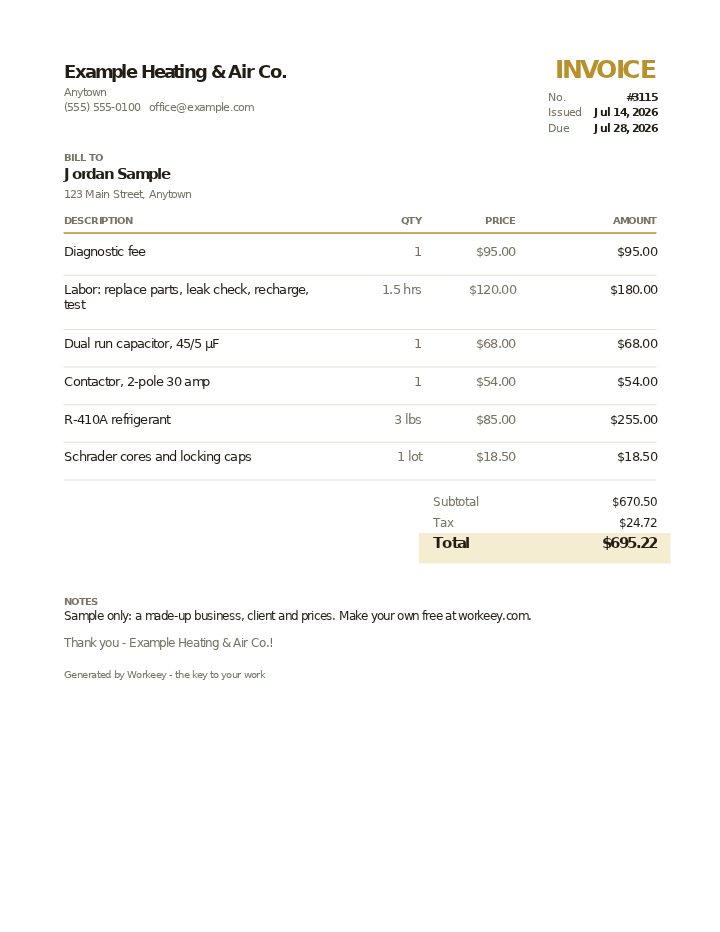
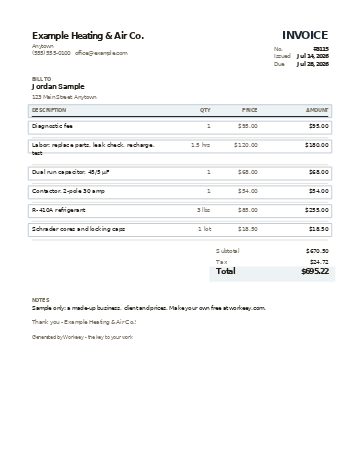
Here is the template filled in for a common summer call: a central AC blowing warm air, with a failed run capacitor, a pitted contactor and a system low on charge. The company, the customer and the prices are made up. Labor is billed by the hour here; if you use flat-rate pricing, that is fine too, just keep the parts visible. Tax is charged on parts and refrigerant only, which is common but not universal, so check your state.
| Qty | Price | Amount | |
|---|---|---|---|
| Diagnostic fee | 1 | $95.00 | $95.00 |
| Labor: replace parts, leak check, recharge, test | 1.5 hrs | $120.00 / hr | $180.00 |
| Dual run capacitor, 45/5 µF | 1 | $68.00 | $68.00 |
| Contactor, 2-pole 30 amp | 1 | $54.00 | $54.00 |
| R-410A refrigerant | 3 lbs | $85.00 / lb | $255.00 |
| Schrader cores and locking caps | 1 lot | $18.50 | $18.50 |
| Subtotal | $670.50 | ||
| Sales tax 6.25% on parts and refrigerant ($395.50) | $24.72 | ||
| Total due | $695.22 |
Parts are billed at the company's price, not its cost: the capacitor cost $34 and bills at $68, the contactor cost $27 and bills at $54. Refrigerant is billed per pound actually added, read off the scale. Payment terms on this sample: due in 14 days, paid by card or bank from the pay link in the invoice email, or by check to Example Heating & Air Co.
How to invoice HVAC work
Say the diagnostic fee out loud when the customer books, and say whether it is credited toward the repair if they go ahead. Either way is fine; surprising them with it is not. On the invoice, show it as its own line. Do the same with after-hours or weekend rates: if a call at 9 pm costs more, the line should say so, and so should the person who booked it.
Refrigerant is where trust is won or lost. Weigh what you add and write the pounds and the type on the invoice. If the system keeps losing charge, write that on the invoice too, along with your recommendation, so the homeowner has it in writing when you come back. For a full system replacement, quote it first, and since equipment can run into thousands, asking for a deposit before you order it is normal; bill that deposit separately and show it as paid on the final invoice. When a due date passes, our late-payment reminder templates help you follow up.
- Tell the customer the diagnostic fee and whether it is credited, before you arrive
- Write the equipment's brand, model and refrigerant type on every invoice
- Bill refrigerant by the weighed pound, with the type named
- Note a leak you found but did not fix, with your recommendation
- Quote replacements first and ask for a deposit before ordering equipment
Or do it free in Workeey
A paper template still leaves you numbering invoices, retyping addresses and working out tax on your phone's calculator in the truck. With Workeey's invoicing, one tap turns the finished job into an invoice: customer, address and lines already on it, tax added, number set. Quoted the replacement first? One tap turns the estimate into the invoice.
The customer gets the invoice by email with a pay link, and once you connect Stripe they can pay it by card, Apple Pay, Google Pay or US bank. Each invoice reads draft, sent, paid or overdue, so you know who still owes you after a busy week. Turn on reminder texts for any invoice and the customer gets texts on a schedule until it is paid, up to eight. Invoicing is free on the free plan; see pricing for the plans, and Workeey for HVAC for the rest of the app.
More for HVAC techs: pages and free templates
- HVAC software — the whole HVAC business in one app
- HVAC invoicing — installs, refrigerant and parts on one bill
- How to start an HVAC business — a step-by-step guide to going out on your own
- Best apps for an HVAC business — the apps for this trade compared
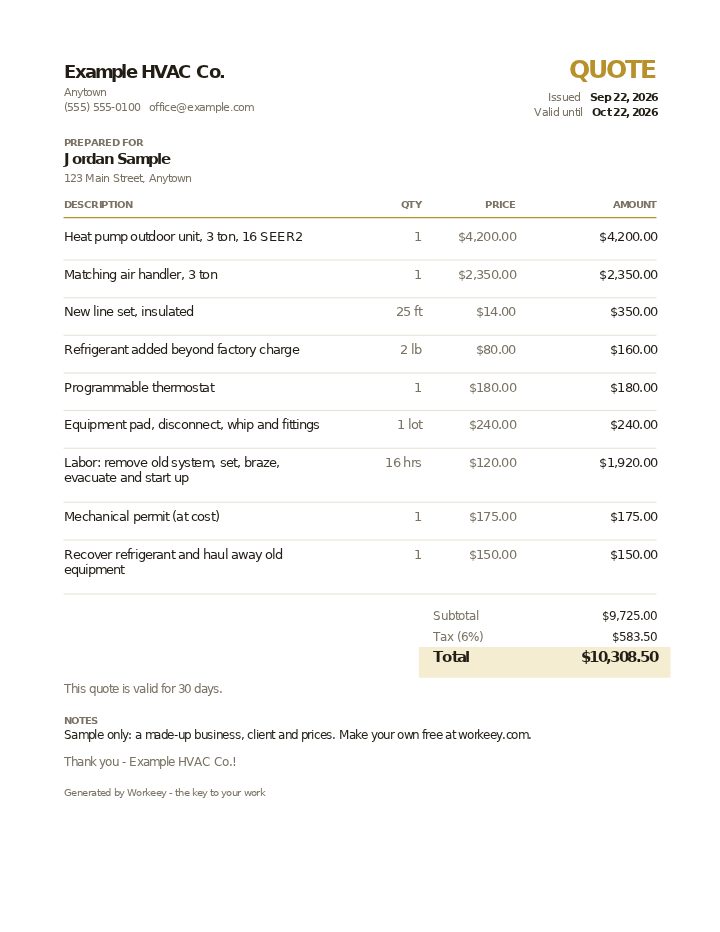
- HVAC estimate template — a free quote sample
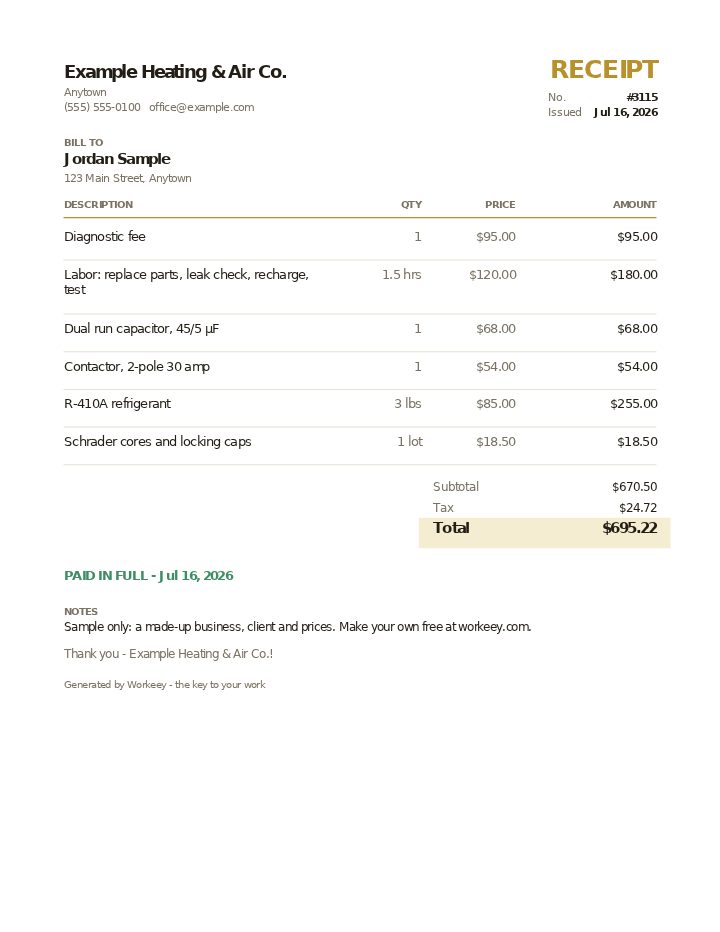
- HVAC receipt template — a free paid-in-full sample
- HVAC price list template — free, with sample prices
- HVAC work order template — free, with a filled-in sample
- HVAC technician wages by state — what employed HVAC technicians earn in every state, from BLS data
- Free invoice template — every field a trade invoice needs
- Free estimate template — copy it, price it, send it
- Free receipt template — a paid-in-full receipt to copy
- Work order template — the job written down before you bill it
- Late payment reminder templates — texts, emails and a letter to copy and send
- All free templates and tools
What should an HVAC invoice include?
Your company details and license number, the customer and equipment address, an invoice number, date and due date, the equipment's brand, model and refrigerant type, the diagnostic fee, labor, each part, refrigerant by the pound, tax, the total and how to pay.
Is the diagnostic fee credited toward the repair?
That is your call. Some HVAC companies credit it when the customer approves the repair, others always charge it. Decide your rule, tell the customer when they book, and show it on the invoice either way.
How should I charge for refrigerant on an invoice?
Per pound added, weighed on your scale, at your price per pound, with the refrigerant type named. A line like "R-410A, 3 lbs × $85.00" is clear and hard to argue with.
Flat rate or time and materials for HVAC repairs?
Both work. Flat rate gives the customer one price for a named repair and rewards fast techs. Time and materials shows hours and parts separately. Whichever you use, list the parts so the customer can see what was replaced.