Workeey is built for your phone. Scan the code with your phone to get the Android app, or open workeey.com on your phone. The iPhone app and a desktop version are coming soon.
Get the Workeey app. Same account, same jobs.


Free landscaping estimate template, with a patio and planting quote worked out
A landscape job is mostly things the client has never priced: tons of gravel, square feet of pavers, cubic yards of mulch, hours of digging. Put each one on its own line and the total stops looking like a number you made up. Copy the free landscaping estimate template below, compare it to the backyard patio and planting sample, and send it while the client is still picturing the yard. Or let Workeey itemize it from your own rates.
Download this estimate template: Word, Excel or PDF
Free to download, with no sign-up and no email. Open the Word file to type over the brackets, or the Excel file to swap in your own lines — the totals follow. Prefer paper? Print the blank PDF and fill it in by pen.
- Word (.docx) — the blank estimate, ready to fill in
- Excel (.xlsx) — the sample lines with amounts, tax and the total that work themselves out
- PDF (.pdf) — the filled-in sample, drawn the way Workeey draws a quote
- Blank PDF (.pdf) — print it and fill it in by pen
- Google Docs — your own copy of the Word file, in your Google Drive (Google asks you to sign in)
- Google Sheets — your own copy of the Excel file, in your Google Drive (Google asks you to sign in)
Fill in this estimate online
Change anything and download the PDF — free, no sign-up. What you type isn't sent to Workeey. The PDF is made in your browser.
Quote it, then invoice it, in Workeey
- Tap Share quote and it becomes a quote PDF, good for 30 days, with your deposit percent printed on it.
- When the work is done, one tap turns the estimate into the invoice, emailed with a pay link.
- The free plan includes 23 quick estimates a month.
What goes on a landscaping estimate
Homeowners often have three landscaping quotes on the kitchen table, and the one that wins is usually the one they can read. Open with your business name, phone and email, plus any contractor license or applicator number your state asks for, then the client's name and the property address. Give the estimate a number, the date it was written and the date it expires.
Then write the scope in yard terms: which beds, how big the patio is, what comes out and what goes in. Split hardscape from softscape, because the patio is priced by area and base material while the planting is priced by plant and pot size. Say what is not included, such as irrigation or lighting, and how many days the work should take.
- Business name, contact details and any license number your state requires
- Client name, property address, estimate number, date and expiry
- A scope split into hardscape (patio, edging, walls) and softscape (plants, soil, mulch)
- Materials in the unit you buy them in: square feet, tons, cubic yards, pot size
- Exclusions, plant warranty terms, the deposit to start, and a start window
Copy this landscaping estimate template
Paste the template below into a document or your phone's notes, replace each bracket, and delete what the job does not need. Keep the units honest: if you buy base gravel by the ton, quote it by the ton.
Write plants by size and count, "5 gal boxwood × 8", so the client can see exactly what is going in the ground and you can show it when the delivery arrives. The skeleton:
- [Your business name] · [phone] · [email] · [license # if required]
- Estimate #[…] · Date: […] · Valid until: [date, e.g. 30 days]
- Prepared for: [client name] · [property address]
- Hardscape: [patio size and material, base depth, edging]
- Softscape: [beds to plant, plant list, soil and mulch]
- Not included: [irrigation, lighting, plant loss from missed watering]
- [Material] — [qty in tons, sq ft or cu yd] × [rate] = [$]
- [Plant and pot size] — [count] × [rate] = [$]
- Labor — [hours] × [rate] = [$] · Equipment — [days] × [rate] = [$]
- Debris haul-off — [loads] × [rate] = [$]
- Subtotal [$] · Sales tax [rate]% [$] · Total [$]
- Deposit to start: [%] · Estimated start: [week] · Plant warranty: [terms]
- Accepted by: [name] · [date]
Sample landscaping estimate (quote), filled in
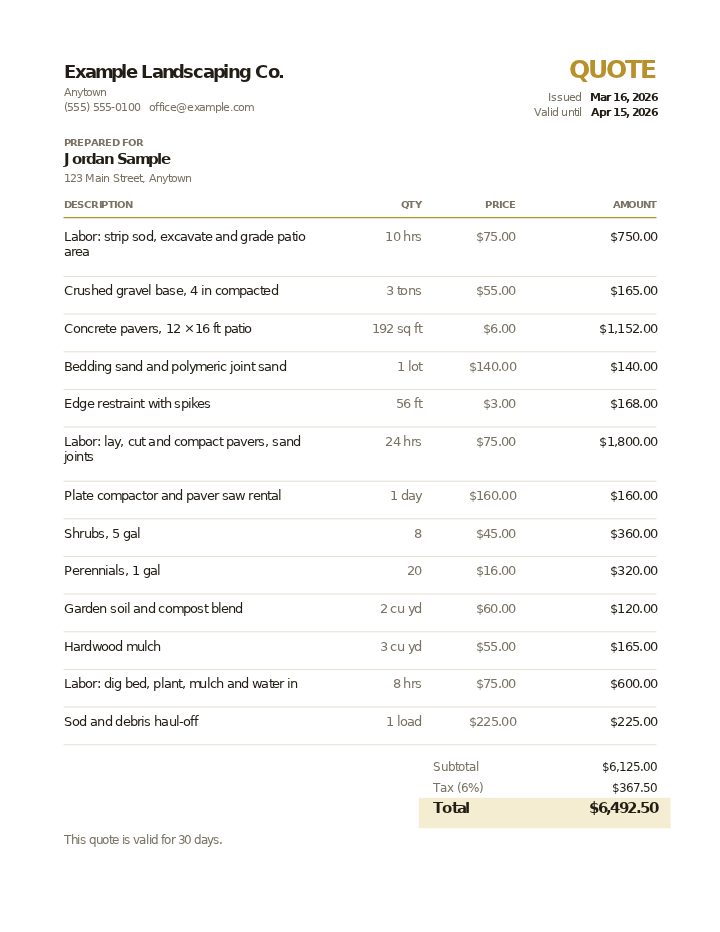
Here is the template filled in for a 12 by 16 foot paver patio off the back door and a new planting bed along the fence. Every price is invented, so swap in your own supplier costs and hourly rate. This sample charges tax on the whole subtotal to keep it simple; many states treat landscaping labor differently from materials, so check yours.
| Qty | Price | Amount | |
|---|---|---|---|
| Labor: strip sod, excavate and grade patio area | 10 hrs | $75.00 / hr | $750.00 |
| Crushed gravel base, 4 in compacted | 3 tons | $55.00 / ton | $165.00 |
| Concrete pavers, 12 × 16 ft patio | 192 sq ft | $6.00 / sq ft | $1,152.00 |
| Bedding sand and polymeric joint sand | 1 lot | $140.00 | $140.00 |
| Edge restraint with spikes | 56 ft | $3.00 / ft | $168.00 |
| Labor: lay, cut and compact pavers, sand joints | 24 hrs | $75.00 / hr | $1,800.00 |
| Plate compactor and paver saw rental | 1 day | $160.00 / day | $160.00 |
| Shrubs, 5 gal | 8 | $45.00 | $360.00 |
| Perennials, 1 gal | 20 | $16.00 | $320.00 |
| Garden soil and compost blend | 2 cu yd | $60.00 / cu yd | $120.00 |
| Hardwood mulch | 3 cu yd | $55.00 / cu yd | $165.00 |
| Labor: dig bed, plant, mulch and water in | 8 hrs | $75.00 / hr | $600.00 |
| Sod and debris haul-off | 1 load | $225.00 / load | $225.00 |
| Subtotal | $6,125.00 | ||
| Sales tax 6% | $367.50 | ||
| Total | $6,492.50 |
Materials and plants carry about a 30% markup: the pavers cost $4.60 a square foot and quote at $6, the 5-gallon shrubs cost $34 and quote at $45. Labor is 42 hours at $75, based on past patios of the same size. The patio works out to about $23 a square foot installed. The quote is valid for 30 days, since paver and nursery prices move with the season.
How to price a landscaping estimate
Measure before you price. A patio quoted from the client's guess at the size is a patio you lose money on. Walk the yard with a tape or a measuring wheel, add 5 to 10 percent extra pavers for cuts and breakage, and work out the base in tons from the area and the depth rather than by eye. Check the slope and access, and call 811 before any digging.
Labor is where landscaping estimates go wrong, because digging time changes with the soil. Clay, roots and rock can double an excavation. Price your hours from jobs you have actually done, and if you cannot see what is under the sod, say so on the estimate and name what you will charge if you hit rock. Our estimate vs quote guide covers when to give a firm number and when to give a range.
- Quote base material by the ton and the depth, not as part of the patio price
- Add 5–10% extra pavers for cuts, and say so in the note
- Mark up plants enough to cover the ones you replace under warranty
- Put equipment rental and dump fees on their own lines
- Offer a plant warranty only if the client agrees to a watering schedule
Estimate, quote, then invoice — in Workeey
In Workeey the estimate lives inside the job, next to the client's address and your notes from the walk-through. Describe the yard work and the AI itemizes an estimate from your own rates: your hourly rate, first hour or call-out charge, travel, evening and weekend rates, your parts markup and your deposit percent. Materials are priced from the web at your markup, and lines you type yourself are remembered for the next yard. The free plan includes 23 quick estimates a month.
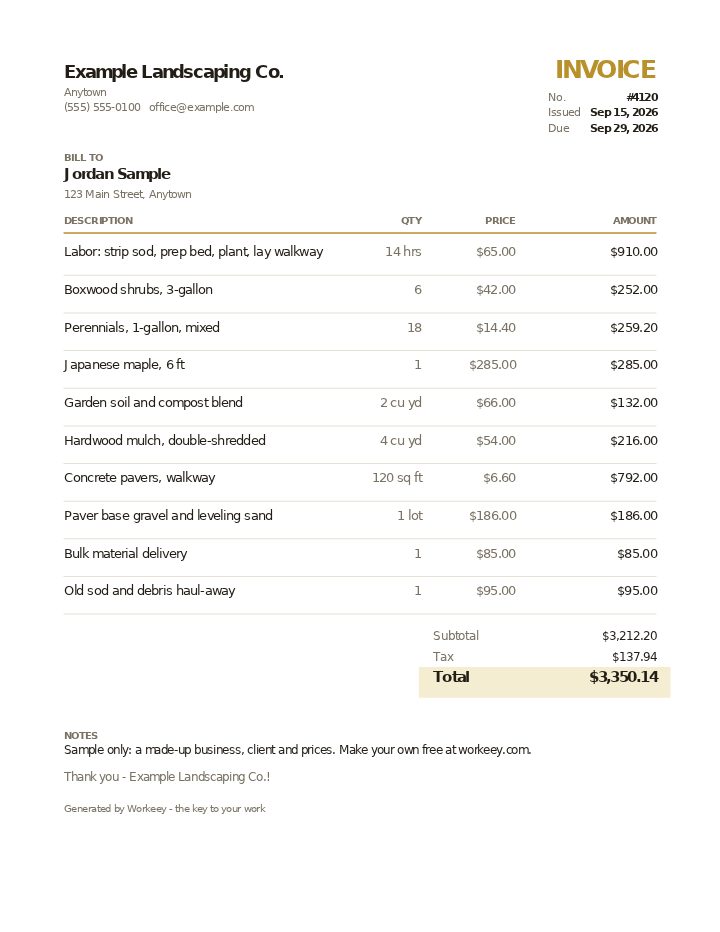
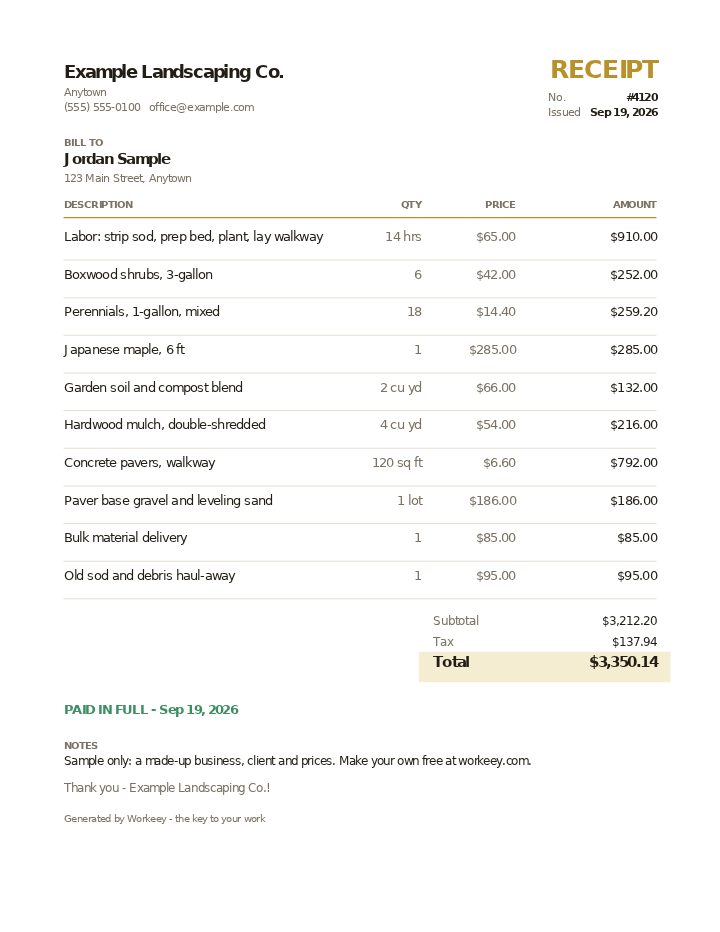
Tap Share quote and it becomes a quote PDF, good for 30 days, with your deposit percent printed on it. Share it from your phone, or tap Email, which opens your own mail app. The client doesn't sign anything in the app; they tell you yes, and you take the deposit the way you always have, because Workeey doesn't collect it. When the work is done, one tap turns the estimate into the invoice, emailed with a pay link (how payments work). See the landscaping invoice template, Workeey for landscapers, or pricing.
More for landscapers: pages and free templates
- Landscaping software — visits, routes and invoices in one app
- Invoicing for landscapers — plants, materials and the install on one bill
- How much to charge for landscaping — a guide to setting your prices
- How to start a lawn care business — a step-by-step guide to going out on your own
- Best apps for a lawn care business — the apps for this trade compared
- Landscaping invoice template — free, with a filled-in sample
- Landscaping receipt template — a free paid-in-full sample
- Landscaping and lawn care price list template — free, with sample prices
- Landscaping and lawn care work order template — free, with a filled-in sample
- Free invoice template — every field a trade invoice needs
- Free estimate template — copy it, price it, send it
- Free receipt template — a paid-in-full receipt to copy
- Work order template — the job written down before you bill it
- Late payment reminder templates — texts, emails and a letter to copy and send
- All free templates and tools
How do you estimate a paver patio?
Measure the area, then price it in layers: excavation labor, base gravel by the ton for the depth you need, bedding sand, pavers by the square foot plus 5 to 10 percent for cuts, edge restraint by the foot, and the labor to lay and compact. Add equipment rental and haul-off.
Should a landscaping estimate include a plant warranty?
Many landscapers offer one, often for one season or one year, but only on plants that were watered as agreed. If you offer it, write the length and the watering condition on the estimate.
Is a landscaping quote binding?
A written quote the client accepts is generally treated as the agreed price for the work it describes. Buried rock or a design change after the yes should be priced as a change, not absorbed.
How long should a landscaping estimate be valid?
Thirty days is common. Nursery and paver prices shift between spring and summer, so an old estimate should not lock in last season's price.