Workeey is built for your phone. Scan the code with your phone to get the Android app, or open workeey.com on your phone. The iPhone app and a desktop version are coming soon.
Get the Workeey app. Same account, same jobs.


Free lawn care estimate template for a season of mowing
Lawn care is sold in visits, not projects. The client wants to know what one cut costs, how many you plan to make, and what the extras add on top. A good lawn care estimate answers all three on one page. Copy the free template below, check it against the season sample for a third-acre lot, and send it before the grass starts growing. Or let Workeey build it from your own rates.
Download this estimate template: Word, Excel or PDF
Free to download, with no sign-up and no email. Open the Word file to type over the brackets, or the Excel file to swap in your own lines — the totals follow. Prefer paper? Print the blank PDF and fill it in by pen.
- Word (.docx) — the blank estimate, ready to fill in
- Excel (.xlsx) — the sample lines with amounts, tax and the total that work themselves out
- PDF (.pdf) — the filled-in sample, drawn the way Workeey draws a quote
- Blank PDF (.pdf) — print it and fill it in by pen
- Google Docs — your own copy of the Word file, in your Google Drive (Google asks you to sign in)
- Google Sheets — your own copy of the Excel file, in your Google Drive (Google asks you to sign in)
Fill in this estimate online
Change anything and download the PDF — free, no sign-up. What you type isn't sent to Workeey. The PDF is made in your browser.
Quote it, then invoice it, in Workeey
- Share quote turns it into a quote PDF that holds for 30 days, which you send from your phone, or through your own mail app with the Email button.
- When work is done, one tap turns an estimate into an invoice that is emailed with a pay link.
- The free plan includes 23 quick estimates a month.
What goes on a lawn care estimate
A mowing customer is signing up for months of you showing up, so the estimate has to say more than a price. Start with your business name, phone and email, then the client and the property address, and describe the lot: its size, plus any gates, slopes or dog runs that slow you down. Number and date the estimate and give it an expiry date.
Then price the service the way you will deliver it. List the per-visit price for a mow, trim, edge and blow, how many visits you expect, and the months the season runs. Put one-time work, like spring cleanup or aeration, on separate lines so the client can say yes to the mowing and no to the extras. Spell out how often you bill, what happens on a rained-out week, and how much notice either side gives to stop.
- Business name, contact details and the property address
- Lot size and anything that slows a visit: gates, slopes, pets
- What one visit includes: mow, string trim, edge, blow off hard surfaces
- Per-visit price × expected visits, with the season's start and end
- One-time services on their own lines: cleanups, aeration, overseeding
- Rain-out policy, how often you bill, and notice to cancel
Copy this lawn care estimate template
Paste this into a document or notes app and fill in the brackets. Keep the per-visit line first, because it is the number the client will hold up against every other mowing flyer in the mailbox. Seasonal add-ons go underneath, where the client can cross out what they don't want.
Write the visit count as an estimate, "about 26 weekly visits, April to September", and say that you bill only for visits made. That keeps a dry August from turning into an argument. The skeleton:
- [Your business name] · [phone] · [email]
- Estimate #[…] · Date: […] · Valid until: [date, e.g. 30 days]
- Prepared for: [client name] · [property address] · Lot: [size]
- Each visit: [mow, trim, edge, blow] · Frequency: [weekly / every 10 days]
- Season: [start month] to [end month] · About [number] visits
- Mowing — [visits] × [per-visit price] = [$]
- [Cleanup or add-on] — [qty] × [rate] = [$]
- Fertilizer rounds — [number] × [rate] = [$] (only if you're licensed to apply)
- Subtotal [$] · Sales tax [rate]% [$] · Season total [$]
- Billing: [monthly, for visits made] · Rain-out: [skipped or moved] · Cancel: [notice]
- Deposit to start: [% or none]
- Accepted by: [name] · [date]
Sample lawn care estimate (quote), filled in
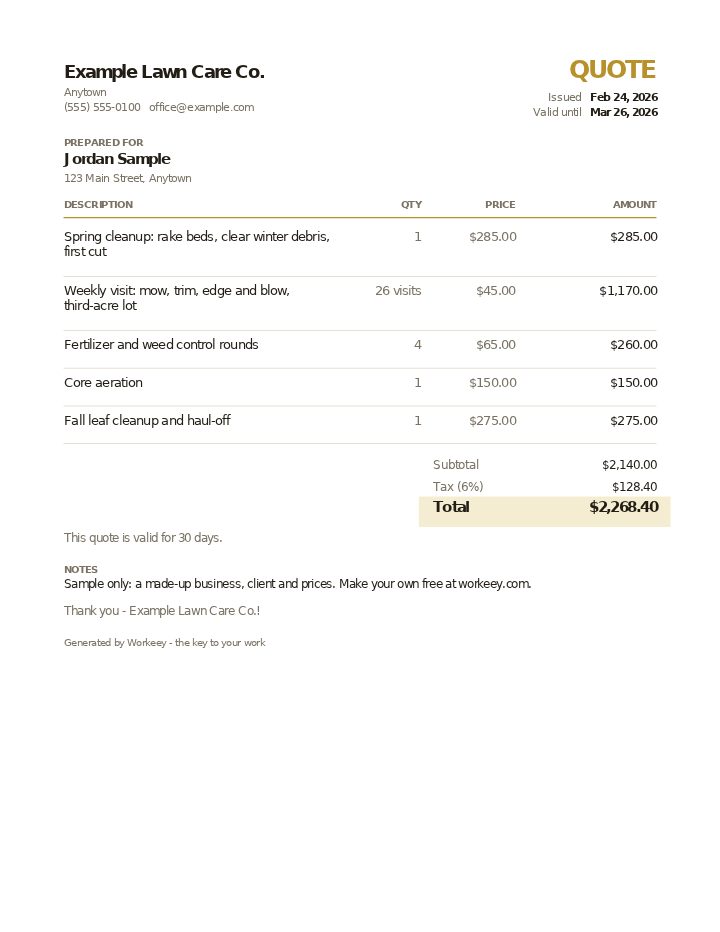
This is the template filled in for a third-acre suburban lot with weekly mowing from April through September, a spring cleanup to open the season and a leaf cleanup to close it. The prices are made up. The season total shows the client the whole commitment up front, while the visits themselves are billed as they happen.
| Qty | Price | Amount | |
|---|---|---|---|
| Spring cleanup: rake beds, clear winter debris, first cut | 1 | $285.00 | $285.00 |
| Weekly visit: mow, trim, edge and blow, third-acre lot | 26 visits | $45.00 / visit | $1,170.00 |
| Fertilizer and weed control rounds | 4 | $65.00 | $260.00 |
| Core aeration | 1 | $150.00 | $150.00 |
| Fall leaf cleanup and haul-off | 1 | $275.00 | $275.00 |
| Subtotal | $2,140.00 | ||
| Sales tax 6% | $128.40 | ||
| Total | $2,268.40 |
The $45 visit covers about 40 minutes on the lot plus the drive to the next stop; at a $55 an hour target, that leaves room for fuel, blades and mower wear. The 26 visits are an estimate for a normal season, and the client pays only for visits made. Fertilizer rounds are product cost marked up about 35%, plus application time. The quote is valid for 30 days.
How to price a lawn care estimate
Price by the visit, but build the visit from time. Time a few cuts on lots you already service and you will see that square footage alone misleads: a flat open quarter acre can take less time than a small yard packed with beds, trees and a fence line to trim along. Count the obstacles, the slope, and how far you push the mower from the trailer.
Route density matters as much as the lot. A customer on a street where you already mow three yards is worth a lower price than one twenty minutes out of your way. Set a minimum per stop so tiny lots still pay for the trip, and write what happens when the grass gets ahead of you after a wet stretch. If you're unsure whether to call it an estimate or a quote, our estimate vs quote guide explains the difference.
- Time real visits and set the per-visit price from your target hourly rate
- Set a minimum charge per stop, even for the smallest lot
- Price overgrown or double-cut visits higher, and say so up front
- Give a better price for route density, not just for a small yard
- Quote cleanups and aeration separately so the mowing price stays clean
Estimate, quote, then invoice — in Workeey
In Workeey the estimate sits inside the job, with the client's address and your notes about the gate code and the dog. Describe the lot and the season, and the AI itemizes an estimate from your own rates: hourly, first hour or call-out, travel, evening and weekend rates, parts markup and deposit percent. Products like fertilizer are priced from the web at your markup, and any line you type, such as "weekly mow, third acre", is remembered for the next lot. The free plan includes 23 quick estimates a month.
Share quote turns it into a quote PDF that holds for 30 days, which you send from your phone, or through your own mail app with the Email button. The client tells you yes; nothing gets signed in the app. When work is done, one tap turns an estimate into an invoice that is emailed with a pay link. Workeey doesn't bill on a schedule by itself, so for a season of mowing you make each invoice when you bill for the visits done. Start from the lawn care invoice template, see Workeey for lawn and landscape businesses, or compare pricing.
More for lawn care pros: pages and free templates
- Lawn care software — mowing routes and a month of visits on one invoice
- Invoicing for lawn care — how to bill a month of mowing
- How much to charge for lawn mowing — a guide to setting your prices
- How to start a lawn care business — a step-by-step guide to going out on your own
- Best apps for a lawn care business — the apps for this trade compared
- Lawn care invoice template — free, with a filled-in sample
- Lawn care receipt template — a free paid-in-full sample
- Landscaping and lawn care price list template — free, with sample prices
- Landscaping and lawn care work order template — free, with a filled-in sample
- Free invoice template — every field a trade invoice needs
- Free estimate template — copy it, price it, send it
- Free receipt template — a paid-in-full receipt to copy
- Work order template — the job written down before you bill it
- Late payment reminder templates — texts, emails and a letter to copy and send
- All free templates and tools
How much should I charge per mowing visit?
Work it out from time, not from the going rate in a Facebook group. Time the visit including trimming, edging and blowing, add the drive to the next stop, and multiply by the hourly rate you need to cover fuel, equipment, insurance and your own pay. Then set a minimum so small lots still cover the stop.
Should a lawn care estimate show the whole season or one visit?
Both. Lead with the per-visit price, then show the expected number of visits and the season total. The per-visit number is what clients compare; the season total stops surprises when the bills add up over the summer.
What if it rains or the lawn doesn't need cutting?
Say it on the estimate. Most lawn businesses either move a rained-out visit to the next dry day or skip it and don't charge, and bill only for visits made. Pick one rule and write it down so a slow-growing month doesn't become a dispute.
Do I need a license to put fertilizer on an estimate?
In many states, applying fertilizer or weed control for pay requires a pesticide applicator license, especially when the product contains herbicide. Check with your state's agriculture department before you quote treatment rounds.